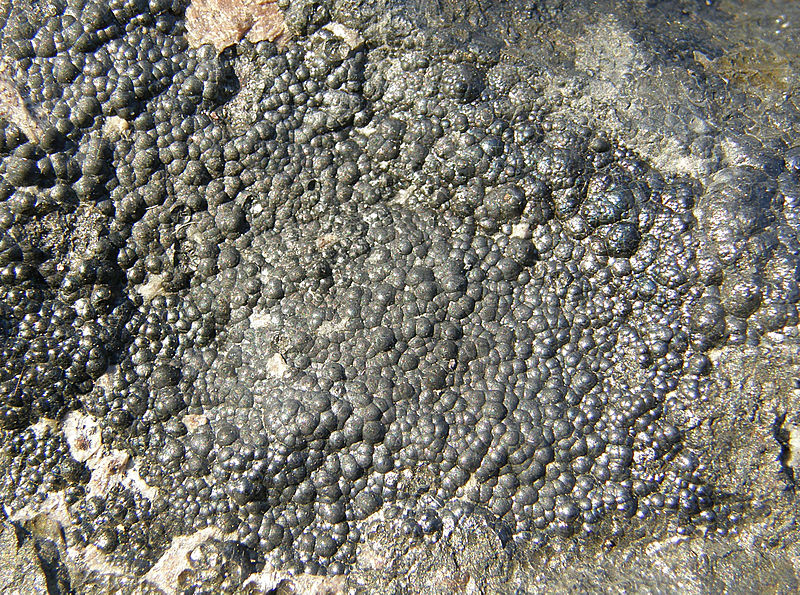
File:Pitchblende_schlema-alberoda.JPG · Wikimedia Commons · See Wikimedia Commons
uraninite
Sign in to saveUraninite, also known as pitchblende, is a radioactive, uranium-rich mineral and ore with a chemical composition that is largely UO2 but because of oxidation typically contains variable proportions of U3O8. Radioactive decay of the uranium causes the mineral to contain oxides of lead and trace amounts of helium. It may also contain thorium and rare-earth elements.
Uraninite is a radioactive mineral rich in uranium that serves as the primary ore source for extracting uranium. As the uranium in uraninite naturally decays over time, it transforms into lead and other elements, making it both scientifically interesting and practically important for nuclear energy and related applications.
AI-generated from the Wikipedia summary — may contain errors.
Key facts
- Mineral.name
- Uraninite
- Mineral.category
- Oxide minerals
- Mineral.image
- Pitchblende schlema-alberoda.JPG
- Mineral.caption
- Pitchblende from Niederschlema-Alberoda deposit, Germany
- Mineral.formula
- Uranium dioxide or uranium(IV) oxide (UO2)
- Mineral.IMAsymbol
- Urn
- Mineral.strunz
- 4.DL.05
- Mineral.system
- Isometric
- Mineral.class
- Hexoctahedral (mm) H-M symbol: (4/m 2/m)
- Mineral.symmetry
- Fmm
- Mineral.unit cell
- a = 5.4682 Å; Z = 4
- Mineral.color
- Steel-black to velvet-black, brownish black, pale gray to pale green; in transmitted light, pale green, pale yellow to deep brown and green-gray (thin fragments)
- Mineral.habit
- Massive, botryoidal, granular. Octahedral crystals uncommon.
- Mineral.cleavage
- Indistinct
- Mineral.fracture
- Conchoidal to uneven
- Mineral.mohs
- 5–6
- Mineral.luster
- Submetallic, greasy, dull
- Mineral.opticalprop
- Isotropic
via Wikipedia infobox
Wikidata facts
- Has part
- uranium dioxide
- Named after
- uranium
- Image
- Pichblende.jpg
Show 9 more facts
- Nickel-Strunz 9th edition (updated 2009)
- 4.DL.05
- Nickel-Strunz '10th ed', review of (9th ed/ 2009 update)
- 4.DL.05
- Commons category
- Uraninite
- chemical formula
- UO₂
- type locality (geology)
- Jáchymov
- crystal system
- cubic crystal system
- described by source
- Granat Encyclopedic Dictionary
- IMA Mineral Symbol
- Urn
- Strunz 8th edition (series ID, updated)
- IV/D.16b
Sources (2)
via Wikidata · CC0
~4 min read
Encyclopedic overview
5 sectionsContents
- Overview
- Occurrence
- See also
- References
- External links
Uraninite, also known as pitchblende, is a radioactive, uranium-rich mineral and ore with a chemical composition that is largely UO2 but because of oxidation typically contains variable proportions of U3O8. Radioactive decay of the uranium causes the mineral to contain oxides of lead and trace amounts of helium. It may also contain thorium and rare-earth elements.
==Overview== Uraninite used to be known as pitchblende (from pitch, because of its black color, and blende, from blenden meaning "to deceive", a term used by German miners to denote minerals whose density suggested metal content, but whose exploitation, at the time they were named, was either unknown or not economically feasible). The mineral has been known since at least the 15th century, from silver mines in the Ore Mountains, on the German/Czech border. The type locality is the historic mining and spa town known as Joachimsthal, the modern-day Jáchymov, on the Czech side of the mountains, where F. E. Brückmann described the mineral in 1772. Pitchblende from the Johanngeorgenstadt deposit in Germany was used by M. Klaproth in 1789 to discover the element uranium.
Excerpted from Wikipedia’s “uraninite” article, available under the CC BY-SA 4.0 licence.