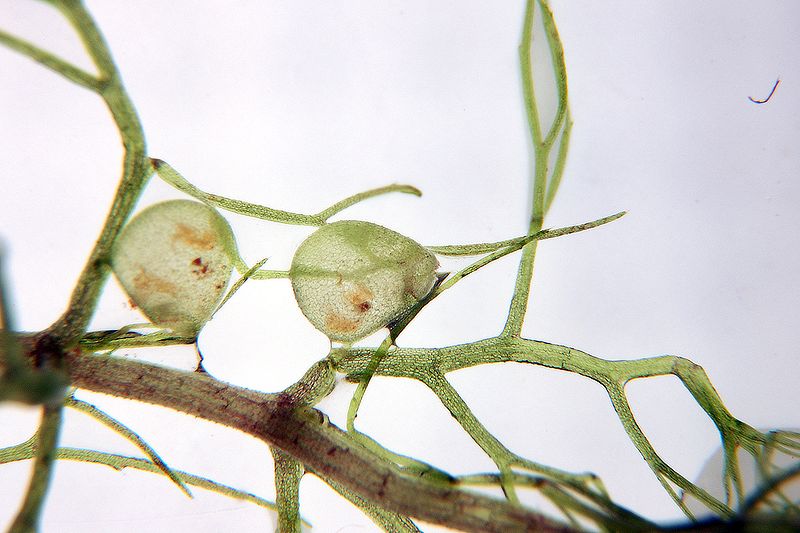
File:Utricularia_aurea_8_Darwiniana.jpg · Wikimedia Commons · See Wikimedia Commons
Utricularia
Sign in to saveAlso known as bladderwort, bladderworts
Utricularia, commonly and collectively called the bladderworts, is a genus of carnivorous plants consisting of approximately 233 species (precise counts differ based on classification opinions; a 2001 publication lists 215 species). They occur in freshwater and wet soil as terrestrial or aquatic species across every continent except Antarctica. Utricularia are cultivated for their flowers, which are often compared with those of snapdragons and orchids, especially amongst carnivorous plant enthusiasts.
OverviewAI-generated
Utricularia is a genus of plants classified within the family Lentibulariaceae. It belongs to the order Lamiales, class Magnoliopsida, and phylum Tracheophyta in the kingdom Plantae. The scientific name is Utricularia L., and its taxonomic status is accepted.
Records for this genus are held by various institutions, including ECOSUR, IIB-UV, CICY, INECOL, and CP. Associated media and records have been documented in Mexico, Venezuela, the United States, Bolivia, and Thailand. The genus is referenced by 461 other encyclopedia articles.
Synthesized by Vinony from 30 facts across 7 sources: Wikidata, GBIF, Plants of the World, Gbif Occ, WoRMS, iDigBio, Vinony graph. Generated from structured data (not the Wikipedia text) and checked against those facts — may still contain errors.
Species
Utricularia
GENUS
- KingdomPlantae
- PhylumTracheophyta
- ClassMagnoliopsida
- OrderLamiales
- FamilyLentibulariaceae
via GBIF · Kew POWO
Museum specimens
- Specimen records
- 3,805
- With media
- 1,863
- Family
- Lentibulariaceae
- Collections
- ECOSUR, IIB-UV, CICY, INECOL, CP, BRIT
- Recorded in
- Mexico, Venezuela, United States, Bolivia, Thailand, Canada, Philippines, China
Wikidata facts
- Instance of
- taxon
- Parent taxon
- Lentibulariaceae
- Image
- Utricularia vulgaris Sturm63.jpg
Show 11 more facts
- Commons category
- Utricularia
- taxon rank
- genus
- taxon name
- Utricularia
- taxonomic type
- Utricularia vulgaris
- topic's main category
- Category:Utricularia
- Commons gallery
- Utricularia
- taxon common name
- 狸藻属
- described by source
- Encyclopædia Britannica 11th edition
- has fruit type
- capsule
- different from
- gray whale
via Wikidata · CC0
~28 min read
Encyclopedic overview
18 sectionsContents
- Description
- Plant structure
- Etymology
- Flowers
- Distribution and habitat
- Dispersal and life form evolution
- Carnivory
- Physical description of the trap
- Trapping mechanism
- Microbial relationships
- Enhanced respiration
- Lloyd's experiments
- Ingestion of larger prey
- Genetics
- Species
- Phylogenetics
- References
- External links
Utricularia, commonly and collectively called the bladderworts, is a genus of carnivorous plants consisting of approximately 233 species (precise counts differ based on classification opinions; a 2001 publication lists 215 species). They occur in freshwater and wet soil as terrestrial or aquatic species across every continent except Antarctica. Utricularia are cultivated for their flowers, which are often compared with those of snapdragons and orchids, especially amongst carnivorous plant enthusiasts.
All Utricularia are carnivorous and capture small organisms by means of bladder-like traps. Terrestrial species tend to have tiny traps that feed on minute prey such as protozoa and rotifers swimming in water-saturated soil. The traps can range in size from . Aquatic species, such as U. vulgaris (common bladderwort), possess bladders that are usually larger and can feed on more substantial prey such as water fleas (Daphnia), nematodes and even fish fry, mosquito larvae and young tadpoles. Despite their small size, the traps are extremely sophisticated. In the active traps of the aquatic species, prey brush against trigger hairs connected to the trapdoor. The bladder, when "set", is under negative pressure in relation to its environment so that when the trapdoor is mechanically triggered, the prey, along with the water surrounding it, is sucked into the bladder. Once the bladder is full of water, the door closes again, the whole process taking only ten to fifteen milliseconds.
Excerpted from Wikipedia’s “Utricularia” article, available under the CC BY-SA 4.0 licence.