File:Waistcoat.jpg · Wikimedia Commons · See Wikimedia Commons
vest
Sign in to saveAlso known as waistcoat, weskit, Yelek
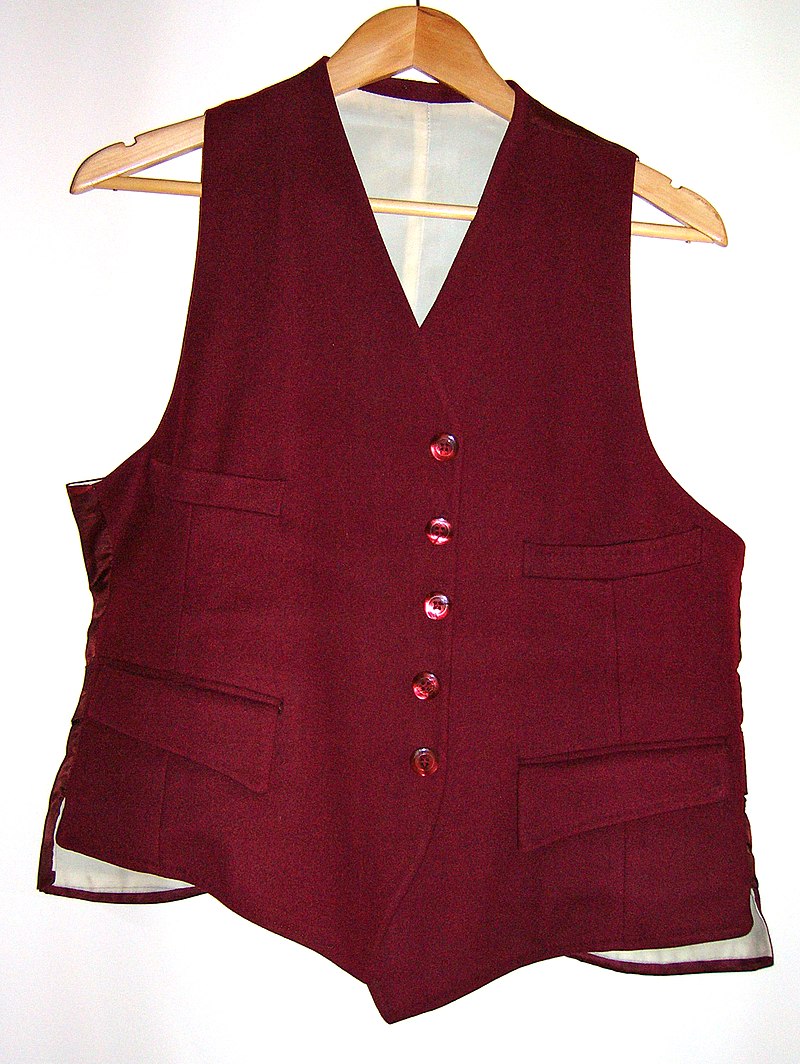
thumb|right|A traditional waistcoat, to be worn with a two-piece suit or separate jacket and trousers A waistcoat (UK and Commonwealth, or ; colloquially called a weskit) or vest (US and Canada) is a sleeveless upper-body garment. It is usually worn over a dress shirt and necktie and below a coat as a part of most men's formal wear. It is also sported as the third piece in the traditional three-piece male suit. Any given waistcoat can be simple or ornate, or for leisure or luxury. Historically, the waistcoat can be worn either in the place of, or underneath, a larger coat, dependent upon the w
A vest is a sleeveless upper-body garment typically worn over a dress shirt and under a jacket as part of formal men's clothing. It matters because it serves as a traditional component of formal wear and three-piece suits, and can range from simple everyday styles to more ornate luxury versions.
AI-generated from the Wikipedia summary — may contain errors.
Wikidata facts
Show 3 more facts
- Commons category
- Waistcoats
- topic's main category
- Category:Vests
- different from
- Vest
Sources (2)
via Wikidata · CC0
~22 min read
Encyclopedic overview
30 sectionsContents
- Names
- Characteristics and use
- Daywear
- Evening wear
- Clergy
- Scouting
- Sport
- History
- 17th–18th centuries
- 19th century
- 20th–21st centuries
- Preliminary timeline and evolution
- England
- Circa 1660–1700
- Circa 1700–1750
- Circa 1750–1770
- Circa 1770–1800
- Transition from "waistcoat" to "vest" in the United States
- Circa 1750–1850
- Circa late 1800
- Circa 1870
- Circa 1890
- Circa 1900
- Circa 1970
- Typology
- Gallery
- See also
- Eras
- References
- External links
thumb|right|A traditional waistcoat, to be worn with a two-piece suit or separate jacket and trousers A waistcoat (UK and Commonwealth, or ; colloquially called a weskit) or vest (US and Canada) is a sleeveless upper-body garment. It is usually worn over a dress shirt and necktie and below a coat as a part of most men's formal wear. It is also sported as the third piece in the traditional three-piece male suit. Any given waistcoat can be simple or ornate, or for leisure or luxury. Historically, the waistcoat can be worn either in the place of, or underneath, a larger coat, dependent upon the weather, wearer, and setting.
Daytime formal wear and semi-formal wear commonly comprises a contrastingly coloured waistcoat, such as in buff or dove gray, still seen in morning dress and black lounge suit. Traditionally, a white waistcoat is worn for white tie and a black one for black tie.
Excerpted from Wikipedia’s “vest” article, available under the CC BY-SA 4.0 licence.
Gallery (26)
Available in 63 languages
- Español
- Français
- Deutsch
- 中文
- 日本語
- Русский
- Português
- Italiano
- العربية
- Afrikaans
- Albanian
- Aragonese
- azb
- Bahasa Indonesia
- Basque
- bat_smg
- Bavarian
- Belarusian
Show 44 more
- Breton
- Catalan
- Croatian
- Czech
- Danish
- Esperanto
- Estonian
- Fijian
- Finnish
- Galician
- Hebrew
- Ido
- Interlingua
- Javanese
- Kazakh
- Kurdish
- Kyrgyz
- Lithuanian
- Luxembourgish
- Macedonian
- Malay
- Nederlands
- Norwegian
- Norwegian Nynorsk
- Piedmontese
- Polski
- Romanian
- rsk
- Serbian
- Sicilian
- simple
- Sindhi
- Slovak
- Slovenian
- Svenska
- Telugu
- Tiếng Việt
- Tumbuka
- Türkçe
- Ukrainian
- Urdu
- Wu Chinese
- فارسی
- 한국어
via Wikidata sitelinks · CC0