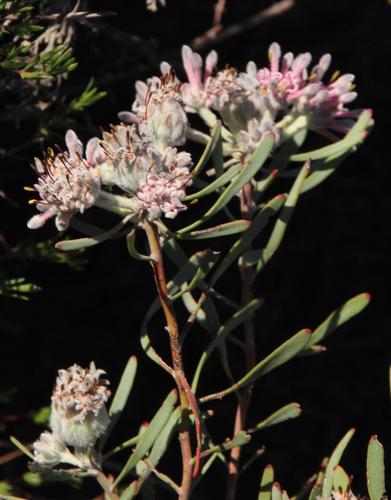
(c) Tony Rebelo, some rights reserved (CC BY-SA), uploaded by Tony Rebelo · cc-by-sa
Vexatorella
Sign in to saveVexatorella is a genus containing four species of flowering plant, commonly known as vexators, in the family Proteaceae. The genus is endemic to the Cape Floristic Region of South Africa. The name means “little trouble-maker”, given with reference to the initial difficulties of placing V. latebrosa within the family. All species are shrubs which occur in dry fynbos habitats on the fringes of the Succulent Karoo ecoregion. The inflorescences are similar to those of the related leucospermums but also share features of the leucadendrons, with the floral bracts becoming woody and enlarged followin
In the Vinony graph
Within Vinony's link graph, Vexatorella is referenced by 89 other articles, and connects out to South Africa, plant and Formicidae.
It sits within the topics Endemic flora of the Cape Provinces, Proteaceae genera and Vexatorella.
Its subject is documented across 10 Wikipedia language editions.
Species
Kleinkaroo Vexator
GENUS
- KingdomPlantae
- PhylumTracheophyta
- ClassMagnoliopsida
- OrderProteales
- FamilyProteaceae
via GBIF · Kew POWO
Wikidata facts
- Instance of
- taxon
- Parent taxon
- Proteaceae
- Image
- Vexatorella amoena Rebelo 1.jpg
Show 4 more facts
- taxon name
- Vexatorella
- taxon rank
- genus
- topic's main category
- Category:Vexatorella
Sources (1)
via Wikidata · CC0
~3 min read
Encyclopedic overview
4 sectionsContents
- Description
- Taxonomy
- Conservation
- References
Vexatorella is a genus containing four species of flowering plant, commonly known as vexators, in the family Proteaceae. The genus is endemic to the Cape Floristic Region of South Africa. The name means “little trouble-maker”, given with reference to the initial difficulties of placing V. latebrosa within the family. All species are shrubs which occur in dry fynbos habitats on the fringes of the Succulent Karoo ecoregion. The inflorescences are similar to those of the related leucospermums but also share features of the leucadendrons, with the floral bracts becoming woody and enlarged following pollination. The flowers are insect-pollinated, with the seeds dispersed by ants (myrmecochory).
== Description == Vexators are upright or spreading evergreen shrubs with alternately set, narrow, spade-shaped leaves ending bluntly in a bony tip, with an entire margin, and greyish or bluish in colour. The stalked flower heads are mostly set individually, sometimes with two to six together at the end of the stems, opening from the center outwards. The individual flowers are 4-merous, star symmetrical and hermaphrodite. The four perianth segments are pink or cream-coloured, and have a sweet smell. From their center, a straight style emerges that is hairless or powdery. The thickened part at its tip called pollen presenter is cleft at its tip. The ovary is egg- to bottle-shaped, consists of one carpel and contains just one cavity with one hanging primordial seed. The ovary is subtended by four free awl-shaped scales. The fruit is an egg-shaped hairless or powdery achene, that is beaked at its tip, and blunt and wrinkly at its base. The bracteoles that support the individual flowers become woody after flowering, a character that set Vexatorella apart from Leucospermum except for L. secundifolium that also develops woody bracteoles.
Excerpted from Wikipedia’s “Vexatorella” article, available under the CC BY-SA 4.0 licence.