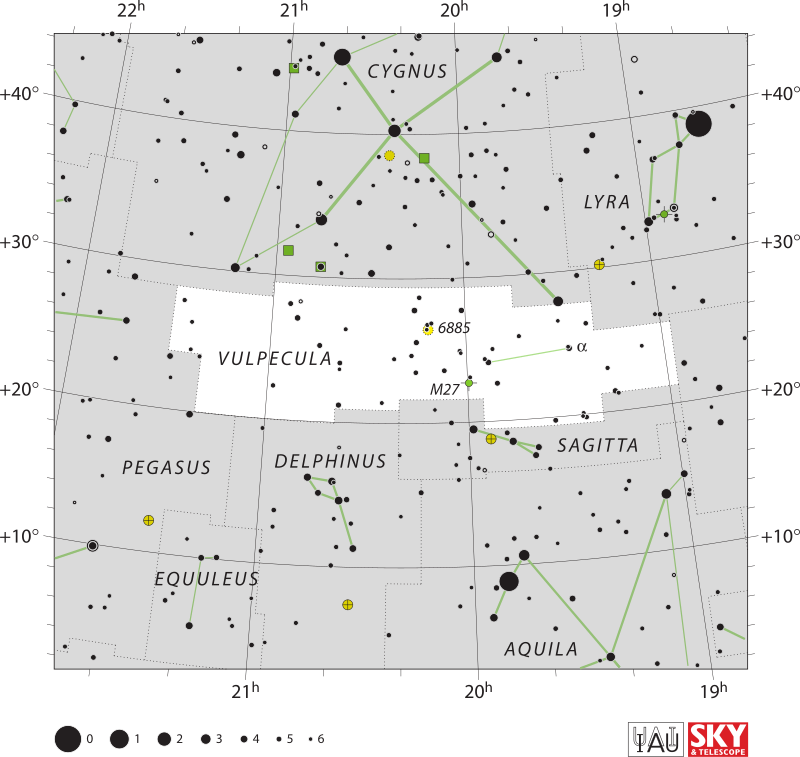
File:Vulpecula_IAU.svg · Wikimedia Commons · See Wikimedia Commons
Vulpecula
Sign in to saveAlso known as Vul, Vulpeculae, Vulpecula cum Ansere
Vulpecula () is a faint constellation in the Northern Sky. Its name is Latin for "little fox", although it is commonly called simply the Fox. It was identified in the 17th century, and is located in the middle of the Summer Triangle (an asterism consisting of the bright stars Deneb, Vega, and Altair).
Vulpecula is a faint constellation in the Northern Sky whose name means "little fox" in Latin. Located within the Summer Triangle—an asterism formed by three bright stars—it was identified during the 17th century.
AI-generated from the Wikipedia summary — may contain errors.
Key facts
- Constellation.name
- Vulpecula
- Constellation.abbreviation
- Vul
- Constellation.genitive
- Vulpeculae
- Constellation.pronounce
- ,genitive
- Constellation.symbolism
- the Fox
- Constellation.quadrant
- NQ4
- Constellation.areatotal
- 268
- Constellation.arearank
- 55th
- Constellation.numbermainstars
- 5, 20
- Constellation.numberbfstars
- 33
- Constellation.numberstarsplanets
- 5
- Constellation.numberbrightstars
- 0
- Constellation.numbernearbystars
- 1
- Constellation.brighteststarname
- α Vul (Anser)
- Constellation.starmagnitude
- 4.44
- Constellation.neareststarname
- WISE 1928+2356
- Constellation.stardistancely
- 22.28
- Constellation.stardistancepc
- 6.83
via Wikipedia infobox
Wikidata facts
- Instance of
- constellation
- Official name
- Vulpecula
- Area
- 268
- Shares border with
- Pegasus
- Image
- VulpeculaCC.jpg
Show 7 more facts
- discoverer or inventor
- Johannes Hevelius
- short name
- Vul
- Commons category
- Vulpecula (constellation)
- topic's main category
- Category:Vulpecula
- Commons gallery
- Vulpecula
- time of discovery or invention
- 1683-00-00
- on focus list of Wikimedia project
- Wikipedia:Vital articles/Level/4
via Wikidata · CC0
~6 min read
Encyclopedic overview
10 sectionsContents
- Features
- Stars
- Deep-sky objects
- Stellar association
- History
- See also
- References
- Sources
- Footnotes
- External links
Vulpecula () is a faint constellation in the Northern Sky. Its name is Latin for "little fox", although it is commonly called simply the Fox. It was identified in the 17th century, and is located in the middle of the Summer Triangle (an asterism consisting of the bright stars Deneb, Vega, and Altair).
==Features== thumb|left|200px|The constellation Vulpecula as it can be seen by the naked eye. thumb|left|200px|The constellation Vulpecula with [[International Astronomical Union|IAU boundaries and stick figure overlaid, from NOIRLab's 88 Constellations project.]]
Excerpted from Wikipedia’s “Vulpecula” article, available under the CC BY-SA 4.0 licence.
Gallery (16)
Available in 83 languages
- Español
- Français
- Deutsch
- 中文
- 日本語
- Русский
- Português
- Italiano
- العربية
- Afrikaans
- Armenian
- Asturian
- Azerbaijani
- Bahasa Indonesia
- Bashkir
- Basque
- be_x_old
- Belarusian
Show 64 more
- Bosnian
- Breton
- Bulgarian
- Burmese
- Catalan
- cdo
- Cornish
- Corsican
- Croatian
- Czech
- Danish
- Egyptian Arabic
- Esperanto
- Estonian
- Finnish
- Galician
- Georgian
- Greek
- Hakka Chinese
- Hebrew
- Hungarian
- Icelandic
- Irish
- Javanese
- Kashmiri
- Latin
- Latvian
- Lithuanian
- Luxembourgish
- Macedonian
- Malay
- Malayalam
- Manx
- Marathi
- Nederlands
- Northern Frisian
- Norwegian
- Norwegian Nynorsk
- Occitan
- Ossetic
- Polski
- Quechua
- Romanian
- Serbian
- Serbian (Latin)
- simple
- Slovak
- Slovenian
- Svenska
- Swahili
- Tiếng Việt
- Türkçe
- Ukrainian
- Urdu
- Waray
- Welsh
- Wu Chinese
- Yakut
- Zaza
- zh_min_nan
- zh_yue
- فارسی
- ไทย
- 한국어
via Wikidata sitelinks · CC0