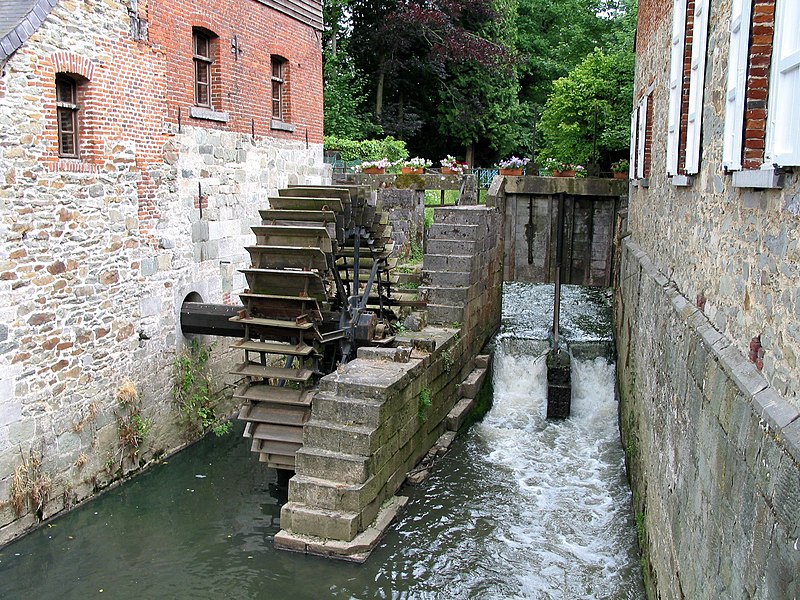
File:Braine-le-Château_JPG02.jpg · Wikimedia Commons · See Wikimedia Commons
watermill
Sign in to saveAlso known as water mill
thumb|Watermill of Braine-le-Château, Belgium (12th century) thumb|Interior of the Lyme Regis watermill, UK (14th century) A watermill or water mill is a mill that uses hydropower. It is a structure that uses a water wheel or water turbine to drive a mechanical process such as milling (grinding), rolling, or hammering. Such processes are needed in the production of many material goods, including flour, lumber, paper, textiles, and many metal products. These watermills may comprise gristmills, sawmills, paper mills, textile mills, hammermills, trip hammering mills, rolling mills, and wire drawi
A watermill is a structure that harnesses the power of flowing water through a water wheel or turbine to drive mechanical processes like grinding grain, sawing wood, or hammering metal. These mills were essential for producing everyday goods such as flour, lumber, paper, textiles, and metal products throughout history.
AI-generated from the Wikipedia summary — may contain errors.
Wikidata facts
- Image
- Braine-le-Château JPG02.jpg
Show 10 more facts
- source of energy
- hydropower
- OpenStreetMap tag
- man_made=watermill
- Commons category
- Watermills
- topic's main category
- Category:Watermills
- Commons gallery
- Watermill
- equivalent class
- dbpedia.org/ontology/Watermill
- described by source
- Pauly–Wissowa
- uses
- mill race
- topic has template
- Template:Infobox windmill
via Wikidata · CC0
~28 min read
Encyclopedic overview
18 sectionsContents
- History
- Western world
- Classical antiquity
- Middle Ages
- Ancient East Asia
- Ancient India
- Arabic world
- Persia
- Operation
- Milling corn
- Overshot and pitchback mills
- Tide mills
- Current status
- Applications
- See also
- Notes
- References
- External links
thumb|Watermill of Braine-le-Château, Belgium (12th century) thumb|Interior of the Lyme Regis watermill, UK (14th century) A watermill or water mill is a mill that uses hydropower. It is a structure that uses a water wheel or water turbine to drive a mechanical process such as milling (grinding), rolling, or hammering. Such processes are needed in the production of many material goods, including flour, lumber, paper, textiles, and many metal products. These watermills may comprise gristmills, sawmills, paper mills, textile mills, hammermills, trip hammering mills, rolling mills, and wire drawing mills.
One major way to classify watermills is by wheel orientation (vertical or horizontal), one powered by a vertical waterwheel through a gear mechanism, and the other equipped with a horizontal waterwheel without such a mechanism. The former type can be further subdivided, depending on where the water hits the wheel paddles, into undershot, overshot, breastshot and pitchback (backshot or reverse shot) waterwheel mills. Another way to classify water mills is by an essential trait about their location: tide mills use the movement of the tide; ship mills are water mills onboard (and constituting) a ship.
Excerpted from Wikipedia’s “watermill” article, available under the CC BY-SA 4.0 licence.
Gallery (52)
Available in 68 languages
- Español
- Français
- Deutsch
- 中文
- 日本語
- Русский
- Português
- Italiano
- العربية
- हिन्दी
- Bahasa Indonesia
- Basque
- be_x_old
- Belarusian
- Bosnian
- Breton
- Bulgarian
- Catalan
Show 49 more
- Central Kurdish
- Chuvash
- Croatian
- Czech
- Danish
- Esperanto
- Estonian
- Finnish
- Georgian
- Greek
- Hebrew
- Hungarian
- Icelandic
- Latvian
- Limburgish
- Lithuanian
- Low German
- Macedonian
- Malay
- Marathi
- Mongolian
- nds_nl
- Nederlands
- Nepali
- Norwegian
- Occitan
- Pashto
- Pennsylvania German
- Picard
- Polski
- rsk
- Serbian
- Serbian (Latin)
- simple
- Slovak
- Slovenian
- Svenska
- Tamil
- Telugu
- Türkçe
- Ukrainian
- Urdu
- Walloon
- Welsh
- Western Panjabi
- Wu Chinese
- zh_yue
- فارسی
- 한국어
via Wikidata sitelinks · CC0