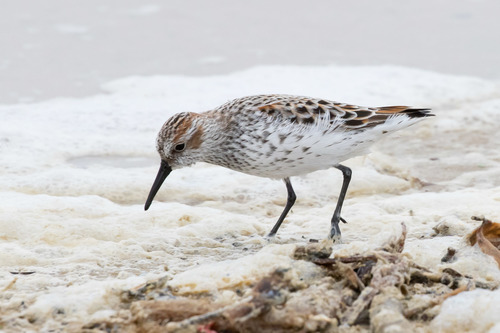
(c) Greg Lasley, some rights reserved (CC BY-NC), uploaded by Greg Lasley · cc-by-nc
OverviewAI-generated
The Western Sandpiper (*Calidris mauri*) is a species of bird classified within the family Scolopacidae and order Charadriiformes. Its scientific name was established by Cabanis in 1857. The species belongs to the class Aves and phylum Chordata, with the genus *Calidris* serving as its parent taxon. It is also referred to by the common names Bergstrandläufer, Correlimos de Alaska, and pibydd y Gorllewin.
This marine habitat species has a recorded range in South America. The Western Sandpiper has a wingspan of 32.5 and a mass of 31. Its conservation status is listed as Least Concern by the IUCN, a designation confirmed in 2024. The taxon is recognized as accepted and is not extinct.
Synthesized by Vinony from 30 facts across 5 sources: Wikidata, iNaturalist, WoRMS, IUCN Red List, Vinony graph. Generated from structured data (not the Wikipedia text) and checked against those facts — may still contain errors.
Species
Least Concernwestern sandpiper
Species
- PhylumChordata
- ClassAves
- OrderCharadriiformes
- FamilyScolopacidae
via IUCN
Wikidata facts
Show 9 more facts
- taxon rank
- species
- IUCN conservation status
- Least Concern
- taxon name
- Calidris mauri
- Commons category
- Calidris mauri
- Commons gallery
- Calidris mauri
- taxon common name
- pilrito-ocidental
- wingspan
- 32.5
- short name
- C. mauri
- taxon range
- South America
via Wikidata · CC0
~2 min read
Encyclopedic overview
The western sandpiper (Calidris mauri) is a small migratory shorebird. The genus name is from Ancient Greek kalidris or skalidris, a term used by Aristotle for some grey-coloured waterside birds. The specific mauri commemorates Italian botanist Ernesto Mauri (1791–1836).
This is one of the most abundant shorebird species in North America, with a population in the millions.
Excerpted from Wikipedia’s “Western Sandpiper” article, available under the CC BY-SA 4.0 licence.