File:Marcia_Fudge_with_Stay_Woke_Vote_t-shirt_in_2018.jpg · Wikimedia Commons · See Wikimedia Commons
woke
Sign in to saveAlso known as stay woke, wokeness, wokeism
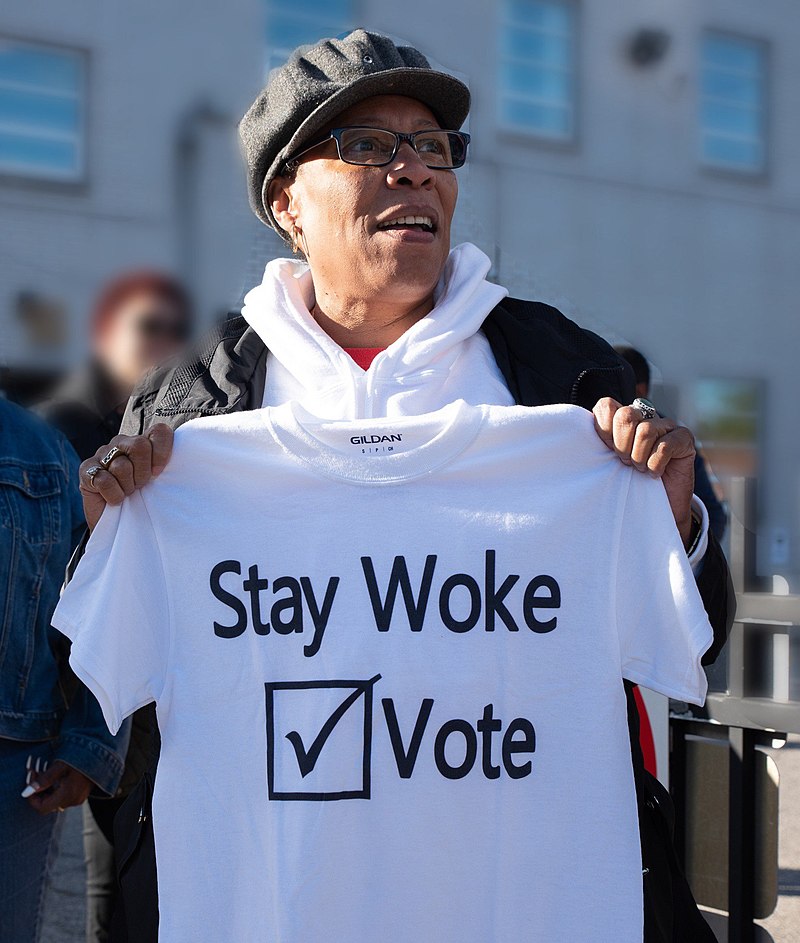
thumb|alt=Congresswoman Marcia fudge at an outdoor gathering holding a T-shirt in front of her which reads "Stay Woke" followed by a tick mark inside a box and the word "Vote"|U.S. Congresswoman Marcia Fudge in 2018
Wikidata facts
- Instance of
- word
Show 6 more facts
- language of work or name
- African American Vernacular English
- different from
- wok
- Commons category
- Wokeness
- has characteristic
- pejorative
- used by
- Black Twitter
- described at URL
- wikispooks.com/wiki/Woke
Sources (3)
via Wikidata · CC0
~29 min read
Encyclopedic overview
24 sectionsContents
- Origins and usage
- 20th century
- 2008–2014: #Staywoke hashtag
- 2014–2015: Black Lives Matter
- 2015–2019: Broadening usage
- 2019–present: emergence of pejorative use<span class="anchor" id="As a pejorative"></span>
- Americas
- Canada
- Latin America
- United States
- <span class="anchor" id=""Woke right""></span><span class="anchor" id="Woke right"></span> Woke right
- Asia
- India
- Europe
- Central Europe
- France
- United Kingdom
- Oceania
- Reception and legacy
- ''Woke-washing'' and ''woke capitalism''
- See also
- References
- Further reading
- External links
thumb|alt=Congresswoman Marcia fudge at an outdoor gathering holding a T-shirt in front of her which reads "Stay Woke" followed by a tick mark inside a box and the word "Vote"|U.S. Congresswoman Marcia Fudge in 2018
Woke is an adjective derived from African-American English used since the 1930s or earlier to refer to awareness of racial prejudice and discrimination, often in the construction stay woke. The term acquired political connotations by the 1970s and gained further popularity in the 2010s with the hashtag #staywoke. Over time, woke came to be used to refer to a broader awareness of social inequalities such as sexism and denial of LGBTQ rights. Woke has also been used as shorthand for some ideas of the American Left involving identity politics and social justice, such as white privilege and reparations for slavery in the United States.
Excerpted from Wikipedia’s “woke” article, available under the CC BY-SA 4.0 licence.