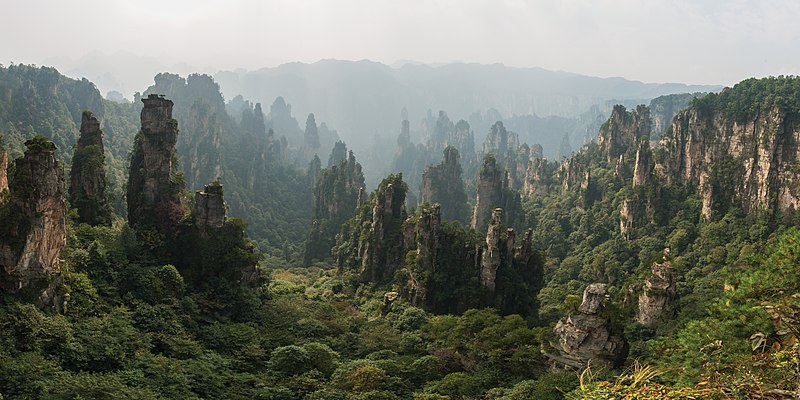
File:1_tianzishan_wulingyuan_zhangjiajie_2012.jpg · Wikimedia Commons · See Wikimedia Commons
Wulingyuan
Sign in to saveAlso known as Wulingyuan Scenic Reserve, Wulingyuan Scenic and Historic Interest Area, Wulingyuan National Park
Wulingyuan (, ) is a scenic and historical site in the Wulingyuan District of South Central China's Hunan Province. It is noted for more than 3,000 quartzite sandstone pillars and peaks across most of the site, many over in height, along with many ravines and gorges with picturesque streams, pools, lakes, rivers, and waterfalls. It features 40 caves, many with large calcite deposits and a natural bridge named Tianqiashengkong (meaning 'bridge across the sky'), which is one of the highest natural bridges in the world. The site also provides habitat for many vulnerable species, including the dho
Wulingyuan is a scenic area in Hunan Province, China, famous for its thousands of dramatic quartzite sandstone pillars, deep ravines, caves, and waterfalls that create striking natural landscapes. The site is significant both as a spectacular tourist destination and as a habitat for vulnerable wildlife species.
AI-generated from the Wikipedia summary — may contain errors.
Key facts
- UNESCO World Heritage Site.image
- 1 tianzishan wulingyuan zhangjiajie 2012.jpg
- UNESCO World Heritage Site.image_upright
- 1.2
- UNESCO World Heritage Site.caption
- The sandstone pillars of Wulingyuan extend hundreds of meters over the valley floor
- UNESCO World Heritage Site.official_name
- Wulingyuan Scenic and Historic Interest Area
- UNESCO World Heritage Site.location
- Wulingyuan District, Zhangjiajie, Hunan, China
- UNESCO World Heritage Site.criteria
- (vii)
- UNESCO World Heritage Site.ID
- 640
- UNESCO World Heritage Site.year
- 1992
- UNESCO World Heritage Site.locmapin
- China Hunan#China
- Chinese.pic
- Wulingyuan (Chinese characters).svg
- Chinese.piccap
- "Wulingyuan" in Chinese characters
- Chinese.picsize
- 125px
- Chinese.c
- 武陵源
- Chinese.p
- Wǔlíngyuán
- Chinese.w
- Wu3-ling2-yüan2
- Chinese.j
- Mou5-ling4-jyun
- Chinese.y
- Móuh-lìhng-yùhn
- Chinese.tl
- Bú-lîng-guân
via Wikipedia infobox
Wikidata facts
- Instance of
- protected area
- Part of
- Hunan
- Country
- China
- Located in
- Wulingyuan District
- Area
- 26400
- Image
- 1 zhangjiajie huangshizhai wulingyuan panorama 2012.jpg
Show 4 more facts
- Commons category
- Wulingyuan
- IUCN protected areas category
- IUCN category VI: Protected Area with sustainable use of natural resources
- heritage designation
- World Heritage Site
- native label
- 武陵源
Sources (2)
via Wikidata · CC0
~2 min read
Encyclopedic overview
5 sectionsContents
- Geology
- Main scenic spots
- Gallery
- References
- External links
Wulingyuan (, ) is a scenic and historical site in the Wulingyuan District of South Central China's Hunan Province. It is noted for more than 3,000 quartzite sandstone pillars and peaks across most of the site, many over in height, along with many ravines and gorges with picturesque streams, pools, lakes, rivers, and waterfalls. It features 40 caves, many with large calcite deposits and a natural bridge named Tianqiashengkong (meaning 'bridge across the sky'), which is one of the highest natural bridges in the world. The site also provides habitat for many vulnerable species, including the dhole, Asiatic black bear, and Chinese water deer.
The site is situated in Zhangjiajie City and lies about to the northwest of Changsha, the capital of Hunan Province. The park covers an area of 690 square kilometers (266 square miles). Wulingyuan forms part of the Wuling Mountain Range. The scenic area consists of four national parks, which are the Zhangjiajie National Forest Park, Suoxi Valley Nature Reserve, Tianzi Mountain Nature Reserve, and the recently added Yangjiajie Scenic Area. Overall there are over 560 attraction sights to view. The site was inscribed as a UNESCO World Heritage Site in 1992.
Excerpted from Wikipedia’s “Wulingyuan” article, available under the CC BY-SA 4.0 licence.
Gallery (4)
On the map
3 mapped locations