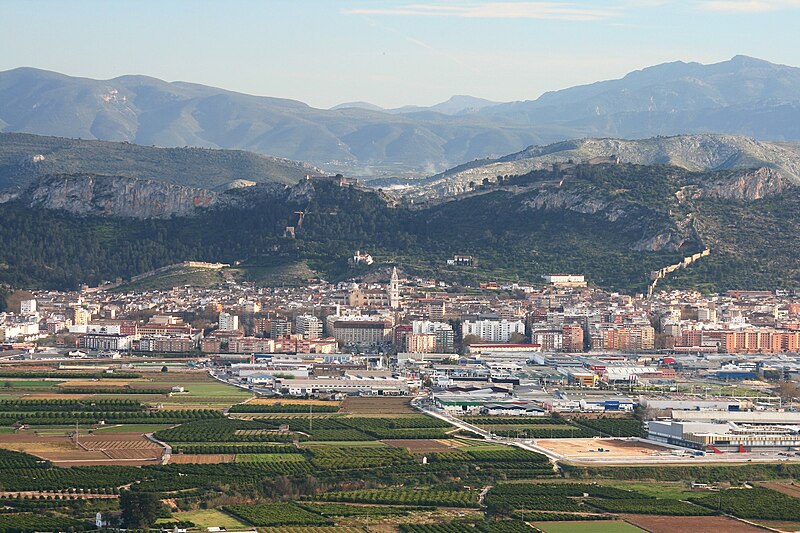
File:Xativa_cityview-2_web.jpg · Wikimedia Commons · See Wikimedia Commons
Xàtiva
Sign in to saveAlso known as Játiva, Exativa
Xàtiva, also known as , is a town and municipality in eastern Spain, in the province of Valencia, on the right (western) bank of the river Albaida and at the junction of the Valencia–Murcia and Valencia Albacete railways, in the north of the Central comarques and serves as the capital of the Costera comarca. It holds the distinction of having the highest number of enclaves in Spain, totaling twenty-six. It is located 25 km west of the Mediterranean Sea. During the Al-Andalus Islamic era, Arabs brought the technology to manufacture paper to Xàtiva. In the 12th century, Xàtiva was known for
Xàtiva is a town in eastern Spain's Valencia province that serves as the capital of the Costera region and is notable for having more territorial enclaves than any other Spanish municipality, with twenty-six separate areas. The town has historical significance as a center for papermaking technology during the Islamic Al-Andalus period, and it sits strategically near major railway lines connecting Valencia to Murcia and Albacete.
AI-generated from the Wikipedia summary — may contain errors.
Key facts
- Settlement.name
- Xàtiva
- Settlement.settlement_type
- Town and municipality
- Settlement.image_skyline
- Xativa_cityview-2_web.jpg
- Settlement.image_caption
- View of Xàtiva
- Settlement.image_flag
- Bandera de Xàtiva (roja).svg
- Settlement.image_shield
- Coat of Arms of Xàtiva.svg
- Settlement.shield_size
- 65px
- Settlement.map_caption
- Location of Xàtiva
- Settlement.pushpin_map
- Spain
- Settlement.subdivision_type
- Country
- Settlement.subdivision_type1
- Autonomous community
- Settlement.subdivision_type2
- Province
- Settlement.subdivision_name2
- 15px Valencia / València
- Settlement.subdivision_type3
- Comarca
- Settlement.subdivision_name3
- Costera
- Settlement.subdivision_type4
- Judicial district
- Settlement.subdivision_name4
- Xàtiva
- Settlement.elevation_m
- 115
via Wikipedia infobox
Wikidata facts
- Official name
- Xàtiva
- Demonym
- xativí
- Country
- Spain
- Located in
- Province of Valencia
- Continent
- Europe
- Official language
- Spanish
- Population
- 31008
- Area
- 76.56
- Elevation
- 115
- Time zone
- UTC+02:00
- Shares border with
- Novelé
- Official website
- www.xativa.es
- Image
- 1. Ajuntament de Xàtiva (La Costera, País Valencià).jpg
- Licence plate code
- V
- Patron saint
- Our Lady of the Snows
Show 12 more facts
- topic's main category
- Category:Xàtiva
- Commons category
- Xàtiva
- postal code
- 46800
- category of associated people
- Category:People from Xàtiva
- category for people born here
- Category:Births in Xàtiva
- category for people who died here
- Category:Deaths in Xàtiva
- Commons gallery
- Xàtiva
- native label
- Xàtiva
- described by source
- Encyclopædia Britannica 11th edition
- male population
- 14288
- female population
- 14943
- P12749
- Alperton
Sources (10)
via Wikidata · CC0
~35 min read
Encyclopedic overview
39 sectionsContents
- Etymology
- History
- Prehistory and Antiquity
- Middle Ages
- Early Modern Period
- Contemporary period
- Geography
- Climate
- Demography
- Urban planning
- Economy
- Transport
- Roads
- Railway
- Intercity bus
- Urban bus
- Administration and politics
- Municipal government
- Territorial organization
- Hamlets
- Neighborhoods
- Culture
- Heritage
- Military heritage
- Religious heritage
- Civil heritage
- Historic fountains
- Museums
- Theaters
- Festivals
- Main sights
- Cuisine
- Sister cities
- Notable people
- Gallery
- See also
- Notes
- References
- External links
Xàtiva, also known as , is a town and municipality in eastern Spain, in the province of Valencia, on the right (western) bank of the river Albaida and at the junction of the Valencia–Murcia and Valencia Albacete railways, in the north of the Central comarques and serves as the capital of the Costera comarca. It holds the distinction of having the highest number of enclaves in Spain, totaling twenty-six. It is located 25 km west of the Mediterranean Sea. During the Al-Andalus Islamic era, Arabs brought the technology to manufacture paper to Xàtiva. In the 12th century, Xàtiva was known for its schools, education, and learning circles. Islamic scholar Abu Ishaq al-Shatibi's last name refers to Xàtiva where he lived and died. After the Reconquista by Northern Christian kingdoms and the following Christian repopulation, the city became the cradle of one of the most powerful and controversial families of the Renaissance, the House of Borgia, which produced Popes like Callixtus III (Alfonso de Borgia) and Alexander VI (Rodrigo de Borgia).
Historically, Xàtiva was a prominent town in the Kingdom of Valencia, rivaling Valencia and Orihuela during the foral period. It is the birthplace of the Borgia popes and preserves a rich artistic heritage, despite suffering significant destruction in 1707 by Bourbon troops during the War of the Spanish Succession. In 1822, it briefly served as the capital of the Province of Xàtiva, which was dissolved in 1833 following the 1833 territorial division of Spain. In the late 1970s, Xàtiva was proposed as a potential capital for the Valencian Community due to its historical and geographic significance, avoiding tensions between Alicante and Valencia. The city's population is approximately 30,378 (2024). Together with nearby municipalities, it forms an integrated urban area with around 61,000 inhabitants in 2023.
Excerpted from Wikipedia’s “Xàtiva” article, available under the CC BY-SA 4.0 licence.
Gallery (32)
On the map
4 mapped locations