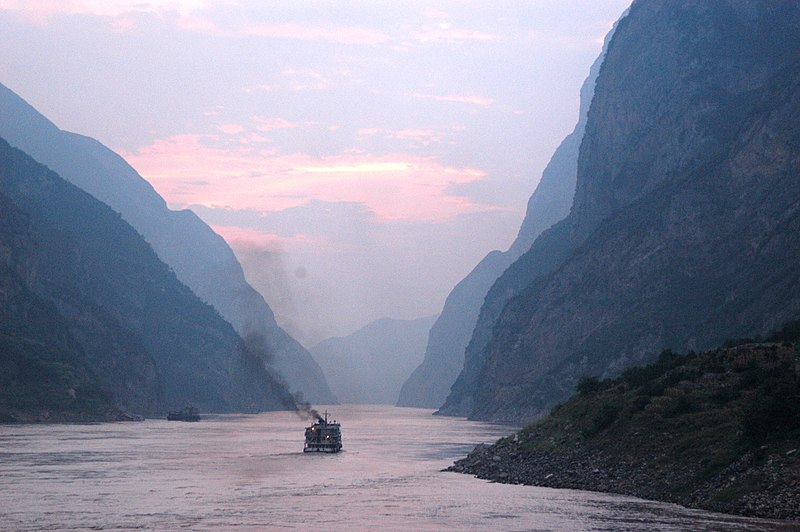
File:Dusk_on_the_Yangtze_River.jpg · Wikimedia Commons · See Wikimedia Commons
Yangtze
Sign in to saveAlso known as Chang Jiang, Changjiang, Yangzi, Yangtze River, Changjiang River, Chang Jiang River, Yang-tsze-kiang, Jiang
The Yangtze River, Yangzi River ( or ) or Chang Jiang () is the longest river in China and the third-longest river in the world. It rises at Jari Hill in the Tanggula Mountains of the Tibetan Plateau and flows for , including the Dam Qu River, the longest source of the Yangtze, in a generally easterly direction to the East China Sea. It is the fifth-largest primary river by discharge volume in the world. Its drainage basin comprises one-fifth of the land area of China, and is home to nearly one-third of the country's population.
The Yangtze River is China's longest river and the world's third-longest, flowing eastward from the Tibetan Plateau to the East China Sea. It matters because its drainage basin covers one-fifth of China's land and is home to nearly one-third of the country's population, making it vital to the nation's geography and people.
AI-generated from the Wikipedia summary — may contain errors.
Key facts
- Chinese.title
- Chang Jiang
- River.name
- Yangtze River
- River.image
- Dusk on the Yangtze River.jpg
- River.image_size
- 300
- River.image_caption
- Dusk on the middle reaches of the Yangtze River (Three Gorges), taken in July 2002.
- River.map
- Yangtze river map.png
- River.map_size
- 300px
- River.map_caption
- Map of the Yangtze River drainage basin
- River.pushpin_map_size
- 300px
- River.subdivision_type1
- Country
- River.subdivision_name1
- China
- River.subdivision_type2
- Provinces
- River.subdivision_name2
- Sichuan, Hubei, Hunan, Anhui, Jiangsu
- River.subdivision_type3
- Municipalities
- River.subdivision_name3
- Chongqing, Shanghai
- River.subdivision_type4
- Major cities
- River.subdivision_name4
- Luzhou, Chongqing, Yichang, Jingzhou, Yueyang, Changsha, Wuhan, Jiujiang, Anqing, Tongling, Wuhu, Nanjing, Zhenjiang, Yangzhou, Nantong, Shanghai
- River.length
- Yangtze – Jinsha – Tongtian – Dam Qu
via Wikipedia infobox
Wikidata facts
- Instance of
- river
- Has part
- Jinsha River
- Country
- China
- Located in
- Qinghai
- Continent
- Asia
- Image
- Qutang Gorge on Changjiang.jpg
- Length
- 6300
Show 12 more facts
- Commons category
- Yangtze River
- mouth of the watercourse
- East China Sea
- topic's main category
- Category:Yangtze River
- category for the water basin
- Category:Chang Jiang Basin
- Commons gallery
- 长江
- watershed area
- 1808500
- discharge
- 31900
- lake on watercourse
- Poyang Lake
- basin country
- China
- on focus list of Wikimedia project
- Wikipedia:Vital articles/Level/4
- topic has template
- Q14374375
- P12749
- Panzerwerfer
via Wikidata · CC0
~52 min read
Encyclopedic overview
33 sectionsContents
- Etymology
- Chinese{{anchor|Chinese name|Chinese names}}
- English and other European
- Tibetan
- Geography
- History
- Geologic history
- Early history
- Age of steam
- Navigation on the upper river
- Navy ships
- Contemporary events
- Hydrology
- Periodic floods
- Degradation of the river
- Contribution to ocean pollution
- Reconnecting lakes
- Discharge
- Major cities along the river
- Crossings
- Dams
- Tributaries
- Protected areas
- Wildlife
- Fish
- Other animals
- Tourism
- Gallery
- See also
- Notes
- References
- Further reading
- External links
The Yangtze River, Yangzi River ( or ) or Chang Jiang () is the longest river in China and the third-longest river in the world. It rises at Jari Hill in the Tanggula Mountains of the Tibetan Plateau and flows for , including the Dam Qu River, the longest source of the Yangtze, in a generally easterly direction to the East China Sea. It is the fifth-largest primary river by discharge volume in the world. Its drainage basin comprises one-fifth of the land area of China, and is home to nearly one-third of the country's population.
The Yangtze has played a major role in the history, culture, and economy of China. For thousands of years, the river has been used for water, irrigation, sanitation, transportation, industry, boundary-marking, and war. The Yangtze Delta generates as much as 20% of China's GDP, and the Three Gorges Dam on the Yangtze is the largest hydro-electric power station in the world. In mid-2014, the Chinese government announced it was building a multi-tier transport network, comprising railways, roads and airports to create a new economic belt alongside the river.
Excerpted from Wikipedia’s “Yangtze” article, available under the CC BY-SA 4.0 licence.
Gallery (52)
On the map
27 mapped locations
Available in 159 languages
- Español
- Français
- Deutsch
- 中文
- 日本語
- Русский
- Português
- Italiano
- العربية
- हिन्दी
- Afrikaans
- Albanian
- Albanian
- Amharic
- Aragonese
- Armenian
- Assamese
- Asturian
Show 140 more
- Awadhi
- azb
- Azerbaijani
- Bahasa Indonesia
- Balinese
- Bangla
- Bashkir
- Basque
- bat_smg
- Bavarian
- be_x_old
- Belarusian
- Bhojpuri
- Bikol
- Bosnian
- Breton
- Bulgarian
- Buriat
- Burmese
- Catalan
- cdo
- Cebuano
- Central Kurdish
- Chechen
- Cornish
- Crimean Tatar
- Croatian
- Czech
- Danish
- Egyptian Arabic
- Esperanto
- Estonian
- Faroese
- Fiji Hindi
- Fijian
- Filipino
- Finnish
- Galician
- Gan Chinese
- gcr
- Georgian
- Greek
- Guarani
- Hakka Chinese
- Hebrew
- Hungarian
- Icelandic
- Ido
- Iloko
- Interlingua
- Interlingue
- Irish
- Javanese
- Kabyle
- Kanuri
- Kara-Kalpak
- Karachay-Balkar
- Kazakh
- kbp
- Kurdish
- Kyrgyz
- Lao
- Latin
- Latvian
- Lezghian
- Lingua Franca Nova
- Lithuanian
- lld
- Lombard
- Low German
- Luxembourgish
- Macedonian
- Malay
- Malayalam
- Manipuri
- Marathi
- Mari
- Mazanderani
- Mingrelian
- Mongolian
- Moroccan Arabic
- Nederlands
- Nepali
- Newari
- Northern Frisian
- Northern Sami
- Norwegian
- Norwegian Nynorsk
- Nyanja
- Occitan
- Ossetic
- Piedmontese
- Polski
- Punjabi
- Quechua
- roa_tara
- Romanian
- Romansh
- Rusyn
- Scots
- Serbian
- Serbian (Latin)
- simple
- Sindhi
- Sinhala
- Slovak
- Slovenian
- Svenska
- Swahili
- Tajik
- Tamil
- Tatar
- Telugu
- Tibetan
- Tiếng Việt
- Toki Pona
- Tulu
- Türkçe
- Turkmen
- Ukrainian
- Urdu
- Uyghur
- Uzbek
- Venetian
- Veps
- Walloon
- Waray
- Welsh
- Western Frisian
- Western Panjabi
- Wu Chinese
- Yakut
- Yiddish
- zh_classical
- zh_min_nan
- zh_yue
- Zhuang
- فارسی
- ไทย
- 한국어
via Wikidata sitelinks · CC0