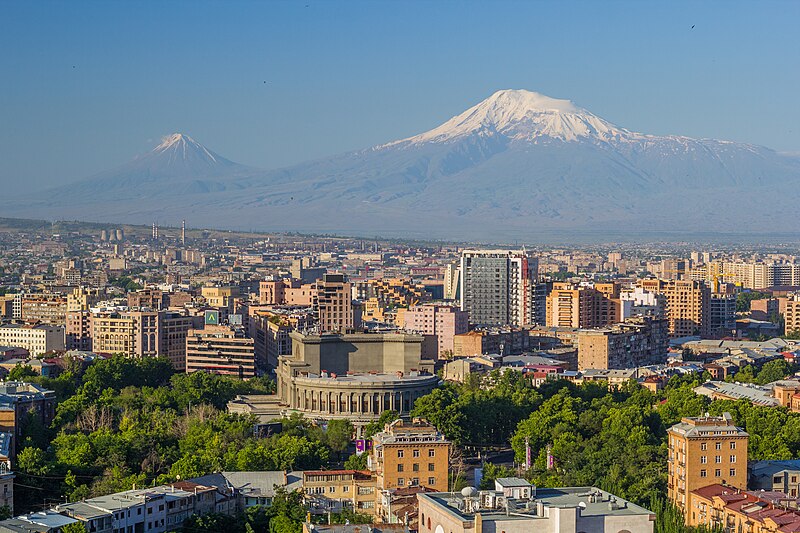
File:Mount_Ararat_and_the_Yerevan_skyline_(June_2018).jpg · Wikimedia Commons · See Wikimedia Commons
Yerevan
Sign in to saveAlso known as Erivan, Erevan, The Pink City, Irevan, Iravan
Yerevan ( , , ; ; sometimes spelled Erevan) is the capital and largest city of Armenia, as well as one of the world's oldest continuously inhabited cities. Situated along the Hrazdan River, Yerevan is the administrative, cultural, and industrial centre of the country, as its primate city. It has been the capital since 1918, the fourteenth in the history of Armenia and the seventh located in or around the Ararat Plain. The city also serves as the seat of the Araratian Pontifical Diocese, which is the largest diocese of the Armenian Apostolic Church and one of the oldest dioceses in the world.
Yerevan is the capital and largest city of Armenia, and one of the world's oldest continuously inhabited cities located along the Hrazdan River. It serves as Armenia's administrative, cultural, and industrial center and has been the country's capital since 1918, while also hosting the seat of the Araratian Pontifical Diocese, one of the oldest dioceses in the world.
AI-generated from the Wikipedia summary — may contain errors.
Key facts
- Settlement.name
- Yerevan
- Settlement.native_name
- Երևան
- Settlement.native_name_lang
- hy
- Settlement.settlement_type
- Capital city
- Settlement.imagesize
- 300px
- Settlement.image_flag
- Flag of Yerevan.svg
- Settlement.image_seal
- Coat of arms of Yerevan.svg
- Settlement.nicknames
- "The Pink City", "Mother City"
- Settlement.mapsize
- 230px
- Settlement.map_caption
- Location in Armenia##Location in Asia
- Settlement.pushpin_map
- Armenia#Asia
- Settlement.pushpin_relief
- 1
- Settlement.subdivision_type
- Country
- Settlement.parts_type
- Administrative Districts
- Settlement.parts
- 12
- Settlement.established_title
- Settled (Shengavit)
- Settlement.established_title1
- Founded as Erebuni by Argishti I of Urartu
- Settlement.established_date1
- 782 BC
via Wikipedia infobox
Wikidata facts
- Instance of
- big city
- Part of
- central Armenia
- Named after
- Erebuni Fortress
- Official name
- Ереван
- Demonym
- Erevančanka
- Award
- Order of Lenin
- Country
- Bagratid Armenia
- Located in
- Erivan Khanate
- Contains
- Kentron District
- Official language
- Armenian
- Population
- 1106300
- Area
- 227
- Elevation
- 987
- Time zone
- UTC+04:00
- Body of water
- Yerevan Lake
- Head of government
- Tigran Avinyan
- Legislature
- Yerevan Municipality
- Capital of
- Armenian Soviet Socialist Republic
- Founded by
- Argishti I of Urartu
- Official website
- yerevan.am
- Image
- Mount Ararat and the Yerevan skyline in spring (28mm).jpg
- Dialing code
- 10
- Flag
- flag of Yerevan
- Coat of arms
- Seal of Yerevan
Show 21 more facts
- Significant event
- Siege of Erivan
- Commons category
- Yerevan
- postal code
- 0001–0099
- twinned administrative body
- Astana
- topic's main category
- Category:Yerevan
- category for people born here
- Category:Births in Yerevan
- category for people who died here
- Category:Deaths in Yerevan
- inception
- 0782-00-00
- category of associated people
- Category:People from Yerevan
- Commons gallery
- Երևան
- native label
- Երևան
- time of earliest written record
- 0782-00-00
- category for people buried here
- Category:Burials in Yerevan
- Human Development Index
- 0.797
- category for honorary citizens of entity
- Category:Honorary citizens of Yerevan
- related category
- Category:Yerevan-related lists
- on focus list of Wikimedia project
- Wikipedia:Vital articles/Level/4
- present in work
- Civilization V
- P12749
- Cebu City
- social media followers
- 10000
Sources (14)
via Wikidata · CC0
~103 min read
Encyclopedic overview
75 sectionsContents
- Etymology
- Symbols
- History
- Pre-history and pre-classical era
- Erebuni
- Median and Achaemenid rules
- Ancient Kingdom of Armenia
- Sasanian and Roman periods
- Arab Islamic invasion
- Bagratid Armenia
- Seljuk period, Zakarid Armenia and Mongol rule
- Aq Qoyunlu and Kara Koyunlu tribes
- Iranian rule
- Russian rule
- Brief independence
- Soviet era
- Modern independence
- Geography
- Topography and cityscape
- Climate
- Architecture
- Parks
- Politics and government
- Capital
- Municipality
- Administrative districts
- Demographics
- Ethnic groups
- Religion
- Armenian Apostolic Church
- Russian Orthodox Church
- Other religions
- Health and medical care
- Culture
- Museums
- Libraries
- Art
- Music
- Dance
- Theatre
- Cinema
- Festivals
- Media
- Monuments
- Historic
- Contemporary
- Transportation
- Air
- City buses, public vans and trolleybuses
- Underground
- Railway
- Taxi
- Economy and services
- Industry
- Finance and banking
- Construction
- Energy
- Tourism and nightlife
- Education
- Science and research
- Sport
- Football
- Chess
- Basketball
- Tennis
- Artistic gymnastics
- Other sports
- International relations
- Twin towns – sister cities
- Partnerships
- Notable people
- Notes
- References
- Bibliography
- External links
Yerevan ( , , ; ; sometimes spelled Erevan) is the capital and largest city of Armenia, as well as one of the world's oldest continuously inhabited cities. Situated along the Hrazdan River, Yerevan is the administrative, cultural, and industrial centre of the country, as its primate city. It has been the capital since 1918, the fourteenth in the history of Armenia and the seventh located in or around the Ararat Plain. The city also serves as the seat of the Araratian Pontifical Diocese, which is the largest diocese of the Armenian Apostolic Church and one of the oldest dioceses in the world.
The history of Yerevan dates back to the 8th century BC, with the founding of the fortress of Erebuni in 782 BC by King Argishti I of Urartu at the western extreme of the Ararat Plain. Erebuni was "designed as a great administrative and religious centre, a fully royal capital." By the late ancient Armenian Kingdom, new capital cities were established and Yerevan declined in importance. The city was mostly depopulated by the Great Surgun of 1603–05, when the Safavid Empire forcibly deported hundreds of thousands of Armenians to Iran. In 1679, the city was mostly destroyed by an earthquake, and then rebuilt on a smaller scale. In 1828, Yerevan became part of the Russian Empire, which led to the repatriation of Armenians whose ancestors had been forcibly relocated in the 17th century. After World War I, Yerevan became the capital of the First Republic of Armenia as thousands of survivors of the Armenian genocide in the Ottoman Empire arrived in the area. The city expanded rapidly during the 20th century while Armenia was a part of the Soviet Union. In a few decades, Yerevan was transformed from a provincial town within the Russian Empire to Armenia's principal cultural, artistic, and industrial centre, as well as becoming the seat of national government.
Excerpted from Wikipedia’s “Yerevan” article, available under the CC BY-SA 4.0 licence.
Gallery (52)
On the map
3 mapped locations
Available in 190 languages
- Español
- Français
- Deutsch
- 中文
- 日本語
- Русский
- Português
- Italiano
- العربية
- हिन्दी
- Abkhazian
- Achinese
- Adyghe
- Afrikaans
- Akan
- Albanian
- Amharic
- Aragonese
Show 171 more
- Armenian
- Arpitan
- Asturian
- Avaric
- Awadhi
- azb
- Azerbaijani
- Bahasa Indonesia
- Balinese
- Bangla
- Bashkir
- Basque
- bat_smg
- be_x_old
- Belarusian
- Bikol
- Bosnian
- Breton
- Bulgarian
- Buriat
- Catalan
- cdo
- Cebuano
- Central Kurdish
- Chechen
- Chuvash
- Crimean Tatar
- Croatian
- Czech
- Danish
- Egyptian Arabic
- Erzya
- Esperanto
- Estonian
- Faroese
- Fiji Hindi
- Filipino
- Finnish
- fiu_vro
- Fula
- Gagauz
- Galician
- Georgian
- Gothic
- Greek
- Haitian Creole
- Hakka Chinese
- Hausa
- Hawaiian
- Hebrew
- Hungarian
- hyw
- Icelandic
- Ido
- Iloko
- Interlingua
- Interlingue
- Irish
- Javanese
- Kabyle
- Kannada
- Kara-Kalpak
- Kashmiri
- Kazakh
- kge
- Khmer
- Kinyarwanda
- Komi
- Kotava
- Kurdish
- Kyrgyz
- Ladino
- Latin
- Latvian
- Lezghian
- Ligurian
- Limburgish
- Lingua Franca Nova
- Lithuanian
- Lombard
- Luxembourgish
- Macedonian
- Malagasy
- Malay
- Malayalam
- Maltese
- Manipuri
- Manx
- Māori
- map_bms
- Marathi
- Mari
- Mazanderani
- Minangkabau
- Mingrelian
- Moksha
- Mongolian
- Moroccan Arabic
- Navajo
- Nederlands
- Nepali
- Northern Frisian
- Norwegian
- Norwegian Nynorsk
- Novial
- Nyanja
- Occitan
- Old English
- olo
- Ossetic
- Papiamento
- Piedmontese
- Polski
- Punjabi
- Quechua
- Romanian
- Rusyn
- Sanskrit
- Santali
- Sardinian
- Scots
- Scottish Gaelic
- Serbian
- Serbian (Latin)
- Shona
- Sicilian
- Silesian
- simple
- Sindhi
- Sinhala
- Slovak
- Slovenian
- Sundanese
- Svenska
- Swahili
- Tajik
- Talysh
- Tamil
- Tatar
- Telugu
- Tibetan
- Tiếng Việt
- Tumbuka
- Türkçe
- Turkmen
- Udmurt
- Ukrainian
- Upper Sorbian
- Urdu
- Uyghur
- Uzbek
- Venetian
- Veps
- Volapük
- Waray
- Welsh
- West Flemish
- Western Frisian
- Western Panjabi
- Wu Chinese
- Yakut
- Yiddish
- Yoruba
- Zaza
- Zeelandic
- zh_classical
- zh_min_nan
- zh_yue
- فارسی
- ไทย
- 한국어
via Wikidata sitelinks · CC0