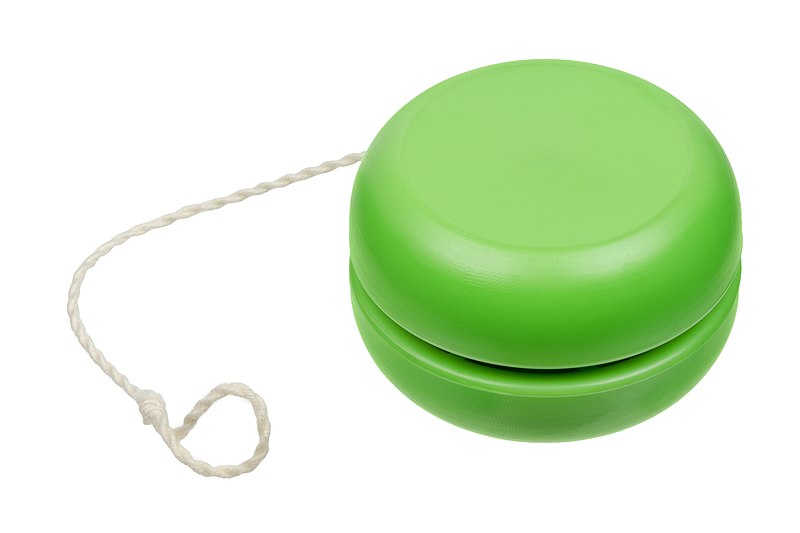
File:Yo-Yo-Plastic-Toy-Green.jpg · Wikimedia Commons · See Wikimedia Commons
yo-yo
Sign in to saveAlso known as Yoyo
thumb|A plastic yo-yo A yo-yo (also spelled yoyo) is a toy consisting of an axle connected to two disks, and a string looped around the axle, similar to a spool. It is an ancient toy documented since 440 BC. It was also called a bandalore in the 18th century.
A yo-yo is a toy made of two disks connected by an axle with a string looped around it, functioning like a spool that spins up and down. It is an ancient toy with a documented history going back to at least 440 BC and was also known as a bandalore during the 18th century.
AI-generated from the Wikipedia summary — may contain errors.
Wikidata facts
- Instance of
- hobby
- Image
- Wooden yo-yo.jpg
Show 7 more facts
- Commons category
- Yo-yos
- topic's main category
- Category:Yo-yos
- Commons gallery
- Yo-yo
- Unicode character
- 🪀
- different from
- Jojo
- on focus list of Wikimedia project
- Wikipedia:Vital articles/Level/4
- inception
- 0500-00-00
Sources (2)
via Wikidata · CC0
~20 min read
Encyclopedic overview
23 sectionsContents
- Etymology and history
- First yo-yo company
- 1960s resurgence
- Rise of the ball bearing
- Modern yo-yo
- Techniques
- Sleeping
- Mounts, transitions, and dismounts
- Loops and regens
- Tricks which adjust string tension
- Yo-yo notation
- Styles
- Unresponsive (1A)
- Looping (2A)
- Two-handed string tricks (3A)
- Off-string (4A)
- Freehand (5A)
- Modern responsive (0A)
- Physical mechanism
- Purported use as weapons
- See also
- References
- External links
thumb|A plastic yo-yo A yo-yo (also spelled yoyo) is a toy consisting of an axle connected to two disks, and a string looped around the axle, similar to a spool. It is an ancient toy documented since 440 BC. It was also called a bandalore in the 18th century.
It is played by holding the free end of the string known as the handle (by inserting one fingerusually the middle or ring fingerinto a slip knot), allowing gravity (or the force of a throw and gravity) to spin the yo-yo and unwind the string (similar to how a pullstring works). The player then allows the yo-yo to wind itself back to the player's hand, exploiting its spin (and the associated rotational energy). This is often called "yo-yoing" or "playing yo-yo".
Excerpted from Wikipedia’s “yo-yo” article, available under the CC BY-SA 4.0 licence.
Gallery (18)
Available in 59 languages
- Español
- Français
- Deutsch
- 中文
- 日本語
- Русский
- Português
- Italiano
- العربية
- हिन्दी
- Armenian
- Asturian
- Azerbaijani
- Bahasa Indonesia
- Bangla
- Basque
- Bikol
- Bulgarian
Show 40 more
- Catalan
- Croatian
- Czech
- Danish
- Esperanto
- Estonian
- Filipino
- Finnish
- Galician
- Greek
- Hebrew
- Hungarian
- Icelandic
- Interlingua
- Javanese
- Kurdish
- Latvian
- Lithuanian
- Luxembourgish
- Malay
- Nederlands
- Norwegian
- Norwegian Nynorsk
- Polski
- Romanian
- Serbian
- simple
- Svenska
- Tiếng Việt
- Türkçe
- Ukrainian
- Urdu
- Uzbek
- Western Frisian
- Western Panjabi
- Wu Chinese
- zh_yue
- فارسی
- ไทย
- 한국어
via Wikidata sitelinks · CC0