Category
page 1Spanish colonization of the Americas

Cuba
Cuba, officially the Republic of Cuba, is an island country in the Caribbean. It comprises the eponymous main island as well as 4,195 islands, islets, and cays. Situated at the convergence of the Caribbean Sea, Gulf of Mexico, and Atlantic Ocean, Cuba is located east of the Yucatán Peninsula, south of both Florida and the Bahamas, west of Hispaniola, and north of Jamaica and the Cayman Islands. Havana is the largest city and capital. Cuba is the third-most populous country in the Caribbean after Haiti and Dominican Republic, with about 10 million inhabitants. It is the largest country in the C

Dominican Republic
Dominican Republic is a country on the Caribbean island of Hispaniola in the Greater Antilles of the Caribbean Sea in the North Atlantic Ocean. It shares a maritime border with Puerto Rico to the east and a land border with Haiti to the west, occupying the eastern five-eighths of Hispaniola which, along with Saint Martin, is one of only two islands in the Caribbean shared by two sovereign states. In the Antilles, the country is the second-largest nation by area after Cuba at 48,671 square kilometers (18,792 sq mi) and second-largest by population after Haiti with approximately 11.4 million people in 2024, of whom 3.6 million reside in the metropolitan area of Santo Domingo, the capital city.
Puerto Rico
Puerto Rico, officially the Commonwealth of Puerto Rico, is a self-governing Caribbean archipelago and island organized as an unincorporated territory of the United States under the designation of commonwealth. It is located between the Dominican Republic in the Greater Antilles and the U.S. Virgin Islands in the Lesser Antilles. Located about 1,000 miles (1,600 km) southeast of Miami, Florida, it consists of the eponymous main island and numerous smaller islands, including Vieques, Culebra, and Mona. With approximately 3.2 million people, it is divided into 78 municipalities, of which the most populous is the capital municipality of San Juan, followed by those within the San Juan metropolitan area. Spanish and English are the official languages of the government, though Spanish predominates.
North Carolina
state of the United States of America
Spanish Empire
colonial empire governed by Spain between 1492 and 1976
Age of Discovery
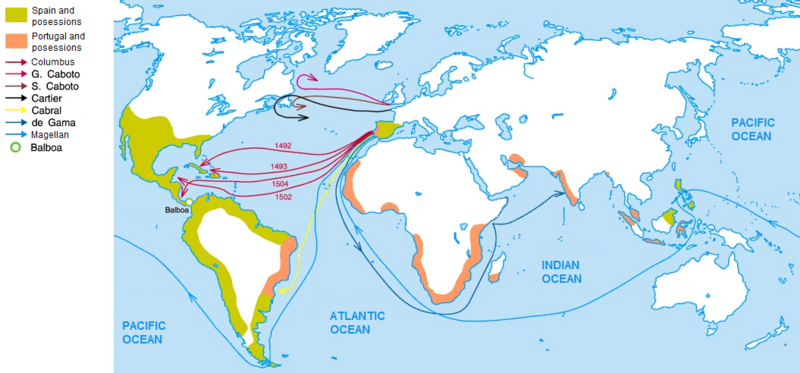
period of European global exploration from early 15th century to 17th century

conquistador
thumb|right|Hernán Cortés led the [[Spanish conquest of the Aztec Empire and expanded the Spanish Empire in the Americas]]
thumb|right|Afonso de Albuquerque expanded the [[Portuguese Empire across the Indian Ocean]]

New Spain
viceroyalty of the Spanish Empire (1535-1821)

Treaty of Tordesillas
treaty dividing territory between Portugal and Spain

Catholic Monarchs
title for Queen Isabella I of Castile and King Ferdinand II of Aragon
.jpg)
viceroy
thumb|"Roy" Edward III of England|Edward III, King of England. [[Bruges Garter Book.]]
A viceroy () is an official who reigns over a polity in the name of and as the representative of the monarch of the territory.
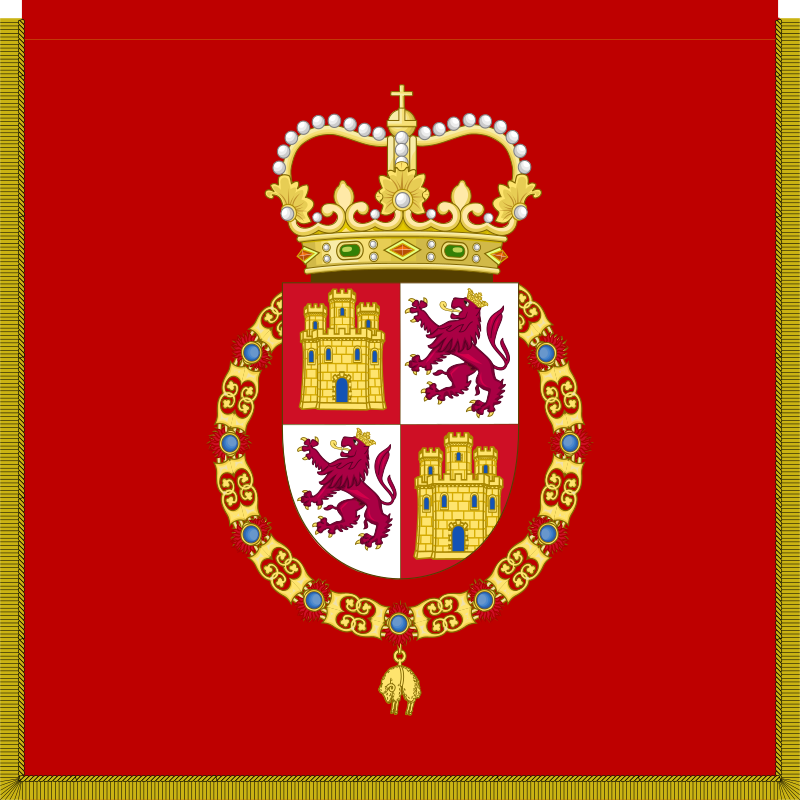
Spanish colonization of the Americas
overseas expansion under the Crown of Castile

Viceroyalty of New Granada
viceroyalty of the Spanish Empire in the Americas (1717-1819)

Inca Garcilaso de la Vega
Spanish chronicler (1539-1616)

Viceroyalty of Peru
viceroyalty of the Spanish Empire

Viceroyalty of the Río de la Plata
(1776-1814) Viceroyalty of the Spanish Empire in America

Spanish American wars of independence
1808–1833 armed conflicts in the Americas between Spain and independence movements

Morganton
city in Burke County, North Carolina, United States

Columbian Exchange
biological exchange across Atlantic Ocean

encomienda
thumb|200px|Francisco Hernández Girón was a Spanish encomendero in the [[Viceroyalty of Peru who protested the New Laws in 1553. These laws, passed in 1542 but repealed in 1545, gave certain rights to indigenous peoples and protected them against abuses. Drawing by Felipe Guamán Poma de Ayala.]]

cacique
thumb|right|Túpac Amaru II, an Andean cacique who led a 1781 rebellion against Spanish rule in Peru
thumb|Cangapol, chief of the Tehuelches, 18th century.
General Archive of the Indies
historical documentary archive located in Seville, Spain

hacienda
thumb|right|250px|Hacienda Lealtad is a working coffee hacienda which used slave labor in the 19th century, located in [[Lares, Puerto Rico.]]
Manila galleon
Royal Spanish trading ships, 1565–1815
Spanish Florida
former Spanish possession in North America (1513–1763, 1783–1821)
Spanish treasure fleet
convoy system used by the Spanish Empire from 1566 to 1790
Gonzalo Pizarro
Spanish conquistador, younger paternal half-brother of Francisco Pizarro
Felipe Huaman Puma de Ayala
Incan scholar and noble
Jesuit missions among the Guaraní
Catholic missionary initiative and set of missions in Paraguay, Argentina and Brazil
Francisco Hernández de Córdoba Brito del Socorro y Nazareno
Spanish conquistador
.svg)
adelantado
Adelantado (, , ; meaning 'advanced') was a title held by some Spanish nobles in service of their respective kings during the Middle Ages. It was later used as a military title held by some Spanish conquistadores of the 15th, 16th and 17th centuries.
Inter caetera
papal bull by Alexander VI (4 May 1493) which granted to the Catholic Kings Ferdinand II of Aragon and Isabella I of Castile all lands to the "west and south" of a line 100 leagues west and south of any of the islands of the Azores or of Cape Verde

La Isabela
historic site in the Dominican Republic
Chincha Islands War
1864–1866 war in South America with Spain fighting against Chile, Peru, Ecuador and Bolivia
New Kingdom of Granada
Venezuela and Colombia in the Spanish Empire (1538-1717)
Spanish West Indies
Spanish possession in the Caribbean between 1492-1898
Casa de Contratación
maritime trade house at Seville in Spain during the Age of Exploration
East Florida
region
Captaincy General of Chile
Spanish 1541-1818 possession in South America
Louisiana
province of New Spain
Treaty of Madrid
signed by Spain and Portugal on 1750, concerning their empires and status of their territories of what is now Brazil
The Californias
Region of western North America
Captaincy General of Venezuela
Spanish 1888 América
First Treaty of San Ildefonso
1777 treaty between Spain and Portugal
Juan Bautista de Anza
Basque explorer and governor (1736-1788)
Santa María la Antigua del Darién
city founded in 1510 during the Spanish colonization
Patriarchate of the West Indies
patriarchate of the Roman Catholic Church
Council of the Indies
administrative organ of the Spanish Empire
Balmis Expedition
research and philanthropic expedition
Bourbon Reforms
set of economic and political legislation promulgated by the Spanish Crown under various kings of the House of Bourbon, mainly in the 18th century

La Navidad
fort on the northeast coast of Haiti
decolonization of the Americas
process by which the countries in the Americas gained their independence from European rule
Valladolid debate
moral debate in Spain between 1550–1551 to discuss the rights and treatment of a colonized people by colonizers
New Castile Governorate
governorate of the Spanish Empire
Laws of Burgos
first codified set of laws governing Spaniards in the Americas
Cabrillo National Monument
National Monument of the United States and historic district

casta
thumb|upright=1.3|. A casta painting showing 16 racial groupings. Anonymous, 18th century, oil on canvas, 148×104 cm, , , Mexico
India Catalina
Indigenous Colombian translator and intermediary
A Short Account of the Destruction of the Indies
1551 text by Bartolomé de Las Casas
Treaty of Madrid
document signed on 1670 between England and Spain.