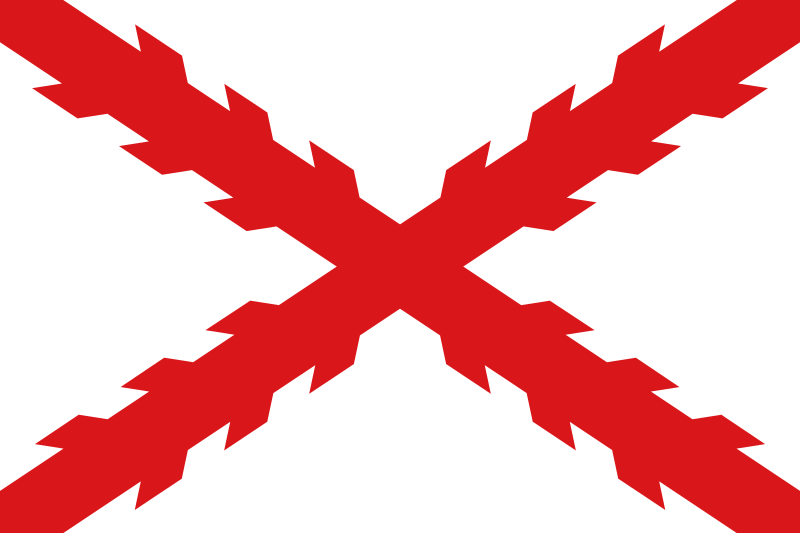
File:Flag_of_Cross_of_Burgundy.svg · Wikimedia Commons · See Wikimedia Commons
Spanish Empire
Sign in to saveAlso known as Imperio español, Monarquía universal Española, Monarquía Hispánica
colonial empire governed by Spain between 1492 and 1976
The Spanish Empire was a vast colonial territory controlled by Spain from 1492 until 1976, spanning nearly five centuries across multiple continents. It matters historically because it was one of the largest and longest-lasting empires in world history, profoundly shaping the cultures, languages, and political systems of regions across the Americas, Africa, and Asia.
AI-generated from the Wikipedia summary — may contain errors.
Wikidata facts
- Instance of
- colonial empire
- Part of
- Iberian Union
- Has part
- Spain
- Official name
- Imperio español
- Religion
- Latin Church
- Participant in
- Eighty Years' War
- Country
- Spain
- Continent
- Insular Oceania
- Official language
- Spanish
- Currency
- Spanish dollar
- Population
- 60000000
- Area
- 20000000
- Form of government
- absolute monarchy
- Anthem
- Marcha Real
- Founded by
- Catholic Monarchs
- Patron saint
- Immaculate Conception of Mary
Show 11 more facts
- Commons category
- Spanish Empire
- topic's main category
- Category:Spanish Empire
- replaced by
- Spain
- replaces
- Crown of Castile
- inception
- 1402-00-00
- dissolved, abolished or demolished date
- 1976-02-26
- Gregorian calendar start date
- 1582-10-15
- language used
- Spanish
- official religion
- Catholicism
- native label
- Monarquía universal española(Monarquía hispánica /Monarquía de España /Monarquía española)
- on focus list of Wikimedia project
- Wikipedia:Vital articles/Level/4
Sources (7)
via Wikidata · CC0
~40 min read
Encyclopedic overview
The Spanish Empire, sometimes referred to as the Hispanic Monarchy or the Catholic Monarchy, was a colonial empire that existed between 1492 and 1976. In conjunction with the Portuguese Empire, it ushered in the European Age of Discovery. It achieved a global scale, controlling vast portions of the Americas, Africa, various islands in Asia and Oceania, as well as territory in other parts of Europe. It was one of the most powerful empires of the early modern period, becoming known as "the empire on which the sun never sets". At its greatest extent in the late 1700s and early 1800s, the Spanish Empire covered 13.7 million square kilometres (5.3 million square miles), making it one of the largest empires in history.
Beginning with the 1492 arrival of Christopher Columbus and continuing for over three centuries, the Spanish Empire would expand across the Caribbean Islands, half of South America, most of Central America and much of North America. In the beginning, Portugal was the only serious threat to Spanish hegemony in the New World. To end the threat of Portuguese expansion, Spain conquered Portugal and the Azores Islands from 1580 to 1582 during the War of the Portuguese Succession, resulting in the establishment of the Iberian Union, a forced union between the two crowns that lasted until 1640 when Portugal regained its independence from Spain. In 1700, Philip V became king of Spain after the death of Charles II, the last Habsburg monarch of Spain, who died without an heir.
Excerpted from Wikipedia’s “Spanish Empire” article, available under the CC BY-SA 4.0 licence.
Gallery (12)
Available in 97 languages
- Español
- Français
- Deutsch
- 中文
- 日本語
- Русский
- Português
- Italiano
- العربية
- हिन्दी
- Afrikaans
- Albanian
- Armenian
- Asturian
- azb
- Azerbaijani
- Bahasa Indonesia
- Basque
Show 78 more
- Belarusian
- Bikol
- Breton
- Bulgarian
- Burmese
- Catalan
- cbk_zam
- Cebuano
- Central Kurdish
- Croatian
- Czech
- Danish
- Egyptian Arabic
- Esperanto
- Estonian
- Filipino
- Finnish
- Galician
- Georgian
- Greek
- Guarani
- Haitian Creole
- Hakka Chinese
- Hausa
- Hebrew
- Hungarian
- Icelandic
- Ido
- Iloko
- Interlingua
- Kazakh
- Kyrgyz
- Lao
- Latin
- Latvian
- Lithuanian
- Macedonian
- Malagasy
- Malay
- Marathi
- Mingrelian
- Mongolian
- Nederlands
- Nepali
- Newari
- Norwegian
- Norwegian Nynorsk
- Occitan
- Polski
- Punjabi
- Romanian
- Samoan
- Sardinian
- Serbian
- Serbian (Latin)
- simple
- Slovak
- Slovenian
- Svenska
- Tajik
- Tamil
- Telugu
- Tiếng Việt
- Türkçe
- Ukrainian
- Urdu
- Uyghur
- Uzbek
- Venetian
- Waray
- Welsh
- Western Panjabi
- Wu Chinese
- zh_min_nan
- zh_yue
- فارسی
- ไทย
- 한국어
via Wikidata sitelinks · CC0