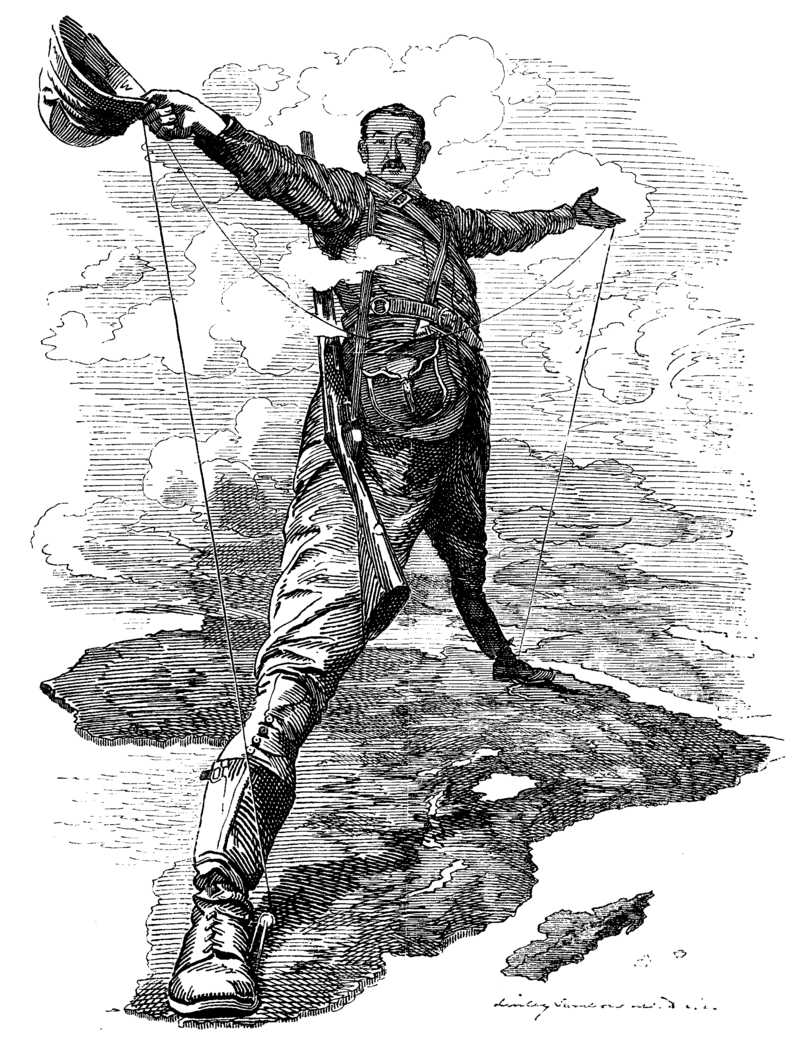
File:Punch_Rhodes_Colossus.png · Wikimedia Commons · See Wikimedia Commons
imperialism
Sign in to savethumb|The Rhodes Colossus|Political cartoon satirising the [[Cape to Cairo Railway, a symbol of British imperialism during the Scramble for Africa]]
Imperialism is when a powerful country extends its control over other territories and peoples, often to gain resources, markets, or political influence. It matters historically because imperial expansion shaped the modern world—redrawing maps, establishing colonies, and creating lasting political and economic relationships between nations that continue to affect global affairs today.
AI-generated from the Wikipedia summary — may contain errors.
Wikidata facts
- Instance of
- activity
- Subclass of
- expansionism
- Image
- China imperialism cartoon.jpg
Show 5 more facts
- Commons category
- Imperialism
- topic's main category
- Category:Imperialism
- on focus list of Wikimedia project
- Wikipedia:Vital articles/Level/4
- opposite of
- anti-imperialism
- different from
- militarism
via Wikidata · CC0
~84 min read
Encyclopedic overview
56 sectionsContents
- Definition
- Colonialism
- Age of Imperialism
- Theories of imperialism
- Justification and issues
- Expansionism
- Orientalism and imaginative geography
- Cartography
- Cultural imperialism
- Religious imperialism
- Psychological imperialism
- Social imperialism
- Social Darwinism
- Environmental determinism
- Historical examples
- Arab
- Belgian
- British
- England
- Scotland
- United Kingdom
- Caliphate
- Canada
- China
- Denmark
- Dutch
- Egypt
- France
- Education policy
- Germany
- Inca
- Italy
- Japan
- Mongol
- Mughal
- Nomadic empires
- Ottoman
- Persia
- Portugal
- Rome
- Russia
- Russian Empire
- Soviet Union
- Russia under Putin
- Spain
- Imperialism in the Caribbean basin
- Scholarly debate and controversy
- Sweden
- United States
- Anti-imperialism
- See also
- Notes
- References
- Sources
- Further reading
- External links
thumb|The Rhodes Colossus|Political cartoon satirising the [[Cape to Cairo Railway, a symbol of British imperialism during the Scramble for Africa]]
Imperialism is the maintaining and extending of power over foreign nations, particularly through expansionism, employing both hard power (military and economic power) and soft power (diplomatic power and cultural imperialism). Imperialism focuses on establishing or maintaining hegemony and a more formal empire.
Excerpted from Wikipedia’s “imperialism” article, available under the CC BY-SA 4.0 licence.
Gallery (52)
Available in 131 languages
- Español
- Français
- Deutsch
- 中文
- 日本語
- Русский
- Português
- Italiano
- العربية
- हिन्दी
- Afrikaans
- Albanian
- Albanian
- Aragonese
- Armenian
- Assamese
- Asturian
- Avaric
Show 112 more
- azb
- Azerbaijani
- Bahasa Indonesia
- Bangla
- Bashkir
- Basque
- bat_smg
- Bavarian
- be_x_old
- Belarusian
- Bosnian
- Breton
- btm
- Bulgarian
- Buriat
- Catalan
- Central Kurdish
- Chechen
- Cornish
- Croatian
- Czech
- Danish
- Egyptian Arabic
- Esperanto
- Estonian
- Fiji Hindi
- Filipino
- Finnish
- fiu_vro
- Galician
- gcr
- Georgian
- Greek
- Hausa
- Hebrew
- Hungarian
- Icelandic
- Ido
- Iloko
- Interlingua
- Jamaican Creole English
- Kanuri
- Karachay-Balkar
- Kazakh
- kbp
- Kurdish
- Kyrgyz
- Latin
- Latvian
- Limburgish
- Lithuanian
- Lombard
- Low German
- Macedonian
- Malagasy
- Malay
- Malayalam
- Marathi
- Minangkabau
- Mingrelian
- Mirandese
- Mongolian
- Nederlands
- Nepali
- Newari
- Norwegian
- Norwegian Nynorsk
- nrm
- Occitan
- Papiamento
- Pashto
- Piedmontese
- Polski
- Punjabi
- Romanian
- Romansh
- Rusyn
- Scots
- Serbian
- Serbian (Latin)
- Sicilian
- simple
- Sindhi
- Sinhala
- Slovak
- Slovenian
- Svenska
- Swahili
- Tajik
- Tamil
- Tatar
- Tiếng Việt
- Toki Pona
- Türkçe
- Ukrainian
- Urdu
- Uzbek
- Waray
- Welsh
- Western Frisian
- Western Panjabi
- Wu Chinese
- Yakut
- Yiddish
- Zaza
- zh_classical
- zh_min_nan
- zh_yue
- Zulu
- فارسی
- ไทย
- 한국어
via Wikidata sitelinks · CC0