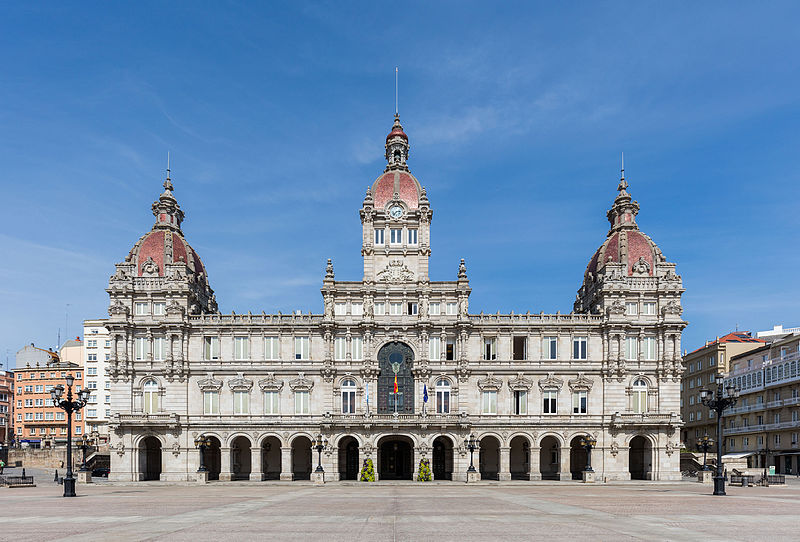
File:Ayuntamiento,_La_Coruña,_España,_2015-09-25,_DD_44.jpg · Wikimedia Commons · See Wikimedia Commons
A Coruña
Sign in to saveAlso known as Corunna, The Groyne, La Coruña, Coruña, Corunha, Coruna, Corunium, Crunia
city and municipality in the province of A Coruña, Galicia, Spain
A Coruña is a city and municipality located in the northwestern Spanish region of Galicia, serving as the capital of its province. It is historically significant as a major port city on Spain's Atlantic coast, making it an important center for maritime trade and culture in the region.
AI-generated from the Wikipedia summary — may contain errors.
Wikidata facts
- Instance of
- municipality of Galicia
- Official name
- A Coruña
- Demonym
- cascarilleiro
- Country
- Spain
- Located in
- A Coruña Province
- Contains
- San Cristovo das Viñas, A Coruña
- Population
- 251543
- Area
- 37.83
- Elevation
- 21
- Time zone
- UTC+01:00
- Body of water
- Atlantic Ocean
- Head of government
- Xulio Ferreiro
- Capital of
- A Coruña Province
- Shares border with
- Oleiros
- Official website
- www.coruna.gal
- Image
- Enseada do Orzán.jpg
- Dialing code
- 981 y 881
- Licence plate code
- C
Show 17 more facts
- topic's main category
- Category:A Coruña
- postal code
- 15001–15011
- Commons category
- A Coruña
- opposite of
- Christchurch
- twinned administrative body
- Rio de Janeiro
- category of associated people
- Category:People from A Coruña
- category for people born here
- Category:Births in A Coruña
- category for people who died here
- Category:Deaths in A Coruña
- Commons gallery
- A Coruña
- native label
- A Coruña
- described by source
- Encyclopædia Britannica 11th edition
- male population
- 113900
- female population
- 131811
- P8168
- General Motors
- social media followers
- 47929
- P12749
- Bălănești Hill
Sources (8)
via Wikidata · CC0
~40 min read
Encyclopedic overview
A Coruña ( Galician pronunciation: [ɐ koˈɾuɲɐ] ; in Spanish: La Coruña [la koˈɾuɲa] ; also informally called just Coruña; historical English: Corunna or The Groyne) is a city and municipality in Galicia, Spain. With a population of 249,255, it is the 2nd-largest city in Galicia behind Vigo. The city is the provincial capital of the province of A Coruña, having also served as political capital of the Kingdom of Galicia from the 16th to the 19th centuries, and as a regional administrative centre between 1833 and 1982.
A Coruña is located on a promontory in the Golfo Ártabro, a large gulf on the Atlantic Ocean. It is the main industrial and financial centre of northern Galicia, and holds the headquarters of the Universidade da Coruña. A Coruña is the city with the tallest mean-height of buildings in Spain, also featuring a population density of 21,972 inhabitants per square kilometre (56,910/sq mi) of built land area.
Excerpted from Wikipedia’s “A Coruña” article, available under the CC BY-SA 4.0 licence.
Gallery (12)
On the map
Available in 99 languages
- Español
- Français
- Deutsch
- 中文
- 日本語
- Русский
- Português
- Italiano
- العربية
- Aragonese
- Armenian
- Asturian
- azb
- Azerbaijani
- Bahasa Indonesia
- Balinese
- Bangla
- Basque
Show 80 more
- Bavarian
- be_x_old
- Belarusian
- Breton
- Bulgarian
- Burmese
- Catalan
- Cebuano
- Central Kurdish
- Chuvash
- Croatian
- Czech
- Danish
- Egyptian Arabic
- Esperanto
- Estonian
- Extremaduran
- Finnish
- Galician
- Georgian
- Greek
- Guarani
- Hebrew
- Hungarian
- Icelandic
- Ido
- Interlingua
- Interlingue
- Irish
- Kazakh
- Kyrgyz
- Ladino
- Latvian
- Ligurian
- Lithuanian
- lld
- Lombard
- Macedonian
- Malagasy
- Malay
- Māori
- Nederlands
- Northern Frisian
- Norwegian
- Norwegian Nynorsk
- Occitan
- Ossetic
- Pampanga
- Polski
- Romanian
- Sanskrit
- Sardinian
- Scots
- Scottish Gaelic
- Serbian
- Serbian (Latin)
- Silesian
- simple
- Slovak
- Slovenian
- Svenska
- Swahili
- Talysh
- Tatar
- Tiếng Việt
- Türkçe
- Ukrainian
- Urdu
- Uzbek
- Venetian
- Waray
- Welsh
- Western Panjabi
- Wu Chinese
- Zaza
- zh_min_nan
- zh_yue
- فارسی
- ไทย
- 한국어
via Wikidata sitelinks · CC0