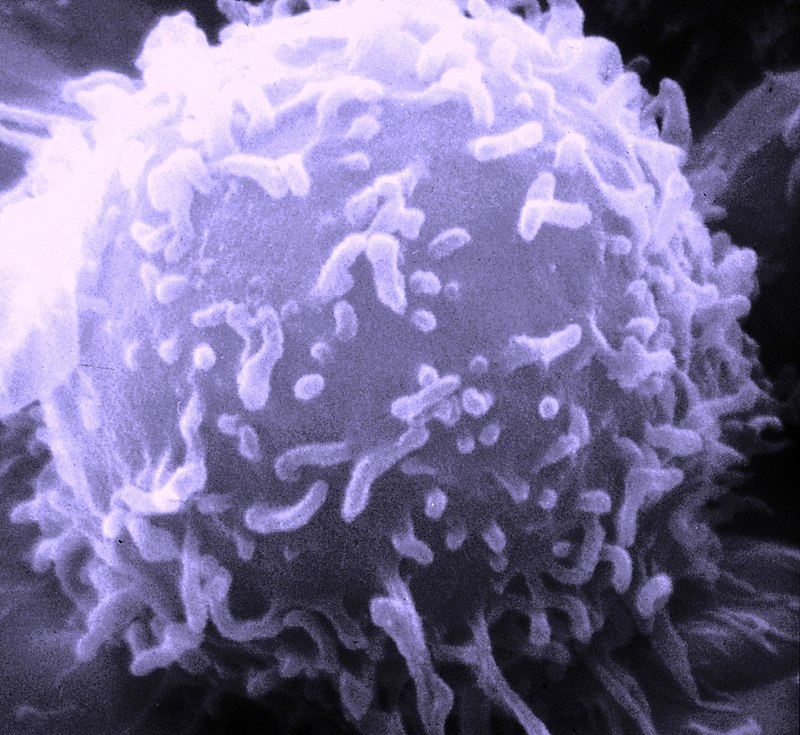
File:SEM_Lymphocyte.jpg · Wikimedia Commons · See Wikimedia Commons
adaptive immune system
Sign in to saveAlso known as adaptive immunity, acquired immunity, acquired immunity system, acquired antibiotic resistance
subsystem of the overall immune system that is composed of highly specialized, systemic cells and processes that eliminate pathogens or prevent their growth
Research
61,285 papers- The immune system as a system of relations.Frontiers in immunology · 2022
- Stress, adaptation, and disease. Allostasis and allostatic load.Annals of the New York Academy of Sciences · 1998
- Maternal Immunological Adaptation During Normal Pregnancy.Frontiers in immunology · 2020
- CD4 T-Cell Subsets and the Pathophysiology of Inflammatory Bowel Disease.International journal of molecular sciences · 2023
- The adaptive immune system of fish.Developments in biological standardization · 1997
via PubMed
Wikidata facts
- Subclass of
- antibiotic resistance
Show 5 more facts
- Commons category
- Immunology
- opposite of
- innate immune response
- found in taxon
- Vertebrata
- topic has template
- Template:Lymphocytic immune system
- has characteristic
- immunological memory
Sources (2)
via Wikidata · CC0
~40 min read
Encyclopedic overview
A scanning electron microscope image of a single human lymphocyte The adaptive immune system (AIS), also known as the acquired immune system or specific immune system, is a subsystem of the immune system that is composed of specialized cells, organs, and processes that eliminate pathogens specifically. The acquired immune system is one of the two main immunity strategies found in vertebrates (the other being the innate immune system).
Like the innate system, the adaptive immune system includes both humoral immunity components and cell-mediated immunity components and destroys invading pathogens. Unlike the innate immune system, which is pre-programmed to react to common broad categories of pathogen, the adaptive immune system is highly specific to each particular pathogen the body has encountered.
Excerpted from Wikipedia’s “adaptive immune system” article, available under the CC BY-SA 4.0 licence.