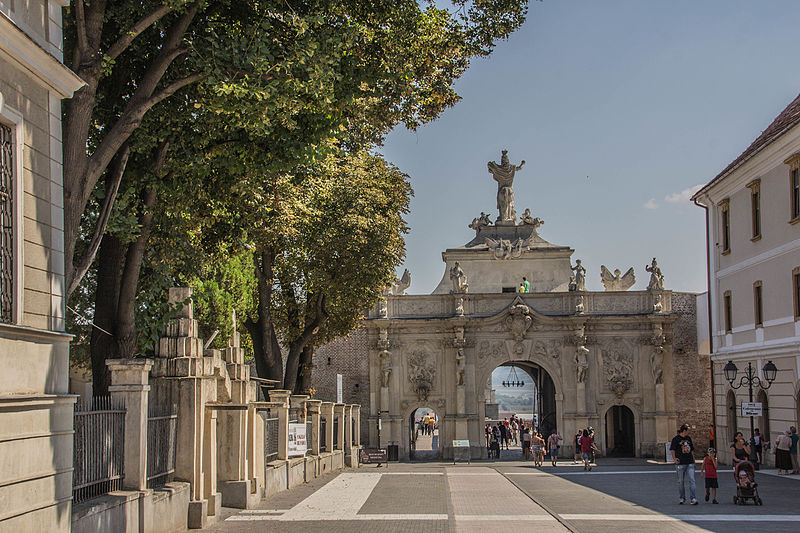
File:Cetatea_Alba_Carolina_Ansamblul_fortificației_„Cetatea_Alba_Iulia_14.jpg · Wikimedia Commons · See Wikimedia Commons
Alba Iulia is a city located in Romania with a long and significant history in the region. It has been an important cultural and historical center, particularly during key periods in Romanian history.
AI-generated from the Wikipedia summary — may contain errors.
Wikidata facts
- Official name
- Alba Iulia
- Country
- Kingdom of Hungary
- Located in
- Eastern Hungarian Kingdom
- Population
- 64227
- Area
- 103.650000
- Elevation
- 230
- Time zone
- Eastern European Time
- Capital of
- Fehér County
- Official website
- www.apulum.ro
- Image
- Cetatea Alba Iulia din aer toamna.jpg
- Dialing code
- 258
- Licence plate code
- AB
Show 18 more facts
- native label
- Karlsburg
- described by source
- Brockhaus and Efron Encyclopedic Dictionary
- postal code
- 510002–510408
- Commons category
- Alba Iulia
- twinned administrative body
- Cetinje
- topic's main category
- Category:Alba Iulia
- contains settlement
- Pâclișa
- category for people born here
- Category:Births in Alba Iulia
- category for people who died here
- Category:Deaths in Alba Iulia
- category of associated people
- Category:People from Alba Iulia
- owner of
- Stadionul Cetate
- street address
- Calea Moţilor nr. 5A, 510134 Alba Iulia
- phone number
- +40-258819462
- member of
- League of Historical Cities
- population by native language
- 652
- P8168
- Doc Pomus
- email address
- mailto:[email protected]
- historical region
- Transylvania
Sources (15)
via Wikidata · CC0
~16 min read
Encyclopedic overview
Alba Iulia ( Romanian pronunciation: [ˌalba ˈjuli.a] ; German: Karlsburg or Carlsburg, formerly Weißenburg [ˈvaɪsn̩bʊʁk] ; Hungarian: Gyulafehérvár [ˈɟulɒfɛɦeːrvaːr]; Latin: Apulum) is a city that serves as the seat of Alba County in the west-central part of Romania. Located on the river Mureș in the historical region of Transylvania, it has a population of 64,227 (as of 2021).
During ancient times, the site was the location of the Roman camp Apulum. Since the High Middle Ages, the city has been the seat of Transylvania's Roman Catholic diocese. Between 1526 and 1570 it was the capital of the Eastern Hungarian Kingdom from which the Principality of Transylvania emerged by the Treaty of Speyer in 1570 and it was the capital of the Principality of Transylvania until 1711. At one point it also was a centre of the Eastern Orthodox Metropolitan of Transylvania with suffragan to Vad diocese. On 1 December 1918, the Union of Transylvania with Romania was declared in Alba Iulia, and Romania's King Ferdinand I and, in 1922 Queen Marie were crowned in the Alba Iulia Orthodox Cathedral.
Excerpted from Wikipedia’s “Alba Iulia” article, available under the CC BY-SA 4.0 licence.
Gallery (12)
On the map
2 mapped locations
Available in 68 languages
- Español
- Français
- Deutsch
- 中文
- 日本語
- Русский
- Português
- Italiano
- العربية
- Achinese
- Aragonese
- azb
- Azerbaijani
- Bahasa Indonesia
- Basque
- Belarusian
- Breton
- Bulgarian
Show 49 more
- Catalan
- Cebuano
- Croatian
- Czech
- Danish
- Egyptian Arabic
- Esperanto
- Estonian
- Finnish
- Galician
- Georgian
- Greek
- Hebrew
- Hungarian
- Interlingue
- Latin
- Latvian
- Lithuanian
- Malay
- Minangkabau
- Nederlands
- Norwegian
- Norwegian Nynorsk
- Ossetic
- Polski
- Romanian
- Scots
- Scottish Gaelic
- Serbian
- Serbian (Latin)
- Silesian
- simple
- Slovak
- Slovenian
- Svenska
- Tajik
- Tamil
- Tatar
- Tiếng Việt
- Türkçe
- Ukrainian
- Urdu
- Uzbek
- Waray
- Western Panjabi
- Wu Chinese
- فارسی
- ไทย
- 한국어
via Wikidata sitelinks · CC0