
Ali Khamenei
Sign in to saveAlso known as Alī Ḥoseynī Khāmeneī, Imam Khamenei, Sayyid Ali Khamenei, Sayyid Ali Hoseyni Khamenei, Ayatollah Khamenei, Ayatollah Ali Khamenei, Khamenei
Ali Hosseini Khamenei was an Iranian politician and Shia cleric who served as the second supreme leader of Iran from 1989 until his assassination in the 2026 Iran war. A member of the Khamenei family, he previously served as the third president of Iran from 1981 to 1989. He held the title Grand Ayatollah, and his tenure as supreme leader, spanning 36 years and six months, made him the longest-serving head of state in West Asia at the time of his death.
OverviewAI-generated
Ali Khamenei is an Iranian Islamic jurist, politician, translator, and writer who has served as the Supreme Leader of Iran and President of Iran. Born in Mashhad in 1939, he holds citizenship in Pahlavi Iran and Iran. His native language is Azerbaijani, and he is a male Shia Muslim. He is a student of Hussein-Ali Montazeri, Hossein Borujerdi, Ruhollah Khomeini, and Javad Khamenei.
Khamenei is a member of the Combatant Clergy Association and the Islamic Republican Party. He is the son of Javad Khamenei and the husband of Mansoureh Khojasteh Bagherzadeh. His children include Mojtaba, Mostafa, and Masoud Khamenei. He has siblings Hadi, Mohammad, and Badri Khamenei. He was honored with the prefixes grand ayatollah and Sayyid.
As an author, he has written 145 works, including *Miscellaneous Fatwas*, *Governance of the Divinely-Sanctioned Social Order under Conditions of Religious Solidarity*, and *Essence of Tawhid*. He ran for president in the October 1981 and 1985 Iranian presidential elections.
Synthesized by Vinony from 31 facts across 3 sources: Wikidata, Open Library, Firecrawl. Generated from structured data (not the Wikipedia text) and checked against those facts — may still contain errors.
In the Vinony graph
Within Vinony's link graph, Ali Khamenei is referenced by 2,029 other articles, and connects out to Persian, Ruhollah Khomeini and Muhammad Iqbal.
Vinony files it under 1939 births, 2026 deaths and 20th-century Iranian politicians.
Its subject is documented across 134 Wikipedia language editions.
Person · Open Library
- Born
- 1939
- Works
- 145
Top works
- Miscellaneous Fatwas
- Governance of the Divinely-Sanctioned Social Order under Conditions of Religious Solidarity
- Essence of Tawhid
- Governance of the Divinely-Sanctioned Social Order under Conditions of Religious Solidarity : Volume 3
- Monotheism (Tawhid)
via Open Library + Wikidata
Film & TV
Mashhad, Khorasan, Iran
Ali Hosseini Khamenei (19 April 1939 – 28 February 2026) was an Iranian cleric and politician who served as the supreme leader of Iran since 1989, the second person to hold the position. He had previously served as the president of Iran from 1981 to 1989. His tenure as supreme leader, spanning 36 years, made him the longest-serving head of state in the Middle East and the longest-serving Iranian…
Known for
- How Khamenei Was Killed – The Attack in Iran — Self (archive footage)2026
- Russia, China, Iran: The Axis of Revenge — Self (archive footage)2024
- Inside the Iranian Uprising — Self (archive footage)2023
- Salman Rushdie: Death on a Trail — Self - Politician (archive footage)2019
- House of Saud: A Family at War — Self (archive footage)2018
- Bitter Rivals: Iran and Saudi Arabia — Self2018
- Bazm-e Razm — Self (archive footage)2017
- A Dying King: The Shah of Iran — Self (archive footage)2017
- The Green Wave — Himself2012
- Letters from Iran — Self (archive footage)2011
via TMDB
Wikipedia views (30d)
234,117 totalvia Wikimedia Pageviews API
Official website
KHAMENEI.IR
پایگاه اطلاعرسانی دفتر حفظ و نشر آثار حضرت آیتالله العظمی سیدعلی خامنهای, پایگاه اطلاعرسانی دفتر حفظ و نشر آثار حضرت آیتالله العظمی سیدعلی خامنهای
khamenei.ir →Link to the official site · 3,574 chars · not written by Vinony
Described at
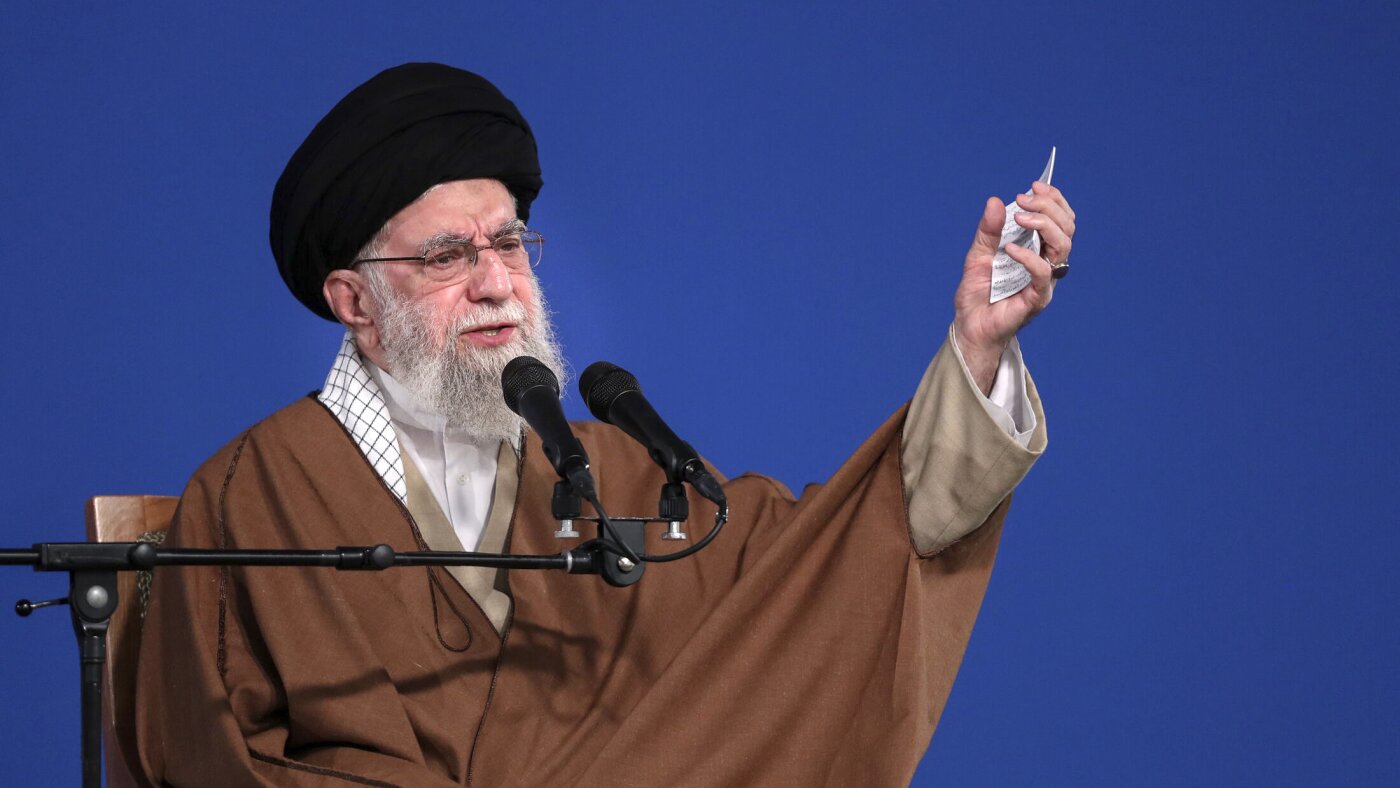
What to know about Iran's supreme leader : NPR
NPR's Steve Inskeep profiles Iran's supreme leader, who is deciding on his next steps after a ceasefire with Israel.
npr.org →What to know about Iran's supreme leader NPR's Steve Inskeep profiles Iran's supreme leader, who is deciding on his next steps after a ceasefire with Israel. In this photo released by the official website of the office of the Iranian supreme leader, Supreme Leader Ayatollah Ali Khamenei speaks to a group of people and officials in Tehran, Iran, Friday, March 21, 2025. Office of the Iranian Supreme Leader/ Via AP hide caption The next phase of the confrontation with Iran depends in part on Ayatollah Ali Khamenei. Khamenei, 86, is not the only voice in Iran's national security establishment, but is thought to have the final word. Over the years, I have occasionally visited Iran for NPR, and had some opportunity to learn about Khamenei. Once I was allowed into a polling place to watch him vote. He dropped the ballot in a box with his left hand — his right hand having been immobilized by a long-ago assassination attempt — and turned to the assembled press corps to briefly curse the United States. Opposition to America and Israel are foundational ideas of his government. Murals across Iran feature his seemingly benevolent white-bearded face. Once I saw his words on one of those murals, which translated as: "We will not get along with America for one single second." Some key facts about him follow, based on past reporting on his very long career, along with fresh analysis from this week. Khamenei is only the second supreme leader since Iran's Islamic revolution in 1979. He succeeded the similarly-named but unrelated Ayatollah Ruhollah Khomeini, who had been the leading figure in the overthrow of Iran's last king, or Shah. Under the constitution framed by his predecessor, Khamenei is to be the supreme guide for a government with many divisions of power. There is an elected president and parliament, as well as a court system and central bank. There is a national security council, and an "Assembly of Experts," clerics who choose each supreme leader. There is an army, but also a separate Revolutionary Guard Corps and competing intelligence services. These institutions provide checks and balances in a way that would almost seem to draw on American traditions of government — with the profound difference that all institutions in Iran are ultimately subordinate to just one power, Khamenei's. Khamenei grew up in the Shiite Muslim holy city of Mashhad, where his four-room childhood home has been preserved. When I visited, people were praying there. His father was an ayatollah, a religious figure with an exalted title and limited income. Khamenei attended theological school. Though he did not have a distinguished clerical career, he became a protege of Khomeini, the revolutionary leader. He was elected president, then Khomeini's successor. Karim Sadjadpour, a longtime Iran scholar, has long observed that Khamenei has far more control of the state than a U.S. president: Barbara Slavin, who studies Iran at the Stimson Center in Washington, adds an important nuance: Iran does have politics and competing points of view, which force Khamenei to rule by "consensus" of the military, political and clerical leaders on his national security council. That said, he controls both militias and intelligence agencies to help enforce his will. He also has tremendous influence in the business world through state-controlled charitable foundations, which have captured some of Iran's oil wealth. "They're one of the biggest conglomerates in the world," said the late Sadegh Samii, who spoke for an NPR profile of Khamenei in 2009. Samii was a Tehran businessman who said the supreme leader of the oil-rich republic directs "beverages, banks, steelmakers, automakers, agriculture, lots of things." Over time, he has also resisted surrendering Iran's uranium enrichment programs, even while denying accusations that Iran was seeking a weapon. Barbara Slavin notes that, at 86, he has taken the step of naming three possible successors. The choice eventually will
Excerpt from a page describing this subject · 10,955 chars · not written by Vinony
Wikidata facts
- Instance of
- human
- Given name
- Ali
- Gender
- male
- Citizenship
- Iran
- Place of birth
- Mashhad
- Place of death
- Tehran
- Child
- Mostafa Khamenei
- Father
- Javad Khamenei
- Sibling
- Badri Khamenei
- Occupation
- poet
- Educated at
- Najaf Seminary
- Political party
- Islamic Republican Party
- Languages spoken
- Persian
- Native language
- Azerbaijani
- Religion
- Shia Islam
- Family
- Khamenei family
- Student of
- Muhammad Husayn Tabatabaei
- Conflict
- Twelve-Day War
- Military branch
- Islamic Revolutionary Guard Corps
- Official website
- khamenei.ir
- Image
- Ali Khamenei Nowruz message official portrait 1397 02.jpg
- Number of children
- 6
Show 23 more facts
- Residence
- Office of the Supreme Leader of Iran
- Significant event
- 1981 attempted assassination of Ali Khamenei
- Commons Creator page
- Ali Khamenei
- name in native language
- علی حسینی خامنهای
- social media followers
- 958879
- Commons category
- Ali Khamenei
- date of birth
- 1939-04-19
- topic's main category
- Category:Ali Khamenei
- Commons gallery
- Ali Khamenei سید علی خامنهای
- topic has template
- Template:Ali Khamenei
- candidacy in election
- 1985 Iranian presidential election
- relative
- Farideh Moradkhani
- on focus list of Wikimedia project
- Wikipedia:Vital articles/Level/4
- handedness
- left-handedness
- honorific prefix
- Sayyid
- allegiance
- Iran
- P11012
- Tylophora
- described at URL
- www.npr.org/tags/146334195/ayatollah-ali-khamenei
- P8168
- Mikhaʾel Laiṭman
- date of death
- 2026-02-28
- cause of death
- airstrike
- manner of death
- homicide
- writing language
- Persian
Sources (12)
via Wikidata · CC0
~40 min read
Encyclopedic overview
Personal details BornAli Hosseini Khamenei (1939-04-19)19 April 1939 Mashhad, Iran
Died28 February 2026(2026-02-28) (aged 86) Tehran, Iran
Excerpted from Wikipedia’s “Ali Khamenei” article, available under the CC BY-SA 4.0 licence.
Gallery (15)
Available in 134 languages
- Español
- Français
- Deutsch
- 中文
- 日本語
- Русский
- Português
- Italiano
- العربية
- हिन्दी
- Afrikaans
- Albanian
- Amharic
- Armenian
- Assamese
- Asturian
- azb
- Azerbaijani
Show 115 more
- Bahasa Indonesia
- Bangla
- Basque
- Bavarian
- be_x_old
- Belarusian
- Bikol
- Bosnian
- Breton
- Bulgarian
- Burmese
- Catalan
- Cebuano
- Central Kurdish
- Chechen
- Chuvash
- Crimean Tatar
- Croatian
- Czech
- Danish
- Egyptian Arabic
- Esperanto
- Estonian
- Faroese
- Filipino
- Finnish
- Galician
- Georgian
- Gilaki
- gpe
- Greek
- Haitian Creole
- Hausa
- Hebrew
- Hungarian
- Iban
- Icelandic
- Ido
- Igbo
- Interlingue
- Irish
- Javanese
- Kashmiri
- Kazakh
- Khmer
- Kurdish
- Ladino
- Lao
- Latin
- Latvian
- Lithuanian
- Lombard
- Luxembourgish
- Macedonian
- Maithili
- Malagasy
- Malay
- Malayalam
- Māori
- Marathi
- Mazanderani
- Mingrelian
- Mongolian
- Moroccan Arabic
- Nederlands
- Nepali
- Norwegian
- Norwegian Nynorsk
- nup
- Occitan
- Odia
- Papiamento
- Pashto
- Polski
- Punjabi
- Quechua
- Romanian
- Scots
- Serbian
- Serbian (Latin)
- Sicilian
- simple
- Sindhi
- Sinhala
- Slovak
- Slovenian
- Somali
- Svenska
- Swahili
- Tajik
- Tamil
- Tatar
- tay
- Telugu
- Tiếng Việt
- Toki Pona
- Türkçe
- Ukrainian
- Urdu
- Uyghur
- Uzbek
- Volapük
- Waray
- Welsh
- Western Frisian
- Western Panjabi
- Wu Chinese
- Yoruba
- Zaza
- zh_min_nan
- zh_yue
- Zulu
- فارسی
- ไทย
- 한국어
via Wikidata sitelinks · CC0