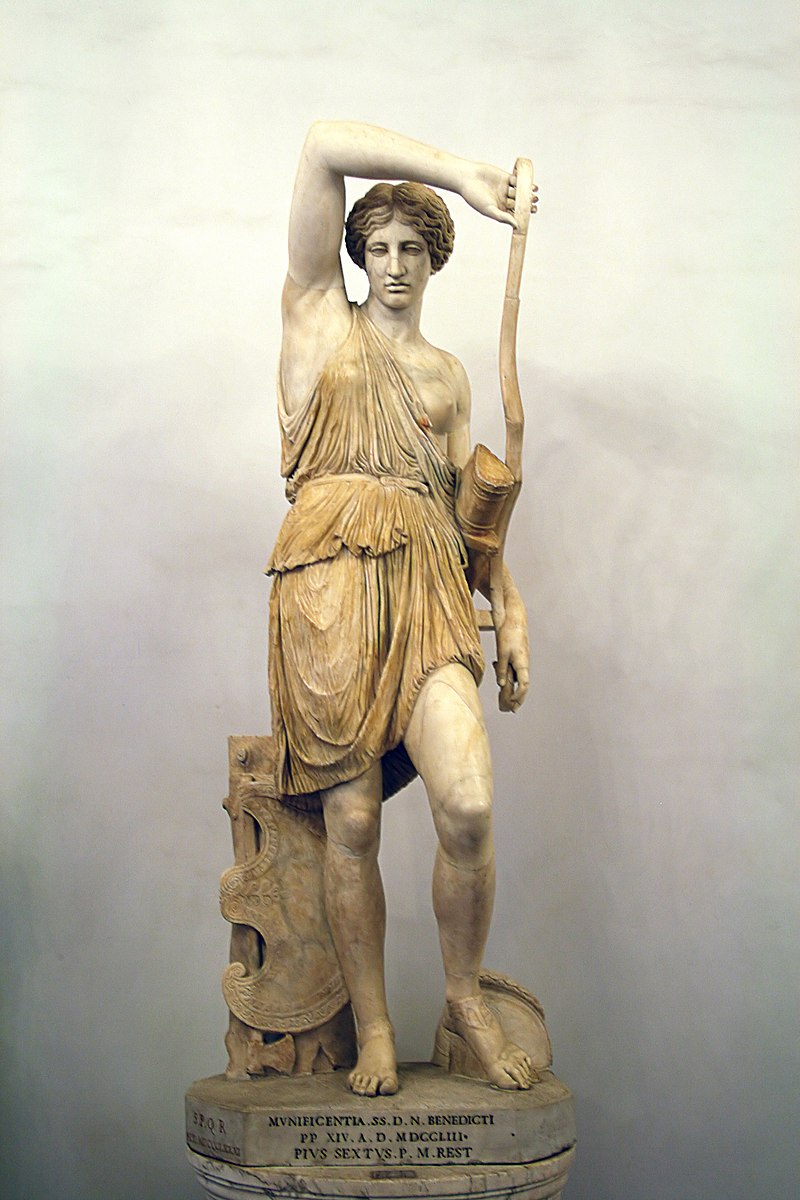
File:Amazzone_ferita_-_Musei_Capitolini.jpg · Wikimedia Commons · See Wikimedia Commons
Amazons
Sign in to saveAlso known as Amazon, Amazones
thumb|Wounded Amazon of the Capitoline Museums, Rome thumb|A Greek fighting an Amazon; detail from painted sarcophagus found in Italy, 350–325 BCE thumb|upright=.8|"Amazon preparing for battle" (Queen Antiope (Amazon)|Antiope or [[Hippolyta) or "Armed Venus", by Pierre-Eugène-Emile Hébert, 1860, National Gallery of Art, Washington, D.C.]] In Greek mythology, the Amazons () were female warriors and hunters, known for their physical agility, strength, archery, riding skills, and the arts of combat. Their society was closed to men and they raised only their daughters, returning their sons to thei
In Greek mythology, the Amazons were a society of female warriors and hunters celebrated for their physical prowess in archery, riding, and combat. These figures appear throughout ancient Greek art and literature as symbols of strength and independence, representing a female-centered society that fascinated and challenged Greek cultural imagination.
AI-generated from the Wikipedia summary — may contain errors.
Wikidata facts
- Gender
- female
- Image
- AmazonBattle.jpg
Show 5 more facts
- described by source
- Pax Leksikon
- Commons category
- Amazons of Greek mythology
- topic's main category
- Category:Amazons (Greek mythology)
- female form of label
- Αμαζόνα
- facet of
- warrior woman
Sources (2)
via Wikidata · CC0
~41 min read
Encyclopedic overview
41 sectionsContents
- Name
- Etymology
- Alternative terms
- Historiography
- Mythology
- Amazons in the Trojan War
- In Scythia
- Amazon homeland
- Heracles myth
- Theseus myth
- Amazons and Dionysus
- Amazons and Alexander the Great
- Roman and ancient Egyptian records
- Amazon queens
- Various authors and chroniclers
- Quintus Smyrnaeus
- Diodorus Siculus
- Justin and Paulus Orosius
- Hyginus
- Valerius Flaccus
- Palaephatus
- Late Antiquity, Middle Ages, and Renaissance literature
- Amazons in art
- Maps
- Archaeology
- Modern legacy
- In literature and media
- Literature and comics
- Film and television
- Games
- Military units
- Social and religious activism
- Science
- See also
- References
- Sources
- Primary
- Secondary
- Further reading
- Other languages
- External links
thumb|Wounded Amazon of the Capitoline Museums, Rome thumb|A Greek fighting an Amazon; detail from painted sarcophagus found in Italy, 350–325 BCE thumb|upright=.8|"Amazon preparing for battle" (Queen Antiope (Amazon)|Antiope or [[Hippolyta) or "Armed Venus", by Pierre-Eugène-Emile Hébert, 1860, National Gallery of Art, Washington, D.C.]] In Greek mythology, the Amazons () were female warriors and hunters, known for their physical agility, strength, archery, riding skills, and the arts of combat. Their society was closed to men and they raised only their daughters, returning their sons to their fathers with whom they would only socialize briefly in order to reproduce. They were portrayed in a number of ancient epic poems and legends, such as the Labours of Heracles, the Argonautica and the Iliad.
Courageous and fiercely independent, the Amazons, commanded by their queen, regularly undertook extensive military expeditions into the far corners of the world, from Scythia to Thrace, Asia Minor, and the Aegean Islands, reaching as far as Arabia and Egypt. Besides military raids, the Amazons are also associated with the foundation of temples and the establishment of numerous ancient cities like Ephesos, Cyme, Smyrna, Sinope, Myrina, Magnesia, Pygela, etc.
Excerpted from Wikipedia’s “Amazons” article, available under the CC BY-SA 4.0 licence.
Gallery (632)
Available in 79 languages
- Español
- Français
- Deutsch
- 中文
- 日本語
- Русский
- Português
- Italiano
- العربية
- हिन्दी
- Afrikaans
- Albanian
- Armenian
- azb
- Azerbaijani
- Bahasa Indonesia
- Bangla
- Bashkir
Show 60 more
- Basque
- Belarusian
- Bikol
- Breton
- Bulgarian
- Burmese
- Catalan
- Chechen
- Chuvash
- Corsican
- Croatian
- Czech
- Danish
- Esperanto
- Estonian
- Filipino
- Finnish
- Galician
- Georgian
- Greek
- Hausa
- Hebrew
- Hungarian
- Ido
- Interlingua
- Kazakh
- Kurdish
- Kyrgyz
- Latin
- Latvian
- Lithuanian
- Macedonian
- Malayalam
- Nederlands
- Norwegian
- Norwegian Nynorsk
- Occitan
- Pashto
- Polski
- Romanian
- Serbian
- Serbian (Latin)
- simple
- skr
- Slovak
- Slovenian
- Svenska
- Tamil
- Tiếng Việt
- Türkçe
- Ukrainian
- Urdu
- Uzbek
- Waray
- Welsh
- Wu Chinese
- Zaza
- zh_min_nan
- فارسی
- 한국어
via Wikidata sitelinks · CC0