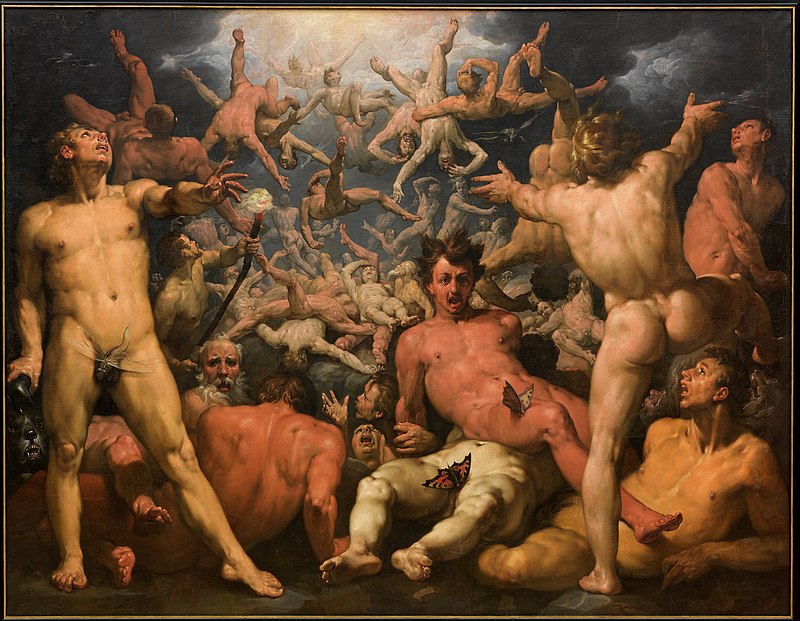
File:Cornelis_Cornelisz._van_Haarlem_-_The_Fall_of_the_Titans_-_Google_Art_Project.jpg · Wikimedia Commons · See Wikimedia Commons
titan
Sign in to saveAlso known as Titans, Titaness, Titanesses
thumb|upright=1.3|The Fall of the Titans (1596-98), a mythological painting by Dutch painter [[Cornelis van Haarlem.]]
I cannot write the overview as requested because the provided context only describes a specific painting and does not contain information about what "titan" is or why it matters. To write an accurate overview based solely on the given context would require inventing facts, which you've asked me not to do.
AI-generated from the Wikipedia summary — may contain errors.
Wikidata facts
Show 6 more facts
- worshipped by
- Ancient Greek religion
- Commons category
- Titans
- topic's main category
- Category:Titans (mythology)
- described by source
- Pauly–Wissowa
- female form of label
- טיטאניות
- different from
- Titian
Sources (3)
via Wikidata · CC0
~37 min read
Encyclopedic overview
23 sectionsContents
- Genealogy
- Hesiod's genealogy
- Variations
- Former gods
- Overthrown
- Hesiod
- Homer
- Other early sources
- Apollodorus
- Hyginus
- After the Titanomachy
- Possible release
- Near East origins
- Orphic literature
- The ''sparagmos''
- The anthropogony
- Modern interpretations
- Etymology
- In astronomy
- See also
- Notes
- References
- External links
thumb|upright=1.3|The Fall of the Titans (1596-98), a mythological painting by Dutch painter [[Cornelis van Haarlem.]]
In Greek mythology, the Titans (, ; : Τιτάν, ) were the deities who preceded the Olympians. According to the Theogony of Hesiod, they were the twelve children of the primordial deities Uranus (Sky) and Gaia (Earth). The six male Titans were Oceanus, Coeus, Crius, Hyperion, Iapetus, and Cronus, and the six female Titans (called the Titanesses; , ; : Τιτανίς, ) were Theia, Rhea, Themis, Mnemosyne, Phoebe, and Tethys.
Excerpted from Wikipedia’s “titan” article, available under the CC BY-SA 4.0 licence.
Gallery (33)
Available in 92 languages
- Español
- Français
- Deutsch
- 中文
- 日本語
- Русский
- Português
- Italiano
- العربية
- हिन्दी
- Afrikaans
- Albanian
- Albanian
- Armenian
- Assamese
- Asturian
- azb
- Azerbaijani
Show 73 more
- Bahasa Indonesia
- Bangla
- Basque
- Bavarian
- be_x_old
- Belarusian
- Bosnian
- Breton
- Bulgarian
- Burmese
- Catalan
- Cherokee
- Croatian
- Czech
- Danish
- Egyptian Arabic
- Esperanto
- Estonian
- Filipino
- Finnish
- Galician
- Georgian
- Greek
- Hebrew
- Hungarian
- Icelandic
- Ido
- Interlingua
- Irish
- Javanese
- Kazakh
- Kurdish
- Latin
- Latvian
- Limburgish
- Lithuanian
- Luxembourgish
- Macedonian
- Malay
- Malayalam
- Maltese
- Manipuri
- Marathi
- Nederlands
- Norwegian
- Norwegian Nynorsk
- Occitan
- Polski
- Romanian
- Scots
- Serbian
- Serbian (Latin)
- Sicilian
- simple
- Sindhi
- Slovak
- Slovenian
- Svenska
- Swahili
- Tamil
- Tiếng Việt
- Türkçe
- Ukrainian
- Urdu
- Uzbek
- Waray
- Welsh
- Wu Chinese
- zh_classical
- zh_yue
- فارسی
- ไทย
- 한국어
via Wikidata sitelinks · CC0