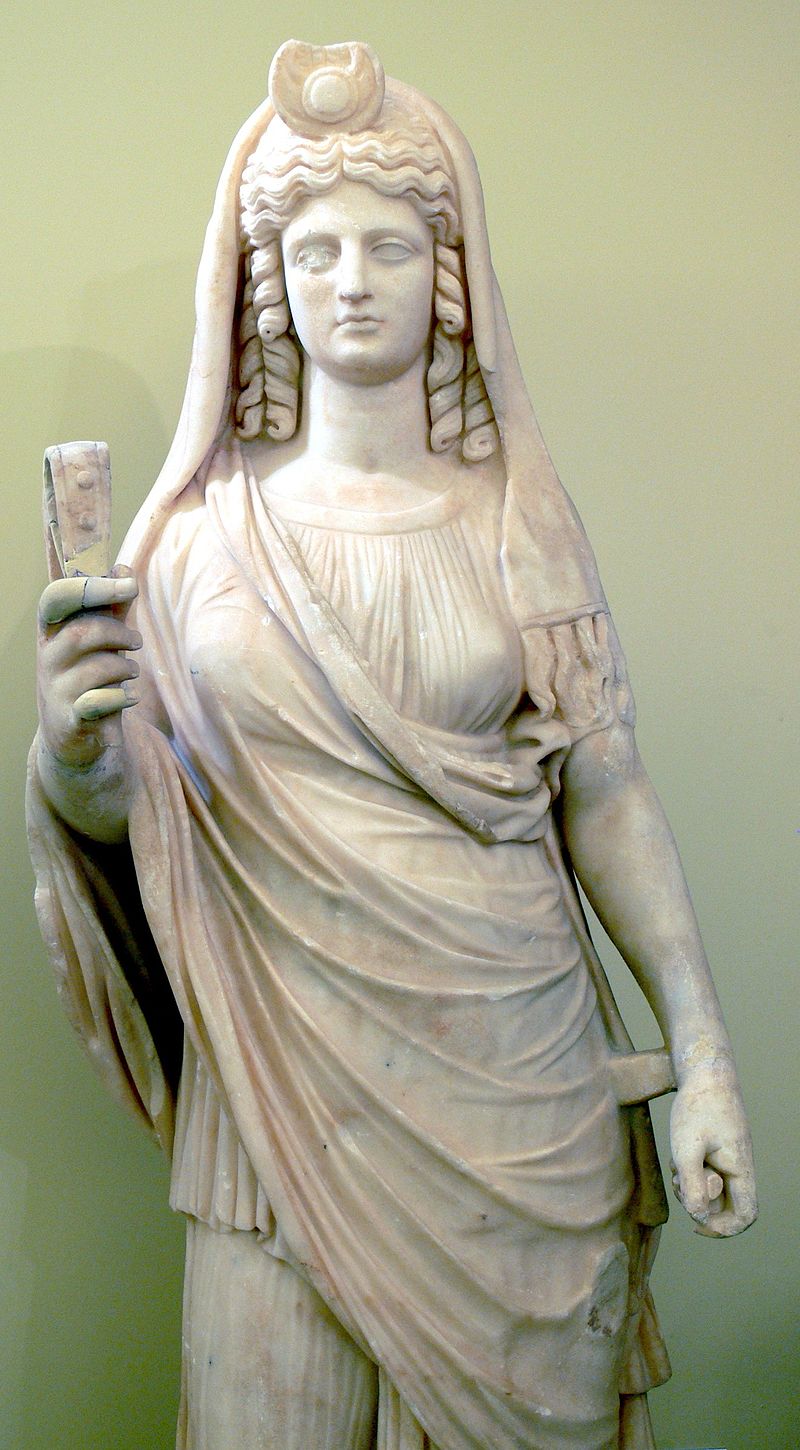
File:AMI_-_Isis-Persephone.jpg · Wikimedia Commons · See Wikimedia Commons
Persephone
Sign in to saveAlso known as Kore
In ancient Greek mythology and religion, Persephone ( ; , classical pronunciation: ), also called Kore () or Cora, is the daughter of Zeus and Demeter. She became the queen of the underworld after her abduction by her uncle Hades, the king of the underworld, who later took her into marriage. The myth of her abduction, her sojourn in the underworld, and her cyclical return to the surface represents her functions as the embodiment of spring and the personification of vegetation, especially grain crops, which disappear into the earth when sown, remain hidden for a period, sprout from the earth, a
Persephone is a figure from ancient Greek mythology, the daughter of Zeus and Demeter who became queen of the underworld after being abducted and married by her uncle Hades. Her myth—involving her abduction, time in the underworld, and cyclical return to the surface—was central to ancient Greek religion because it represented the seasonal cycle of vegetation and grain crops disappearing and reappearing from the earth.
AI-generated from the Wikipedia summary — may contain errors.
Key facts
- Deity.type
- Greek
- Deity.name
- Persephone
- Deity.image
- AMI - Isis-Persephone.jpg
- Deity.caption
- Statue of syncretic Persephone-Isis with a sistrum. Heraklion Archaeological Museum, Crete
- Deity.abode
- The underworld
- Deity.symbol
- Pomegranate, seeds of grain, flaming torch and Flail
- Deity.parents
- Zeus and Demeter
- Deity.spouse
- Hades
- Deity.children
- Zagreus, Melinoë
- Deity.Roman_equivalent
- Proserpina
via Wikipedia infobox
Wikidata facts
- Gender
- female
- Spouse
- Hades
- Child
- Zagreus
- Father
- Zeus
- Mother
- Styx
- Sibling
- Despoina
- Image
- Rape of Prosepina September 2015-3a.jpg
- Work location
- Ancient Greece
- Said to be same as
- Libera
Show 7 more facts
- topic's main category
- Category:Persephone
- Commons category
- Persephone
- worshipped by
- Greek mythology
- unmarried partner
- Zeus
- described by source
- Pauly–Wissowa
- present in work
- Hades
- name in native language
- Περσεφόνη
Sources (6)
via Wikidata · CC0
~49 min read
Encyclopedic overview
28 sectionsContents
- Name
- Titles and functions
- Goddess of spring and nature
- Queen of the underworld
- Nestis
- Epithets
- Mythology
- Variations
- Interpretation of the myth
- Adonis
- Wrath myths
- Favour myths
- Worship
- Origins
- In the Near East and Minoan Crete
- In Mycenaean Greece
- Secret rituals and festivals
- In Rome
- In Magna Graecia
- In Orphism
- Other local cults
- Modern reception
- Jungian interpretation
- See also
- Notes
- References
- Bibliography
- External links
In ancient Greek mythology and religion, Persephone ( ; , classical pronunciation: ), also called Kore () or Cora, is the daughter of Zeus and Demeter. She became the queen of the underworld after her abduction by her uncle Hades, the king of the underworld, who later took her into marriage. The myth of her abduction, her sojourn in the underworld, and her cyclical return to the surface represents her functions as the embodiment of spring and the personification of vegetation, especially grain crops, which disappear into the earth when sown, remain hidden for a period, sprout from the earth, and are harvested when fully grown.
In Classical Greek art, Persephone is invariably portrayed robed, often carrying a sheaf of grain. She may appear as a mystical divinity with a sceptre and a little box, but she was mostly represented in the process of being carried off by Hades.
Excerpted from Wikipedia’s “Persephone” article, available under the CC BY-SA 4.0 licence.
Gallery (52)
Available in 83 languages
- Español
- Français
- Deutsch
- 中文
- 日本語
- Русский
- Português
- Italiano
- العربية
- हिन्दी
- Afrikaans
- Armenian
- Assamese
- Azerbaijani
- Bahasa Indonesia
- Bangla
- Bashkir
- Basque
Show 64 more
- Bavarian
- be_x_old
- Belarusian
- Bosnian
- Breton
- Bulgarian
- Burmese
- Catalan
- Chuvash
- Corsican
- Croatian
- Czech
- Danish
- Egyptian Arabic
- Esperanto
- Estonian
- Filipino
- Finnish
- Galician
- Georgian
- Greek
- Hebrew
- Hungarian
- Ido
- Irish
- Javanese
- Kazakh
- Kurdish
- Latin
- Latvian
- Lithuanian
- Luxembourgish
- Macedonian
- Malay
- Malayalam
- Manipuri
- Marathi
- Nederlands
- Norwegian
- Norwegian Nynorsk
- Occitan
- Pashto
- Polski
- Romanian
- Sardinian
- Scots
- Serbian
- Serbian (Latin)
- simple
- Slovak
- Slovenian
- Svenska
- Tatar
- Tiếng Việt
- Türkçe
- Ukrainian
- Waray
- Welsh
- Wu Chinese
- zh_min_nan
- zh_yue
- فارسی
- ไทย
- 한국어
via Wikidata sitelinks · CC0