(c) Connor E. J. Graham, some rights reserved (CC BY-NC), uploaded by Connor E. J. Graham · cc-by-nc
Anabaena
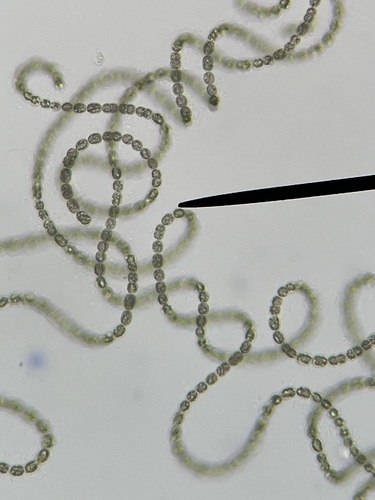
Sign in to saveAnabaena is a genus of filamentous cyanobacteria that exist as plankton. They are known for nitrogen-fixing abilities, and they form symbiotic relationships with certain plants, such as the mosquito fern. They are one of four genera of cyanobacteria that produce neurotoxins, which are harmful to local wildlife, as well as farm animals and pets. Production of these neurotoxins is assumed to be an input into its symbiotic relationships, protecting the plant from grazing pressure.
Species
Genus
- PhylumCyanobacteria
- ClassCyanophyceae
- OrderNostocales
- FamilyAphanizomenonaceae
魚腥藻屬是藍菌的一個屬,與念珠藻類似,細胞呈現鏈珠狀,生長於淺水和潮濕的土壤,它可以單生或群體的的方式存在。魚腥藻屬在水中可能會製造毒素,如果水中毒素濃度過高,動物飲用後有致命的危險。 DNA测序项目开展于1999年,测序鱼腥藻的全基因组,长度为720万个碱基对。该研究主要集中在异形细胞(英语:Heterocyst),其中氮转变成氨。鱼腥藻的某些种类已被用在水稻稻田,证明是一种有效的天然肥料。
via
Museum specimens
- Specimen records
- 533
- With media
- 285
- Family
- Nostocaceae
- Collections
- INECOL, FC-UNAM, NY, US, UHM
- Recorded in
- Mexico, United States, Namibia, Puerto Rico, Czechia, Congo, The Democratic Republic Of The, Germany, Australia
Research
3,953 papers- Distinct cell division features in Anabaena, a multicellular cyanobacterium.Journal of bacteriology · 2025
- Heterocyst development in Anabaena.Current opinion in microbiology · 2003
- Heterocyst formation in Anabaena.Current opinion in microbiology · 1998
- Classification and phylogeny of the cyanobiont Anabaena azollae Strasburger: an answered question?International journal of systematic and evolutionary microbiology · 2014
- Roles of DevBCA-like ABC transporters in the physiology of Anabaena sp. PCC 7120.International journal of medical microbiology : IJMM · 2019
via PubMed
Wikidata facts
- Instance of
- taxon
- Parent taxon
- Nostocaceae
- Image
- Anabaenaflosaquae EPA.jpg
Show 6 more facts
- taxon common name
- アナベナ
- taxon name
- Anabaena
- Commons category
- Anabaena
- taxon rank
- genus
- Gram staining
- gram-negative bacteria
via Wikidata · CC0
~11 min read
Encyclopedic overview
8 sectionsContents
- Species
- Recent changes
- Nitrogen fixation by ''Anabaena''
- Primitive vision pigments studied in ''Anabaena''
- DNA repair
- References
- Further reading
- External links
Anabaena is a genus of filamentous cyanobacteria that exist as plankton. They are known for nitrogen-fixing abilities, and they form symbiotic relationships with certain plants, such as the mosquito fern. They are one of four genera of cyanobacteria that produce neurotoxins, which are harmful to local wildlife, as well as farm animals and pets. Production of these neurotoxins is assumed to be an input into its symbiotic relationships, protecting the plant from grazing pressure.
A DNA sequencing project was undertaken by the United States Department of Energy between 1999 and 2005. This project mapped the complete genome of model organism Anabaena variabilis ATCC 29413, which is 7.2 million base pairs long. A paper detailing the process was published in 2014. The study focused on heterocysts, which convert nitrogen into ammonia. Certain species of Anabaena have been used on rice paddy fields, proving to be an effective natural fertilizer.
Excerpted from Wikipedia’s “Anabaena” article, available under the CC BY-SA 4.0 licence.