Niu, Ze-Qing;Yuan, Feng;Ascher, John S.;Kasparek, Max;Orr, Michael C.;Griswold, Terry;Zhu, Chao-Dong
Anthidium
Sign in to saveAnthidium is a genus of bees often called carder or potter bees, who do not cut leaves, but use conifer resin, plant hairs, mud, or a mix of them to build nests. Like other members of the family Megachilidae (most of which are called "leafcutter bees"), they are solitary bees with pollen-carrying scopa that are only located on the ventral surface of the abdomen (other bee families have pollen-carrying structures on the hind legs). The ~80 species are distributed primarily in the Northern Hemisphere, and South America.
Species
GENUS
- KingdomAnimalia
- PhylumArthropoda
- ClassInsecta
- OrderHymenoptera
- FamilyMegachilidae
via GBIF
Museum specimens
- Specimen records
- 812
- With media
- 155
- Family
- Megachilidae
- Collections
- MHNCA, MZFC-FC-UNAM, IFIT-CP, FCB-UANL, SDNHM, UMNH
- Recorded in
- Mexico, United States
Wikidata facts
- Instance of
- taxon
- Parent taxon
- Megachilidae
- Image
- Anthidium February 2008-1.jpg
Show 7 more facts
- Commons category
- Anthidium
- topic's main category
- Category:Anthidium
- taxon name
- Anthidium
- taxon rank
- genus
- taxon common name
- ullbier
- taxon range
- Lebanon
- external data available at URL
- www.gbif.org/dataset/24d2416a-fe04-45f4-83cd-1db20eff33ad
Sources (3)
via Wikidata · CC0
~6 min read
Encyclopedic overview
6 sectionsContents
- Description
- Extant species (selected)
- Fossil species
- Notes
- References
- External links
Anthidium is a genus of bees often called carder or potter bees, who do not cut leaves, but use conifer resin, plant hairs, mud, or a mix of them to build nests. Like other members of the family Megachilidae (most of which are called "leafcutter bees"), they are solitary bees with pollen-carrying scopa that are only located on the ventral surface of the abdomen (other bee families have pollen-carrying structures on the hind legs). The ~80 species are distributed primarily in the Northern Hemisphere, and South America.
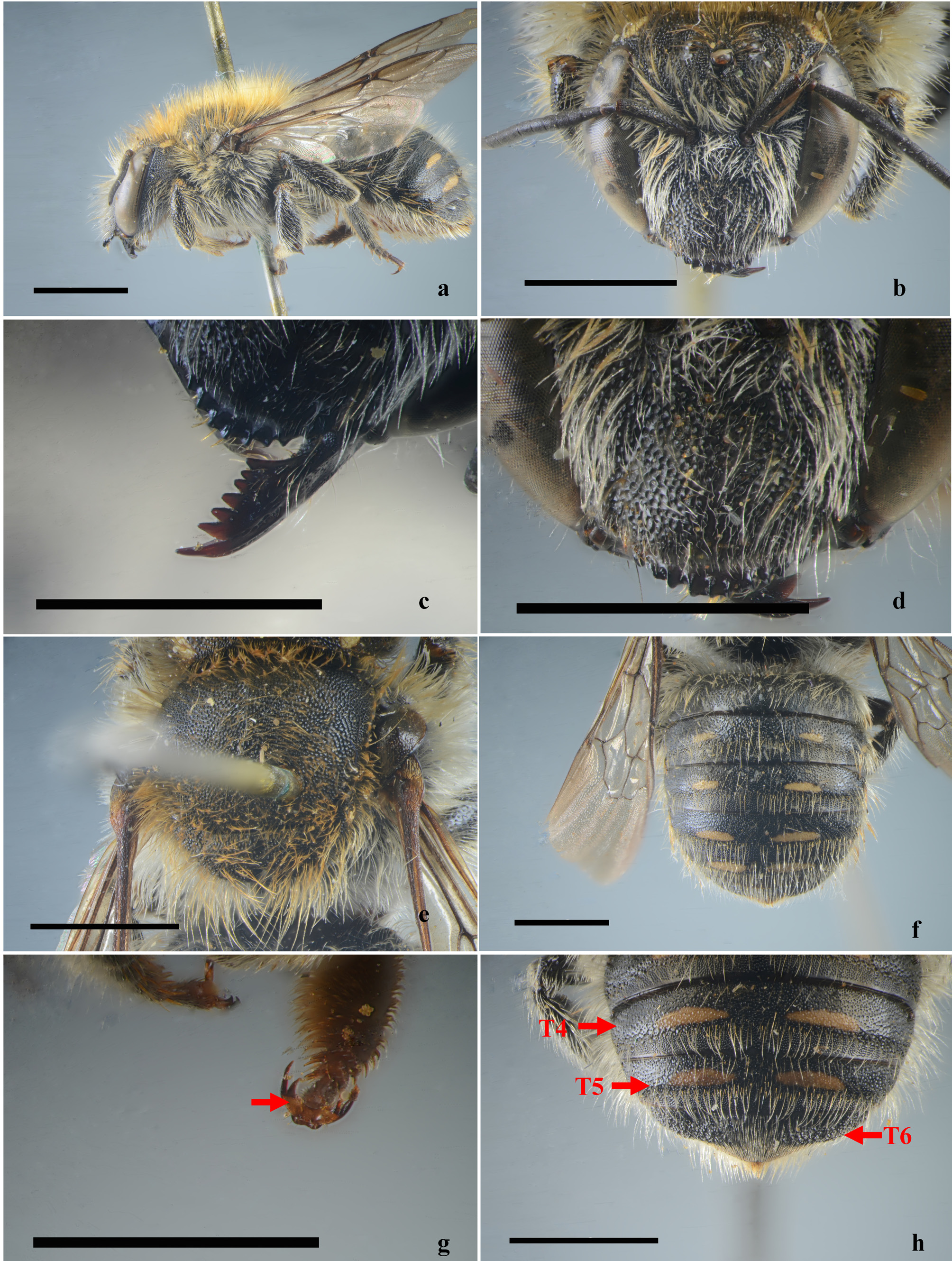
==Description== Most Anthidium species have cream to yellow abdominal bands, typically interrupted in the middle. There is no lobe (arolium) between their claws. Anthidium manicatum, commonly known as the wool carder bee, uses comblike mandibles to "comb" plant fibers into its brood cell walls. It has spread from Europe to North and South America. The males are much larger (ca. 18 mm) than the females (ca.12 mm) which is not uncommon among Megachilidae, but very rare among other bee families. Anthidium manicatum males also have three "thorns" at their abdominal apex which they use as weapons when defending their territory. Anthidium florentinum is one of the more common European species; this species flies all summer and makes nests in holes in the ground, walls or trees, with hairs plucked from plants.
Excerpted from Wikipedia’s “Anthidium” article, available under the CC BY-SA 4.0 licence.
Gallery (2)
Available in 17 languages
- Español
- Français
- Deutsch
- Русский
- Italiano
- العربية
- Azerbaijani
- Cebuano
- Egyptian Arabic
- Nederlands
- Polski
- Svenska
- Tiếng Việt
- Türkçe
- Waray
- فارسی
via Wikidata sitelinks · CC0