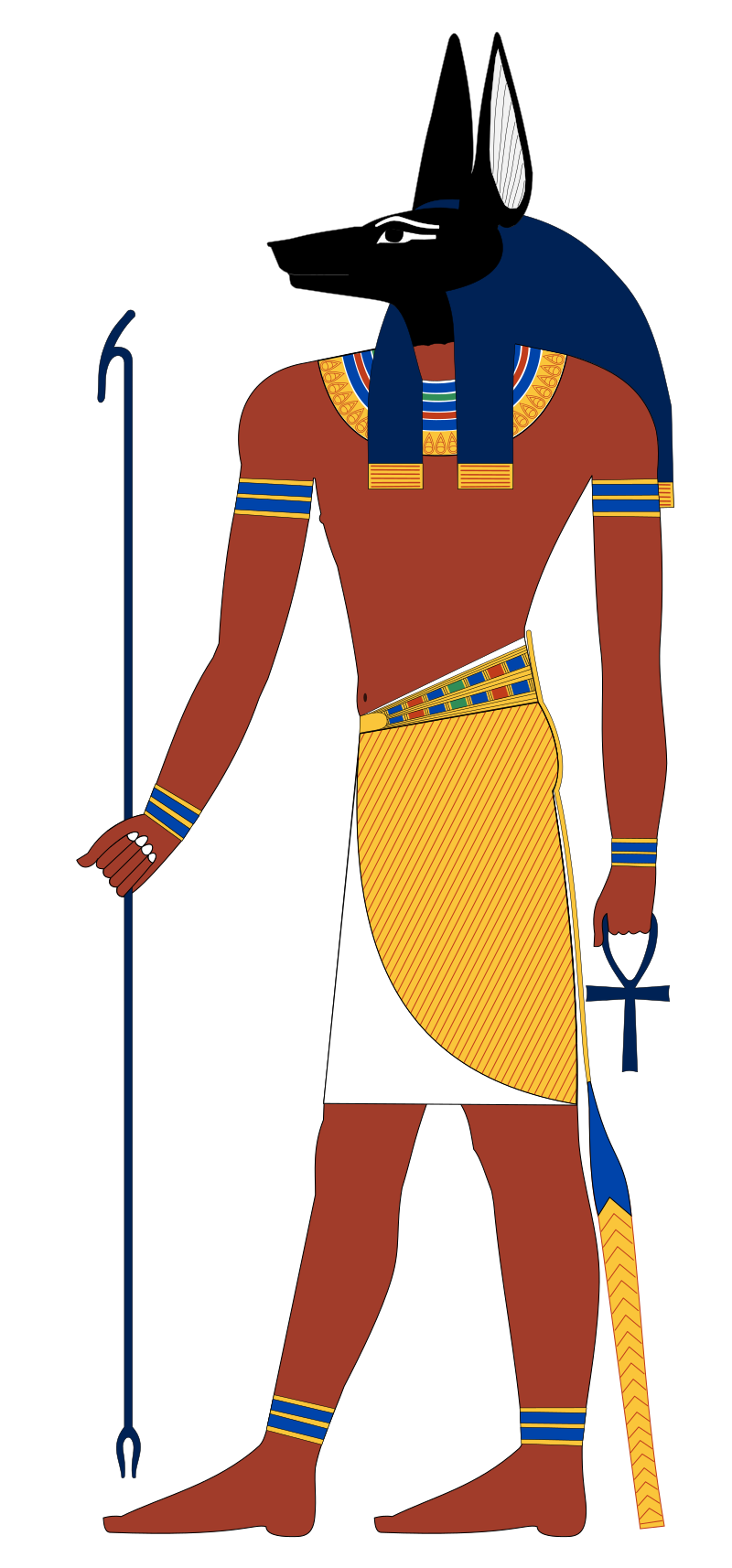
File:Anubis_standing.svg · Wikimedia Commons · See Wikimedia Commons
Anubis
Sign in to saveAlso known as Inpu, Anpu
Anubis (; ), also known as Inpu, Inpw, Jnpw, or Anpu in Ancient Egyptian (), is the god of funerary rites, protector of graves, and guide to the underworld in ancient Egyptian religion, usually depicted as a canine or a man with a canine head.
Anubis was an ancient Egyptian god associated with death, burials, and the afterlife, typically shown as a jackal-like animal or as a human with a jackal's head. He mattered to ancient Egyptians because they believed he protected tombs, oversaw funeral practices, and guided souls to the underworld.
AI-generated from the Wikipedia summary — may contain errors.
Key facts
- Deity.parents
- Nephthys and Osiris , or Ra , or Set
- Deity.consort
- Anput, Nephthys
- Deity.offspring
- Kebechet
- Deity.siblings
- Bata
- Deity.Greek_equivalent
- Hades or Hermes
- Deity.type
- Egyptian
- Deity.name
- Anubis
- Deity.image
- Anubis standing.svg
- Deity.image_upright
- .7
- Deity.caption
- The Egyptian god Anubis,(a modern rendition inspired by New Kingdom tomb paintings)
- Deity.hiero
- i-n:p-w-E16
- Deity.cult_center
- Lycopolis, Cynopolis
- Deity.symbol
- Mummy gauze, fetish, jackal, flail
via Wikipedia infobox
Wikidata facts
- Instance of
- death deity
- Part of
- Egyptian mythology
- Gender
- male
- Spouse
- Anput
- Child
- Kebehet
- Father
- Osiris
- Mother
- Nephthys
- Image
- Anubis standing.svg
Show 8 more facts
- described by source
- Pauly–Wissowa
- topic's main category
- Category:Anubis
- Commons category
- Anubis
- Commons gallery
- Anubis
- worshipped by
- religion of ancient Egypt
- native label
- 𓇋𓈖𓊪𓁢
- name in hiero markup
- i-n:p-w-C6
- on focus list of Wikimedia project
- Wikipedia:Vital articles/Level/4
Sources (3)
via Wikidata · CC0
~15 min read
Encyclopedic overview
16 sectionsContents
- Name
- History
- Roles
- Embalmer
- Protector of tombs
- Guide of souls
- Weigher of hearts
- Portrayal in art
- Worship
- See also
- References
- Informational notes
- Citations
- Bibliography
- Further reading
- External links
Anubis (; ), also known as Inpu, Inpw, Jnpw, or Anpu in Ancient Egyptian (), is the god of funerary rites, protector of graves, and guide to the underworld in ancient Egyptian religion, usually depicted as a canine or a man with a canine head.
Like many ancient Egyptian deities, Anubis assumed different roles in various contexts. Depicted as a protector of graves as early as the First Dynasty (), Anubis was also an embalmer. By the Middle Kingdom (c. 2055–1650 BC) he was replaced by Osiris in his role as lord of the underworld. One of his prominent roles was as a god who ushered souls into the afterlife. He attended the weighing scale during the "Weighing of the Heart", in which it was determined whether a soul would be allowed to enter the realm of the dead. Anubis is one of the most frequently depicted and mentioned gods in the Egyptian pantheon; however, few major myths involved him.
Excerpted from Wikipedia’s “Anubis” article, available under the CC BY-SA 4.0 licence.
Gallery (167)
Available in 91 languages
- Español
- Français
- Deutsch
- 中文
- 日本語
- Русский
- Português
- Italiano
- العربية
- हिन्दी
- Afrikaans
- Albanian
- Albanian
- Aragonese
- Armenian
- Assamese
- Asturian
- Azerbaijani
Show 72 more
- Bahasa Indonesia
- Bangla
- Basque
- Belarusian
- Bosnian
- Breton
- Bulgarian
- Burmese
- Catalan
- cdo
- Central Kurdish
- Chuvash
- Croatian
- Czech
- Danish
- Egyptian Arabic
- Esperanto
- Estonian
- Filipino
- Finnish
- Galician
- Georgian
- Gorontalo
- Greek
- Hebrew
- Hungarian
- hyw
- Icelandic
- Irish
- Kashmiri
- Kazakh
- Latin
- Latvian
- Lithuanian
- Macedonian
- Malay
- Malayalam
- Manipuri
- Mingrelian
- Mongolian
- nds_nl
- Nederlands
- Norwegian
- Occitan
- Polski
- Romanian
- Serbian
- Serbian (Latin)
- Sicilian
- simple
- Sindhi
- Slovak
- Slovenian
- Somali
- Svenska
- Swahili
- Tajik
- Tamil
- Tatar
- Tibetan
- Tiếng Việt
- Türkçe
- Ukrainian
- Urdu
- Uzbek
- Waray
- Welsh
- Wu Chinese
- zh_yue
- فارسی
- ไทย
- 한국어
via Wikidata sitelinks · CC0