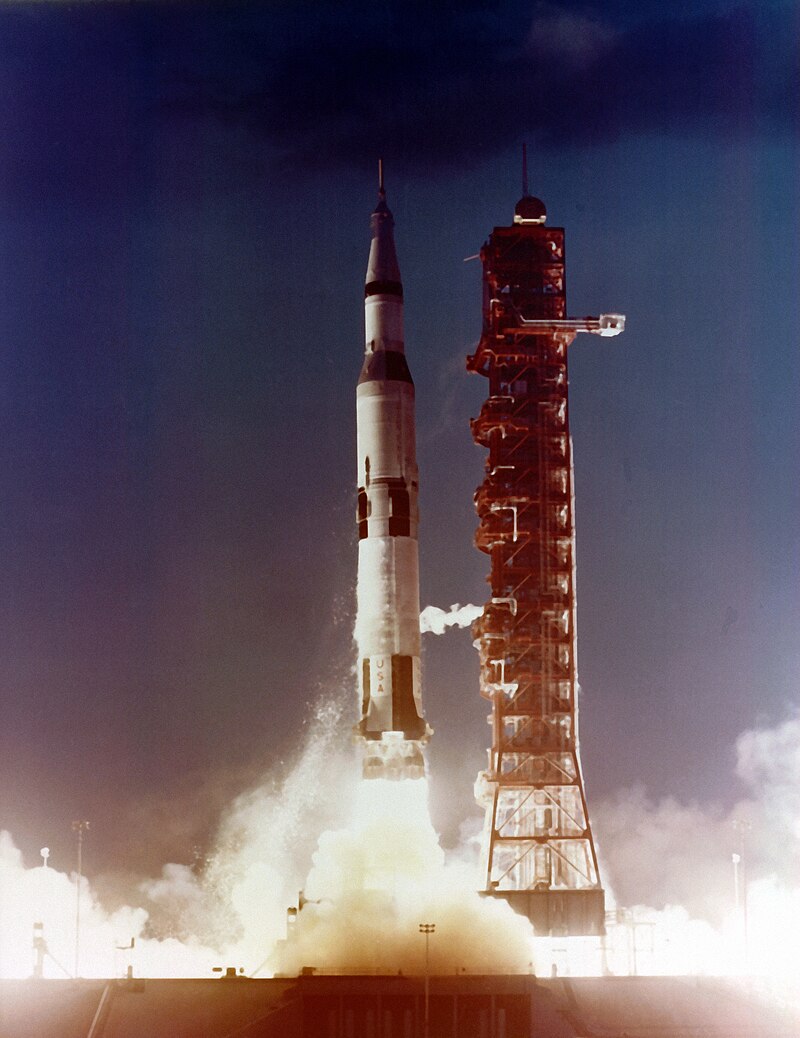
File:Apollo_4_Launch_-_GPN-2000-000044.jpg · Wikimedia Commons · See Wikimedia Commons
Apollo 4
Sign in to saveAlso known as Apollo IV, SA-501
uncrewed test flight of the United States Apollo program
Key facts
- Mission type
- Uncrewed Earth orbital CSM flight ( A )
- Operator
- NASA
- Cospar id
- 1967-113A (command and service modules), 1967-113B (S-IVB)
- Mission duration
- 8 hours, 36 minutes, 59 seconds
- Spacecraft
- Apollo CSM -017, Apollo LTA-10R
- Manufacturer
- North American Rockwell
- Launch mass
- 36,856 kilograms (81,253 lb)
- Launch date
- November 9, 1967, 12:00:01 ( 1967-11-09UTC12:00:01Z ) UTC
- Rocket
- Saturn V SA-501
- Launch site
- Kennedy LC-39 A
- Recovered by
- USS Bennington
- Landing date
- November 9, 1967, 20:37:00 ( 1967-11-09UTC20:38Z ) UTC
- Landing site
- North Pacific Ocean, 30°06′N 172°32′W / 30.100°N 172.533°W / 30.100; -172.533 ( Apollo 4 splashdown )
- Reference system
- Geocentric
- Regime
- Highly elliptical orbit
- Perigee altitude
- −204 kilometers (−110 nmi)
- Apogee altitude
- 18,092 kilometers (9,769 nmi)
- Inclination
- 31.9 degrees
via Wikipedia infobox
Wikidata facts
- Part of
- Apollo program
- Named after
- Apollo
- Country
- United States
- Operator
- NASA
- Followed by
- Apollo 5
- Follows
- Apollo 1
- Duration
- 31019
- Mass
- 36.856
- Orbital period
- 314.58
- Manufacturer
- Grumman
- Image
- Apollo 4 liftoff - GPN-2006-000038.jpg
- Significant event
- splashdown
- Organizer
- NASA
Show 14 more facts
- UTC date of spacecraft landing
- 1967-11-09
- Commons category
- Apollo 4
- UTC date of spacecraft launch
- 1967-11-09
- space launch vehicle
- Saturn V
- Commons gallery
- Apollo 4
- location of landing
- Pacific Ocean
- periapsis
- 204
- type of orbit
- highly elliptical orbit
- apoapsis
- 18092
- orbital inclination
- 31.9
- orbits completed
- 3
- start point
- Kennedy Space Center Launch Complex 39A
- vessel
- Apollo Lunar Module
- recovered by
- USS Bennington
Sources (1)
via Wikidata · CC0
~29 min read
Encyclopedic overview
Apollo 4 (November 9, 1967), also known as SA-501, was the uncrewed first test flight of the Saturn V launch vehicle, the rocket that eventually took astronauts to the Moon. The space vehicle was assembled in the Vehicle Assembly Building, and was the first to be launched from Kennedy Space Center (KSC) in Florida, ascending from Launch Complex 39, where facilities built especially for the Saturn V had been constructed.
Apollo 4 was an "all-up" test, meaning all rocket stages and spacecraft were fully functional on the initial flight, a first for NASA. It was the first time the S-IC first stage and S-II second stage flew. It also demonstrated the S-IVB third stage's first in-flight restart. The mission used a Block I command and service module modified to test several key Block II revisions, including its heat shield at simulated lunar-return velocity and angle.
Excerpted from Wikipedia’s “Apollo 4” article, available under the CC BY-SA 4.0 licence.