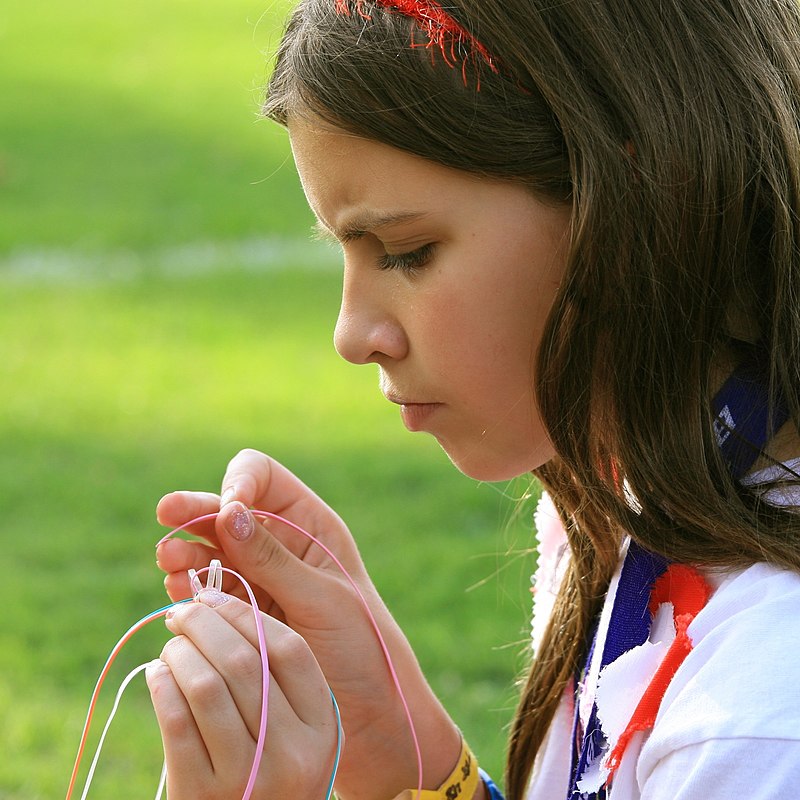
File:Scout_Girl_in_Concentration.jpg · Wikimedia Commons · See Wikimedia Commons
AI overview
Attention is the mental process that allows you to concentrate on specific information or tasks while filtering out distractions around you. It matters because it determines what you consciously notice and remember, directly affecting how well you can learn, work, and interact with the world.
AI-generated from the Wikipedia summary — may contain errors.
Research
780,658 papers- Attention: Multiple types, brain resonances, psychological functions, and conscious states.ReviewJournal of integrative neuroscience · 2021Grossberg SDOI: 10.31083/j.jin.2021.01.406
- Paying attention to attention in depression.ReviewTranslational psychiatry · 2019Keller AS, Leikauf JE, Holt-Gosselin B et al.DOI: 10.1038/s41398-019-0616-1
- Attention in irritable bowel syndrome: A systematic review of affected domains and brain-gut axis interactions.Journal of psychosomatic research · 2025Akbari R, Salimi Y, Dehghani-Aarani F et al.DOI: 10.1016/j.jpsychores.2025.112067
- Manipulation of attention affects subitizing performance: A systematic review and meta-analysis.Neuroscience and biobehavioral reviews · 2022Chen J, Paul JM, Reeve RDOI: 10.1016/j.neubiorev.2022.104753
- Auditory attention--focusing the searchlight on sound.ReviewCurrent opinion in neurobiology · 2007Fritz JB, Elhilali M, David SV et al.DOI: 10.1016/j.conb.2007.07.011
- Attention's Accelerator.Psychological science · 2016Reinhart RM, McClenahan LJ, Woodman GFDOI: 10.1177/0956797616636416
- [The concept of attention].ReviewLa Tunisie medicale · 2009Ben Azouz O, Dellagi L, Kebir O et al.
- Paying attention to consciousness.ReviewProgress in neurobiology · 2003Taylor JGDOI: 10.1016/j.pneurobio.2003.10.002
via PubMed
Wikidata facts
- Subclass of
- cognition
- Has part
- attentional control
- Said to be same as
- Muraqaba
Show 6 more facts
- Commons category
- Attention
- topic's main category
- Category:Attention
- health specialty
- psychiatry
- different from
- meditation
- on focus list of Wikimedia project
- Wikipedia:Vital articles/Level/4
- hashtag
- attention
Sources (3)
via Wikidata · CC0
~30 min read
Encyclopedic overview
36 sectionsContents
- History
- 16th century
- 17th century
- 19th century
- 20th century
- 1910–1949
- 1950–1999
- Components
- Intentionality
- Orienting
- Load
- Neural correlates
- Types
- 1. Focused Attention
- 2. Sustained Attention (Vigilance)
- 3. Selective Attention
- 4. Alternating Attention
- 5. Divided Attention
- Vigilant
- Divided
- Simultaneous
- Social
- Models
- Clinical
- Filter
- Selection
- Spotlight
- Zoom-lens
- Theories
- Attentional engagement
- Feature integration
- Perceptual load
- Cultural variation
- See also
- References
- Further reading
thumb|Focused attention
Attention is the concentration of awareness directed at some phenomenon while mostly excluding others.
Excerpted from Wikipedia’s “attention” article, available under the CC BY-SA 4.0 licence.
Gallery (9)
Available in 66 languages
- Español
- Français
- Deutsch
- 中文
- 日本語
- Русский
- Português
- Italiano
- العربية
- हिन्दी
- Albanian
- Armenian
- Asturian
- Azerbaijani
- Bahasa Indonesia
- Bangla
- Basque
- bat_smg
Show 47 more
- Belarusian
- Bikol
- Bosnian
- Bulgarian
- Catalan
- Chuvash
- Croatian
- Czech
- Danish
- Esperanto
- Estonian
- Finnish
- Galician
- Hebrew
- Hungarian
- Icelandic
- Irish
- Kannada
- Kara-Kalpak
- Kazakh
- Kyrgyz
- Latin
- Latvian
- Macedonian
- Nederlands
- Norwegian
- Pashto
- Polski
- Romanian
- Serbian
- Serbian (Latin)
- simple
- Sindhi
- Slovak
- Svenska
- Tajik
- Tamil
- Telugu
- Tiếng Việt
- Türkçe
- Ukrainian
- Uzbek
- Wu Chinese
- zh_yue
- فارسی
- ไทย
- 한국어
via Wikidata sitelinks · CC0