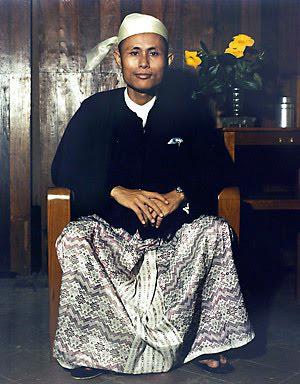
File:Aung_San_color_portrait.jpg · Wikimedia Commons · See Wikimedia Commons
Aung San
Sign in to saveAlso known as General Aung San, Bogyoke Aung San
Burmese revolutionary leader (1915-1947)
Aung San was a Burmese revolutionary leader who lived from 1915 to 1947 and played a key role in Burma's struggle for independence from British colonial rule. He is considered a founding figure of modern Burma, though his legacy remains complex due to controversial aspects of his political career and actions during World War II.
AI-generated from the Wikipedia summary — may contain errors.
Wikidata facts
- Instance of
- human
- Gender
- male
- Citizenship
- Myanmar
- Place of birth
- Natmauk
- Place of death
- Yangon
- Spouse
- Khin Kyi
- Child
- Aung San Suu Kyi
- Occupation
- military personnel
- Position held
- defence minister
- Educated at
- University of Yangon
- Political party
- Anti-Fascist People's Freedom League
- Conflict
- World War II
- Military rank
- major general
- Image
- Aung San color portrait.jpg
Show 7 more facts
- Commons category
- Aung San
- date of birth
- 1915-02-13
- date of death
- 1947-07-19
- manner of death
- homicide
- Commons gallery
- Aung San
- name in native language
- ဗိုလ်ချုပ် အောင်ဆန်း
- place of burial
- Martyrs' Mausoleum
via Wikidata · CC0
~39 min read
Encyclopedic overview
Aung San (Burmese: အောင်ဆန်း, MLCTS: aung hcan:, pronounced [àʊɰ̃ sʰáɰ̃]; 13 February 1915 – 19 July 1947) was a Burmese politician, independence activist and revolutionary. He was instrumental in Myanmar's struggle for independence from British rule, but he was assassinated just six months before his goal was realized. Aung San is considered to be the founder of modern-day Myanmar and the Tatmadaw (the country's armed forces), and is commonly referred to by the titles "Father of the Nation", "Father of Independence", and "Father of the Tatmadaw".
Devoted to ending British Colonial rule in Burma, Aung San founded or was closely associated with many Burmese political groups and movements and explored various schools of political thought throughout his life. He was a life-long anti-imperialist and studied socialism as a student. In his first year of university he was elected to the executive committee of the Rangoon University Students' Union and served as the editor of its newspaper. He joined the Thakin Society in 1938 and served as its general secretary. He also helped establish the Communist Party of Burma in 1939 but quit shortly afterwards due to vehement disagreements with the rest of the party leadership. He subsequently co-founded the People's Revolutionary Party (later the Burma Socialist Party) with the primary goal of Burmese independence from the British.
Excerpted from Wikipedia’s “Aung San” article, available under the CC BY-SA 4.0 licence.