Myanmar
Sign in to saveAlso known as Burma, Republic of the Union of Myanmar, Union of Burma
Myanmar, officially the Republic of the Union of Myanmar and also referred to as Burma (the official English name until 1989), is a country in northwest Southeast Asia. It is the largest country by area in Mainland Southeast Asia and has a population of about 55 million. It is bordered by India and Bangladesh to the northwest, China to the northeast, Laos and Thailand to the east and southeast, and the Andaman Sea and the Bay of Bengal to the south and southwest. The country's capital city is Naypyidaw, while its largest city is Yangon (formerly Rangoon).
OverviewAI-generated
Myanmar, officially the Republic of the Union of Myanmar, is a country located in South-Eastern Asia. Its capital is Naypyidaw, and it covers an area of 676578. The nation is situated in the UTC+06:30 time zone. It shares diplomatic relations with Australia, the Holy See, Israel, and Serbia. The country contains administrative territorial entities including Rakhine State, Chin State, Kachin State, and Shan State.
The population of Myanmar is recorded at various figures, including 53370609, 51316756, and 54500091. The ethnic groups include the Bamar, Shan people, Karen people, and Rakhine. The native labels for the country are ပြည်ထောင်စု သမ္မတ မြန်မာနိုင်ငံတော်, မြန်မာနိုင်ငံ, မြန်မာပြည်, and မြန်မာ. The currency used is the kyat and the Burmese rupee. The legislative body is the Assembly of the Union, and the head of state holds the office of President of Myanmar. The head of government holds the office of Prime Minister of Myanmar, State Administration Council, or State Counsellor of Myanmar.
Synthesized by Vinony from 68 facts across 9 sources: Wikidata, REST Countries, Open Meteo, Openweathermap, World Bank, OpenStreetMap, PubMed, Vinony graph, Geo. Generated from structured data (not the Wikipedia text) and checked against those facts — may still contain errors.
Weather now
7-day forecast
via Open-Meteo
Country
- Capital
- Naypyidaw
- Population
- 51,316,756
- Region
- Asia · South-Eastern Asia
- Demonym
- Burmese
- Currencies
- MMK (Ks)
- Languages
- Burmese
- Calling code
- +95
- Drives on
- Right
- Gini
- 30.7 (2017)
- FIFA code
- MYA
- TLD
- .mm
- Timezones
- UTC+06:30
- Borders
- BGD, CHN, IND, LAO, THA
via REST Countries
Indicators · World Bank
- GDP
- $74.1B(2024)
- Population
- 54,500,091(2024)
- Life expectancy
- 67.1 yrs(2024)
- Unemployment
- 3 %(2025)
- Urban population
- 30.4 %(2024)
- Internet users
- 45.4 %(2020)
- Forest area
- 42.4 %(2023)
- Renewable energy
- 62.9 %(2021)
via World Bank Open Data · CC BY 4.0
Wikipedia views (30d)
223,555 totalvia Wikimedia Pageviews API
Key facts
- Country.conventional_long_name
- Republic of the Union of Myanmar
- Country.common_name
- Myanmar
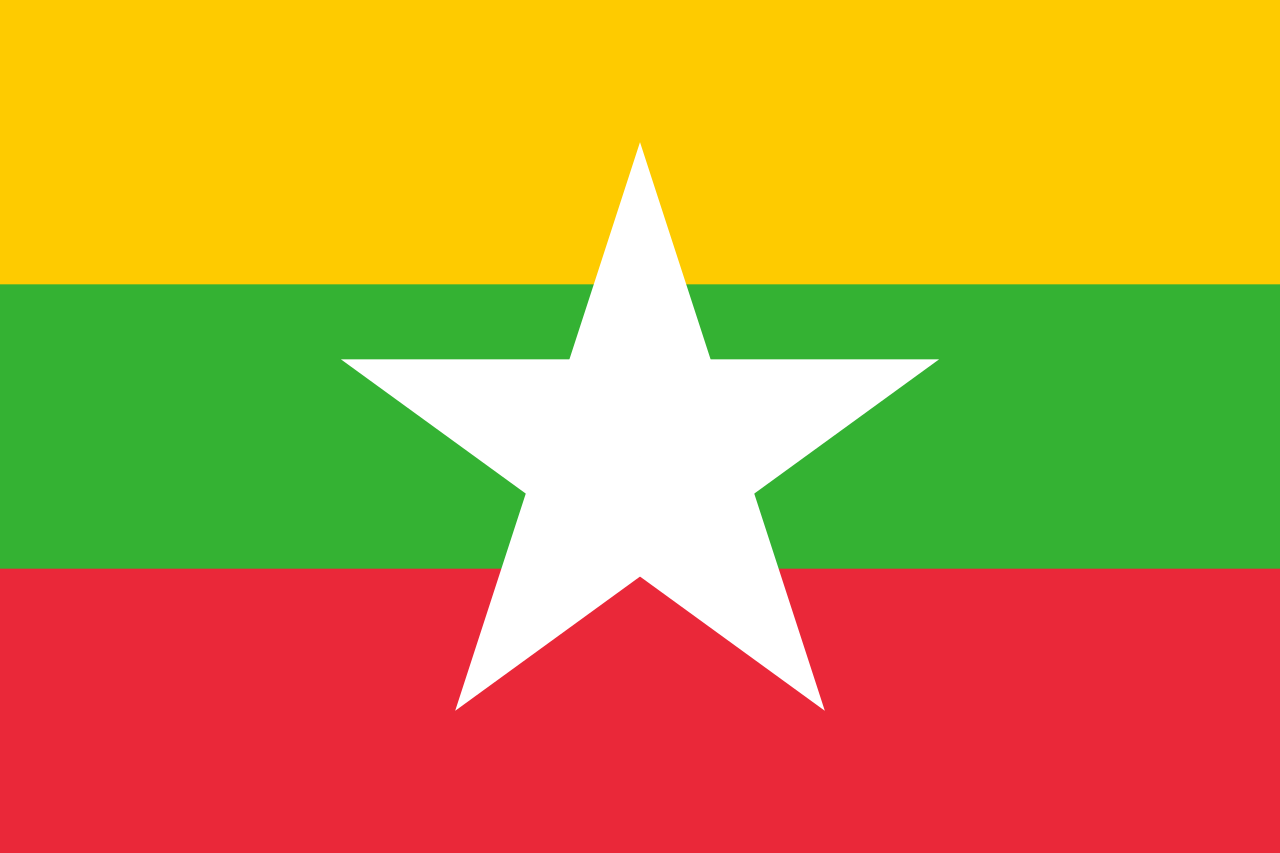
- Country.image_flag
- Flag of Myanmar.svg
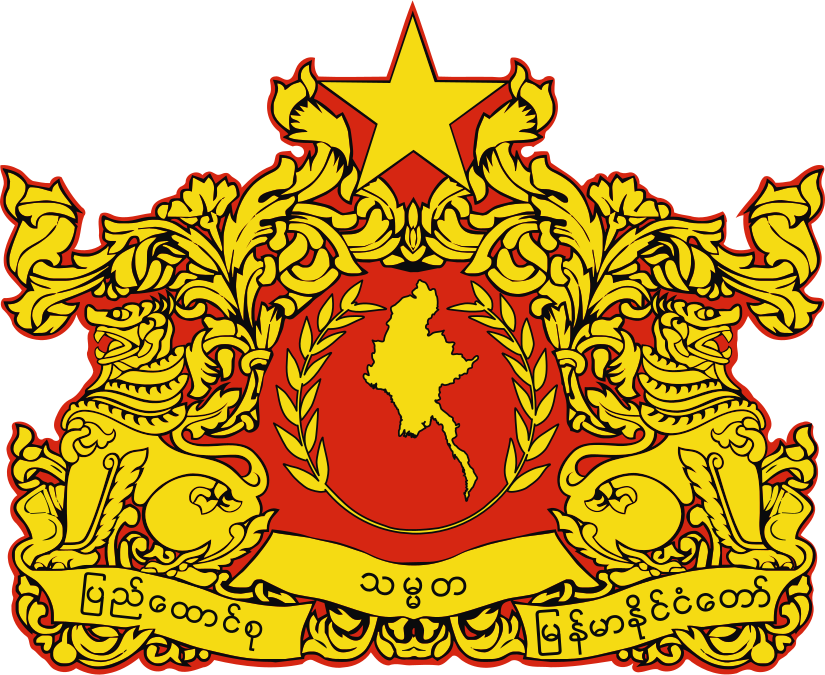
- Country.image_coat
- State Seal of the Republic of the Union of Myanmar.svg
- Country.coa_size
- 100
- Country.symbol_type
- State Seal
- Country.national_anthem
- "Till the End of the World"
- Country.capital
- Naypyidaw
- Country.largest_city
- Yangon
- Country.languages_type
- Official language
- Country.languages
- Burmese
- Country.ethnic_groups_year
- 2019
- Country.religion_year
- 2014
- Country.government_type
- Unitary assembly-independent republic under a military junta
- Country.leader_title1
- President
- Country.leader_name1
- Min Aung Hlaing (acting)
- Country.leader_title2
- SSPC Chairman
- Country.leader_name2
- Min Aung Hlaing
via Wikipedia infobox
Research
8,301 papers- Management of Helicobacter pylori Infection: Myanmar Consensus Report.Helicobacter · 2025Aye TT, Ni N, May TT et al.DOI: 10.1111/hel.70090
- Healthcare in Myanmar.ReviewNagoya journal of medical science · 2016Latt NN, Myat Cho S, Htun NM et al.
- Clinical Severity of β-Thalassemia Pediatric Patients in Myanmar.ReviewHemoglobin · 2022Khaing AA, Myint PP, Paiboonsukwong K et al.DOI: 10.1080/03630269.2022.2025825
- A systematic review of neglected tropical diseases (NTDs) in Myanmar.PLoS neglected tropical diseases · 2023Swe MMM, Phyo AP, Cooper BS et al.DOI: 10.1371/journal.pntd.0011706
- Myanmar's democracy and health on life support.Lancet (London, England) · 2021The LancetDOI: 10.1016/S0140-6736(21)00656-5
- Myanmar's coup d'état and its impact on COVID-19 response: a collapsing healthcare system in a state of turmoil.BMJ military health · 2023Rocha IC, Cedeño TD, Pelayo MG et al.DOI: 10.1136/bmjmilitary-2021-001871
- Myanmar's coup risks a flood of vaccine-preventable disease.Journal of global health · 2022Lwin KS, Ghaznavi C, Win KL et al.DOI: 10.7189/jogh.12.03060
- Smokeless tobacco use in Myanmar.ReviewIndian journal of cancer · 2012Kyaing NN, Sein T, Sein AA et al.DOI: 10.4103/0019-509X.107727
via PubMed
Wikidata facts
- Instance of
- republic
- Official name
- ပြည်ထောင်စုဆိုရှယ်လစ်သမ္မတမြန်မာနိုင်ငံတော်
- Demonym
- مِيَنْمَارِيَّةٌ
- Country
- Myanmar
- Contains
- Wa Self-Administered Division
- Continent
- Asia
- Capital
- Yangon
- Official language
- Burmese
- Currency
- Burmese rupee
- Population
- 53370609
- Area
- 676577.2
- Head of government
- Min Aung Hlaing
- Head of state
- Myint Swe
- Form of government
- republic
- Legislature
- Assembly of the Union
- Anthem
- Kaba Ma Kyei
- Shares border with
- Thailand
- Highest point
- Hkakabo Razi
- Official website
- www.myanmar.gov.mm
- Image
- @HaNgryBam.jpg
- Life expectancy
- 67
- Nominal GDP
- 59364362541
- Unemployment rate
- 3
- Calling code
- +95
Show 67 more facts
- Licence plate code
- BUR
- Electrical plug type
- BS 1363
- Mains voltage
- 230
- Motto
- Gadewch i'r daith ddechrau
- Flag
- flag of Myanmar
- Coat of arms
- State Seal of Myanmar
- topic's main Wikimedia portal
- Portal:Myanmar
- ethnic group
- Mon people
- Unicode character
- 🇲🇲
- category of associated people
- Category:Burmese people
- geography of topic
- Geography of Myanmar
- office held by head of government
- State Administration Council
- public holiday
- Independence Day
- number of out-of-school children
- 4306882
- diplomatic relation
- North Korea
- office held by head of state
- President of Myanmar
- Commons gallery
- မြန်မာပြည်
- inception
- 1948-01-04
- native label
- မြန်မာ
- mobile country code
- 414
- total fertility rate
- 2.05
- maritime identification digits
- 506
- marriageable age
- 20
- topic's main category
- Category:Myanmar
- member of
- World Customs Organization
- railway traffic side
- left
- located in/on physical feature
- Southeast Asia
- category for people who died here
- Category:Deaths in Myanmar
- Commons category
- Myanmar
- top-level Internet domain
- .mm
- category for people born here
- Category:Births in Myanmar
- driving side
- left
- lowest point
- Indian Ocean
- IPA transcription
- ˈbʲirmə
- short name
- ဗမာ
- has seal, badge, or sigil
- State Seal of Myanmar
- central bank
- Central Bank of Myanmar
- category for films shot at this location
- Category:Films shot in Myanmar
- language used
- Sylheti
- described by source
- Granat Encyclopedic Dictionary
- history of topic
- history of Myanmar
- culture
- culture of Myanmar
- BTI Status Index
- 3.2
- BTI Governance Index
- 3.53
- economy of topic
- economy of Burma
- replaces
- British rule in Myanmar
- demographics of topic
- demographics of Myanmar
- Democracy Index
- 1.02
- topic has template
- Template:Administrative divisions of Myanmar
- Human Development Index
- 0.585
- P11012
- promethium
- hashtag
- Myanmar
- on focus list of Wikimedia project
- Wikipedia:Vital articles/Level/4
- Happy Planet Index score
- 40
- Gini coefficient
- 30.7
- Inequality-adjusted Human Development Index
- 0.467
- median income
- 2037600
- female population
- 28430000
- male population
- 26150000
- literacy rate
- 89.1
- P12749
- Giorgio Napolitano
- birth rate
- 17.103
- death rate
- 8.749
- rural population
- 36965999
- urban population
- 17213307
- P8168
- Sibirganovo
- most populous urban area
- Yangon
Sources (15)
via Wikidata · CC0
Travel guide
Get around
Myanmar's infrastructure is in poor shape. Travel to certain regions is prohibited; for others, special permits must be obtained, and a guide/interpreter/minder may be mandatory - although whether these "guides" accompany you to look after you, or to keep you from going to places the government doesn't want you to see, is a question best discussed elsewhere. However, travel between the main tourist sites, namely Mandalay, Bagan, Inle Lake and Yangon, is fairly straightforward.
See
300px|thumb|Leg rowing, Inle Lake Myanmar has not been a popular destination in Southeast Asia as visitors have been largely deterred by the country's volatile politics and restrictions placed on travel. But the political and travel situation has been improving notably since 2015. The country is a true, unspoiled treasure trove, and should capture the imagination of anyone interested in culture and history. Walking around Yangon brings you back to the time of 19th-century British colonial rule. Sparkling-clean parks and temples stand side by side decayed colonial-style buildings and deep potholes. Its cultural and religious attractions, like the Shwedagon Pagoda, add to the city's feel of exoticism, as do the smiles of the locals. Every street corner brings something new—and a short ferry over the river even gives you a glimpse of rural life in the country. Cities of cultural and historical interest close to Yangon are Bago with its Buddhist sights, the delta town of Twante known for its pottery, and the pilgrimage site of Kyaiktiyo with its gold-gilded rock balancing precariously over a cliff.
It's definitely worth it to further explore the Bamar heartland. Unfortunately some outer fringes of the country are off-limits to foreigners, but it's always worth checking the latest situation with people on the ground as things move so fast that the Internet rarely if ever has correct information. thumb|Pyin U Lwin The former city of Bagan is a gem, and gives a glimpse of what life…
Do
thumb|Burmese men playing chinlone Myanmar is an excellent country for trekking. Kalaw is a centre for trekking, and has miles and miles of trails through mountains and hill tribe villages. Kengtung is also known for its hiking paths to hill tribe villages, while Hsipaw has some great treks to waterfalls. Birdwatching can be done around Inle Lake.
Myanmar's national sport is chinlone, played with a small rattan ball. The objective of the game is to keep the ball in the air for as long as possible without using one's arms or hands, and to do it as beautifully as possible.
Spectacular scuba diving and unspoiled beaches abound in the Mergui Archipelago in southeastern Myanmar.
Eat
thumb|Outdoor café in Yangon
Burmese food is influenced by that of India and China, yet unique. Apart from Burmese food, other ethnic traditional foods such as Shan food, Rakhine food, and Myeik food are also distinct. Rice is at the core of Burmese food, and good vegetarian food is widely available. Burmese food is often extremely pungent. Similar to neighbouring Southeast Asian countries, fish sauce (ငံပြာရည် ngan bya yay) is a very popular condiment in Myanmar, and is used to flavour many dishes. Food is inexpensive at most restaurants (priced at 500–3,000 kyat per item at most local restaurants, but can go as high as 8,000 kyat at posh restaurants). There are many up-market restaurants in Yangon and Mandalay.
The majority of low-to-mid-priced restaurants use a cheap blend of palm oil for cooking. This oil may be unhealthy, and common roadside restaurants should be avoided if you are at the slightest risk for hypertension, heart disease, or other fat- or cholesterol-related conditions. Higher class restaurants may use peanut oil instead.
Specific dishes include: thumb|Chapati and mutton curry thumb|Mohinga fish noodle soup, the national dish thumb|Lahpet thoke, fermented tea leaf salad
Curry – Burmese people have a very different definition of curry than other countries. It is very spicy compared to Indian and Thai options, and although you may find it served at room temperature in cheaper restaurants, in a typical Burmese home all curry dishes are served hot. Bu…
Drink
Tap water in Myanmar is not safe to drink, however factory-made ice in restaurants and other shops is OK. Bottled water is readily available. You can also safely drink from the many clay jars dotted around the country, or find safe drinking water in temples. Just look for the large steel tanks with cups tied to the spigots. Water in the clay jars is filtered and many Myanmar people use them. Owners of the jars fill them up with water as a way to make merit.
Similar to Chinese tea, Yenwejan is usually provided free at restaurant tables. While not flavourful, it is boiled water, and so safe to drink (do not drink plain water - even in restaurants - unless it is bottled water). Dried tea leaves similar to Laphet thote's tea leaves (except these are wet) are added to the boiled water to give Yenwejan. Be sure to order it with Laphet thote (customary/good combination). Milk tea (လက်ဖက်ရည် La-Phet-Yay) is also popular in Myanmar and widely available in the local markets and teahouses but beware: the Burmese like their milk teas very, very sweet.
Alcohol is frowned upon by conservative Buddhists, Hindus and Muslims, but consumed widely, mostly among men. Myanmar Beer is the most popular in the country. Other variants, including Mandalay Beer exist. However, many of such companies are government-owned and/or have links to the drug trade. Toddy juice (ta-YEI) is popular in central Myanmar, and is made from fermented palm sugar. An alcoholic drink popular in the Shan State is Shwe le…
Sleep
thumb|Night in Yangon Myanmar has good hotel accommodation, particularly in major cities and the main tourist areas, though prices are substantially higher than in Thailand or Vietnam. Rooms with attached bath are available for under US$10 everywhere except Yangon and with shared bath for anywhere from US$3–6 in most places. Almost every hotel licensed for foreigners has running hot water (though, in remote areas, availability may be restricted to certain hours of the day). Hotels, with a few exceptions, are usually clean. At the budget end, sheets and blankets may be threadbare and the rooms may be poorly ventilated. A few low-end hotels, particularly in Yangon and other large cities, specialize in cubicle rooms, small single rooms with no windows which, while cheap and clean, are not for the claustrophobic. Rates are quoted as single/double, but the rooms are usually the same whether one person or two stay in the room, making good hotels a real bargain if travelling as a couple. Except at the top-end, breakfast is always included in the price of the room.
The tourism boom in Myanmar has left its infrastructure struggling to cope with the increased numbers of visitors. Hotel rooms tend to sell out really fast, and those in popular tourist destinations often sell out months in advance. As a result of the lack of supply, prices have also increased substantially. You should make your hotel bookings well in advance of your planned trip to Myanmar in order not to be stranded whe…
Stay healthy
Hygiene in Myanmar may seem terrible to the average Westerner but it is possible to stay healthy with some basic precautions such as prophylactic medication, care choosing food and water, and antibacterial ointment. Never drink tap water. Restaurants are legally required to use ice made and sold by bottled water companies, so ordering ice is usually safe in major places. Always drink bottled water and check that the cap is sealed on, not simply screwed on. Diseases such as dengue fever, Japanese encephalitis and malaria are endemic. Drug-resistant strains of malaria and tuberculosis are common in many areas. Hepatitis vaccinations are highly recommended and the cholera oral vaccine is worthwhile. At the dinner table, Burmese use a spoon and fork, or their fingers when this is more convenient. You might feel better rinsing all of them before meals. Antibacterial wipes or alcohol hand-rub is a good idea at regular intervals.
As in many developing countries: "if you can't fry, roast, peel or boil it - then forget it".
Respect
thumb|400px|[[Mrauk U, the old capital of Rakhine in Myanmar]]
Modest clothing is highly appreciated everywhere except nightclubs, and practically required in religious places such as pagodas, temples and monasteries (of which there are thousands). Miniskirts, shorts and sleeveless shirts are not allowed in consecrated areas, where you also have to remove your footwear, so loafers and flip-flops that you can slip on and off at the entrance are preferable. Myanmar has some of the most stunning temples in Asia and you will be tempted to visit more than you think. In Myanmar, you have to remove your footwear before entering the entire temple complex, including in outdoor areas. You might want to bring some wet wipes so you can clean your feet after visiting.
Burmese people generally do not engage in public display of affection, even among married couples, and it is generally considered distasteful and should be avoided.
Both men and women wear a longyi, a sort of sarong sold everywhere, and it is not unusual to see Caucasian foreigners walking around in them. They are wrapped in different ways for men and women, so find out how to tie yours. If you turn up at a temple in inappropriate dress, you can always rent a longyi for a pittance.
When giving and receiving business cards, always use your right hand with the palm facing up, and your left hand supporting your right elbow. As the left hand is traditionally reserved for dirty things, handling business cards with it is consi…
Travel guide from Wikivoyage (CC BY-SA 4.0)
~40 min read
Encyclopedic overview
49 sectionsContents
- Etymology
- History
- Prehistory
- Early city-states
- Pagan Kingdom
- Taungoo and Konbaung dynasties
- British Burma (1885–1948)
- Independence (1948–1962)
- Military rule (1962–2011)
- Civil wars
- Period of liberalisation, 2011–2021
- 2015 general elections
- Coup d'état and civil war
- Geography
- Administrative divisions
- Climate
- Biodiversity
- Government and politics
- Political culture
- Foreign relations
- Military
- Human rights and internal conflicts
- Government reforms
- Economy
- Economic history
- Agriculture
- Extractive industries
- Tourism
- Demographics
- Largest cities
- Ethnic groups
- Languages
- Religion
- Health
- Education
- Crime
- Culture
- Cuisine
- Sport
- Art
- Media and communications
- Internet
- Film
- See also
- Notes
- Pronunciations of ''Myanmar''
- References
- Bibliography
- External links
Myanmar, officially the Republic of the Union of Myanmar and also referred to as Burma (the official English name until 1989), is a country in northwest Southeast Asia. It is the largest country by area in Mainland Southeast Asia and has a population of about 55 million. It is bordered by India and Bangladesh to the northwest, China to the northeast, Laos and Thailand to the east and southeast, and the Andaman Sea and the Bay of Bengal to the south and southwest. The country's capital city is Naypyidaw, while its largest city is Yangon (formerly Rangoon).
Early civilisations in the area included the Tibeto-Burman-speaking Pyu city-states in Upper Myanmar and the Mon kingdoms in Lower Myanmar. In the 9th century, the Bamar people entered the upper Irrawaddy valley, and following the establishment of the Pagan Kingdom in the 1050s, the Burmese language and culture and Theravada Buddhism slowly became dominant in the country. The Pagan Kingdom fell to Mongol invasions, and several warring states emerged. In the 16th century, reunified by the Taungoo dynasty, the country became the largest empire in the history of Southeast Asia for a short period. The early 19th-century Konbaung dynasty ruled over an area that included modern Myanmar and briefly controlled Assam, the Lushai Hills, and Manipur as well. The British East India Company seized control of the administration of Myanmar after three Anglo-Burmese Wars in the 19th century, and the country became a British colony. After a brief Japanese occupation, Myanmar was reconquered by the Allies. In 1948, Myanmar declared independence under the terms of the Burma Independence Act 1947.
Excerpted from Wikipedia’s “Myanmar” article, available under the CC BY-SA 4.0 licence.
Gallery (59)
On the map
6 mapped locations
Available in 258 languages
- Español
- Français
- Deutsch
- 中文
- 日本語
- Русский
- Português
- Italiano
- العربية
- हिन्दी
- Abkhazian
- Achinese
- Adyghe
- Afrikaans
- Albanian
- Albanian
- Amharic
- ami
Show 239 more
- Angika
- Aragonese
- Armenian
- Arpitan
- Assamese
- Asturian
- Awadhi
- Aymara
- azb
- Azerbaijani
- Bahasa Indonesia
- Balinese
- Bangla
- Bashkir
- Basque
- bat_smg
- Bavarian
- be_x_old
- Belarusian
- Betawi
- Bhojpuri
- Bikol
- Bishnupriya
- Bislama
- blk
- Bosnian
- Breton
- Buginese
- Bulgarian
- Buriat
- Burmese
- Catalan
- cbk_zam
- cdo
- Cebuano
- Central Dusun
- Central Kurdish
- Chechen
- Chuvash
- Cornish
- Corsican
- Crimean Tatar
- Croatian
- Czech
- dag
- Danish
- Divehi
- dty
- Dzongkha
- Egyptian Arabic
- Esperanto
- Estonian
- Ewe
- Extremaduran
- Faroese
- Fiji Hindi
- Filipino
- Finnish
- fiu_vro
- Fula
- Gagauz
- Galician
- Gan Chinese
- gcr
- Georgian
- Gilaki
- Goan Konkani
- Greek
- Guarani
- Gujarati
- Haitian Creole
- Hakka Chinese
- Hausa
- Hawaiian
- Hebrew
- Hungarian
- hyw
- Iban
- Icelandic
- Ido
- Iloko
- Inari Sami
- Interlingua
- Interlingue
- Inupiaq
- Irish
- Jamaican Creole English
- Javanese
- Kabardian
- Kabyle
- Kannada
- Kanuri
- Kara-Kalpak
- Karachay-Balkar
- Kashmiri
- Kashubian
- Kazakh
- kbp
- kge
- Khmer
- Kikuyu
- Kinyarwanda
- Komi
- Kongo
- Kurdish
- Kyrgyz
- Ladino
- Lao
- Latin
- Latvian
- Ligurian
- Limburgish
- Lingala
- Lingua Franca Nova
- Lithuanian
- lld
- Lombard
- Low German
- Lower Sorbian
- Luxembourgish
- Macedonian
- Madurese
- Maithili
- Malagasy
- Malay
- Malayalam
- Maltese
- Manipuri
- Manx
- Māori
- map_bms
- Marathi
- Mazanderani
- Minangkabau
- Mingrelian
- mnw
- Moksha
- Mongolian
- Moroccan Arabic
- Navajo
- nds_nl
- Neapolitan
- Nederlands
- Nepali
- Newari
- Nias
- Northern Frisian
- Northern Sami
- Norwegian
- Norwegian Nynorsk
- Novial
- nrm
- nup
- Occitan
- Odia
- Old English
- olo
- Oromo
- Ossetic
- Pampanga
- Papiamento
- Pashto
- Picard
- Piedmontese
- Polski
- Punjabi
- Quechua
- Romanian
- Rundi
- Rusyn
- Sanskrit
- Santali
- Sardinian
- Scots
- Scottish Gaelic
- Serbian
- Serbian (Latin)
- Shan
- Shona
- Sicilian
- Silesian
- simple
- Sindhi
- Sinhala
- Slovak
- Slovenian
- Somali
- Standard Moroccan Tamazight
- Sundanese
- Svenska
- Swahili
- Swati
- szy
- Tajik
- Talysh
- Tamil
- Taroko
- Tatar
- tay
- tdd
- Telugu
- Tetum
- Tibetan
- Tiếng Việt
- Tok Pisin
- Toki Pona
- Tongan
- Tulu
- Tumbuka
- Türkçe
- Turkmen
- Udmurt
- Ukrainian
- Upper Sorbian
- Urdu
- Uyghur
- Uzbek
- Venetian
- Veps
- Volapük
- Waray
- Welsh
- West Flemish
- Western Frisian
- Western Panjabi
- Wolof
- Wu Chinese
- Yakut
- Yiddish
- Yoruba
- Zaza
- Zeelandic
- zh_classical
- zh_min_nan
- zh_yue
- Zhuang
- فارسی
- ไทย
- 한국어
via Wikidata sitelinks · CC0