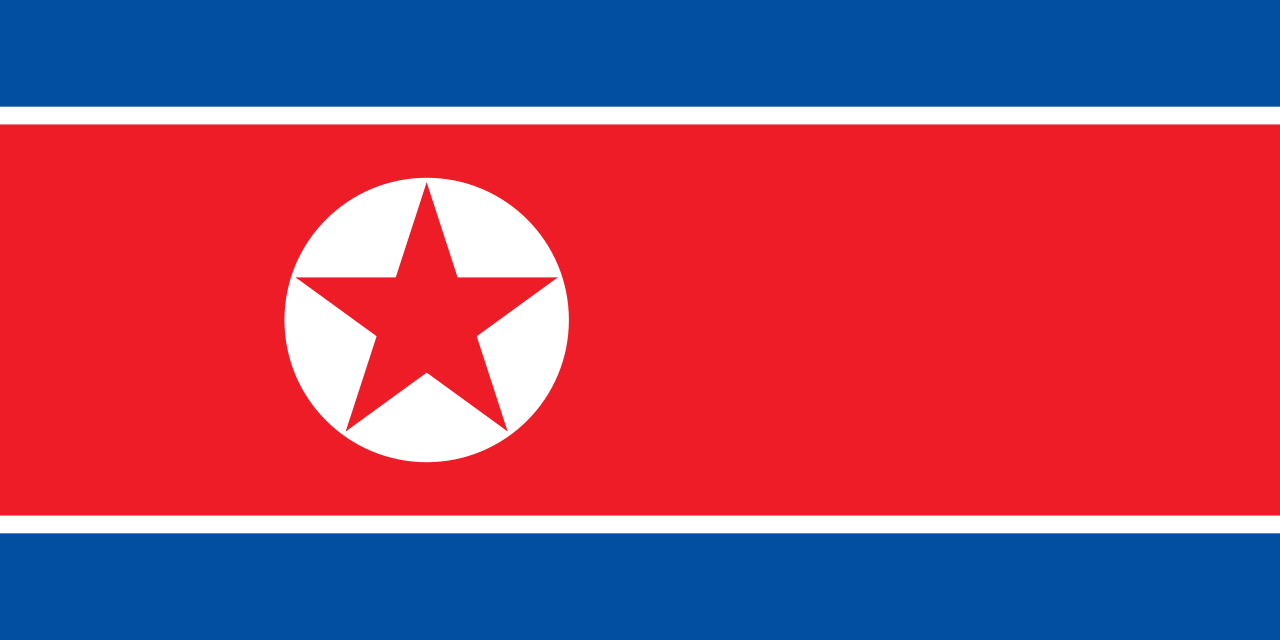
North Korea
Sign in to saveAlso known as PRK, kp, Democratic People's Republic of Korea, DPRK, N. Korea, DPR Korea
North Korea, officially the Democratic People's Republic of Korea (DPRK), is a country in East Asia. It constitutes the northern half of the Korean Peninsula and borders China and Russia to the north at the Yalu (Amnok) and Tumen rivers, and South Korea to the south at the Korean Demilitarized Zone (DMZ). The country's western border is formed by the Yellow Sea, while its eastern border is defined by the Sea of Japan. Pyongyang is the capital and largest city.
OverviewAI-generated
North Korea, officially the Democratic People's Republic of Korea, is a country in Eastern Asia. Its capital is Pyongyang. The nation covers an area of 120538 square kilometers. It has a population of approximately 26 million people. The official language is Korean, and the currency is the North Korean won. The internet user percentage is recorded as 0.
The government is a one-party state and unitary state based on Juche. The legislative body is the Supreme People's Assembly, and the head of government holds the office of Premier. North Korea has diplomatic relations with Germany, Canada, Italy, and Brazil. It was established on September 9, 1948. The country uses the .kp top-level domain and observes the UTC+09:00 timezone.
Synthesized by Vinony from 66 facts across 9 sources: Wikidata, Open Meteo, Openweathermap, World Bank, OpenStreetMap, REST Countries, PubMed, Vinony graph, Geo. Generated from structured data (not the Wikipedia text) and checked against those facts — may still contain errors.
In the Vinony graph
Vinony catalogs North Korea in its Countries collection (215 entries).
Within Vinony's link graph, North Korea is referenced by 15,755 other articles, and connects out to Later Silla, South Korea and East Asia.
The entry is geolocated on the map in city, across 2 mapped points.
Vinony files it under 1948 establishments in North Korea, Atheist states and Communist states.
Weather now
cached 8h ago7-day forecast
via Open-Meteo
Country
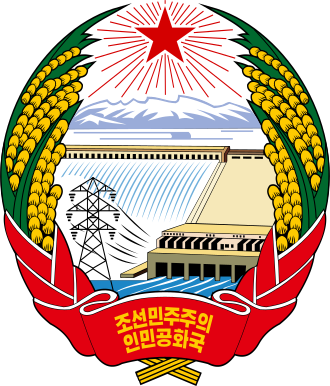
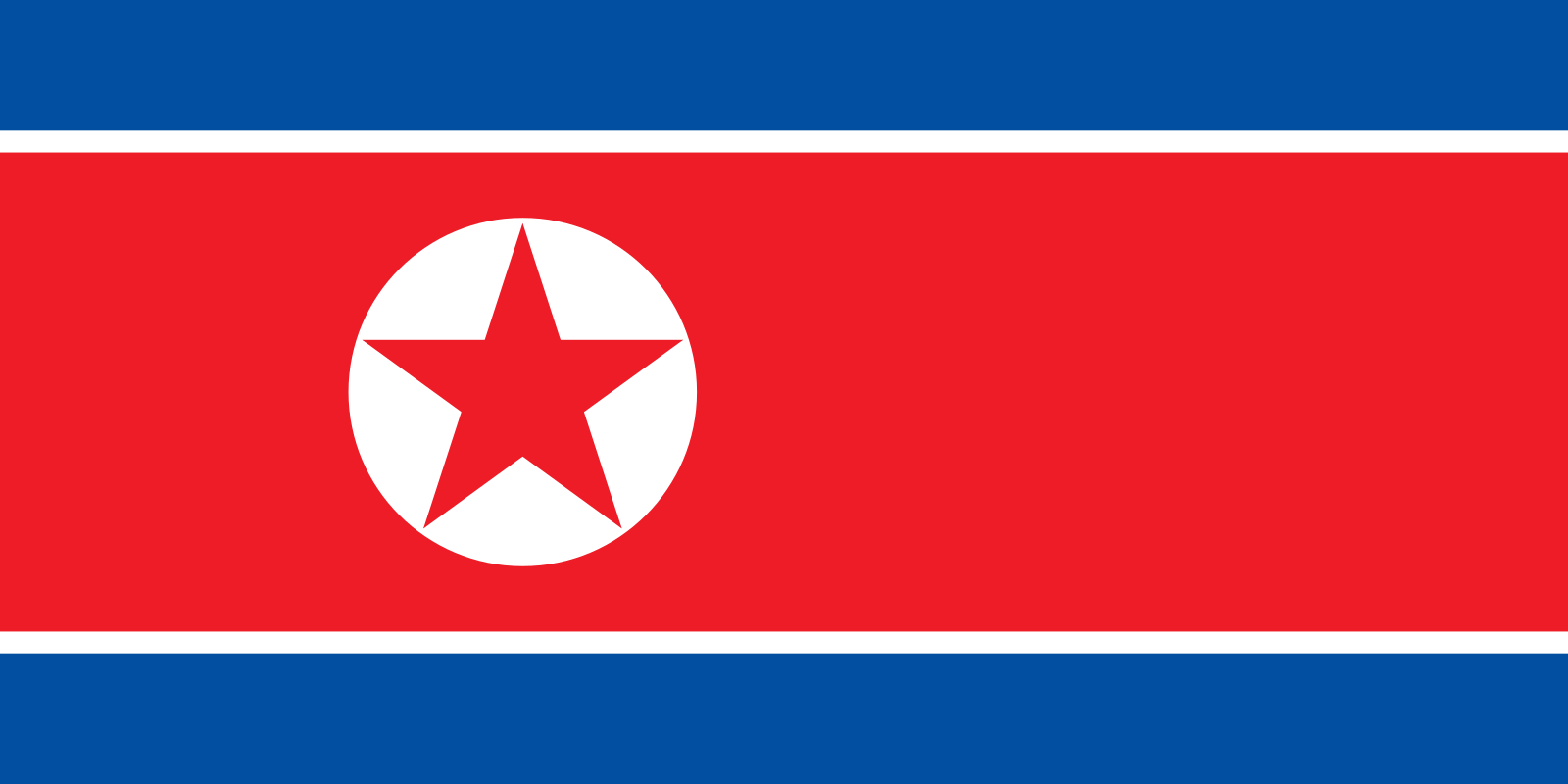
- Capital
- Pyongyang
- Population
- 25,950,000
- Region
- Asia · Eastern Asia
- Demonym
- North Korean
- Currencies
- KPW (₩)
- Languages
- Korean
- Calling code
- +850
- Drives on
- Right
- FIFA code
- PRK
- TLD
- .kp
- Timezones
- UTC+09:00
- Borders
- CHN, KOR, RUS
via REST Countries
Indicators · World Bank
- Population
- 26,498,823(2024)
- Life expectancy
- 73.7 yrs(2024)
- Unemployment
- 3.5 %(2025)
- Urban population
- 63.9 %(2024)
- Internet users
- 0 %(2004)
- Forest area
- 49.6 %(2023)
- Renewable energy
- 14.7 %(2021)
via World Bank Open Data · CC BY 4.0
Wikipedia views (30d)
244,181 totalvia Wikimedia Pageviews API
Research
10,478 papers- Possible Bioterrorism by North Korea and South Korea's Preparedness.ReviewInfection & chemotherapy · 2024Hwang KDOI: 10.3947/ic.2024.0068
- Helminthiases in North Korea: a neglected public health challenge.Pathogens and global health · 2019Chang EDOI: 10.1080/20477724.2019.1683326
- North Korean arrivals' medical service usage in South Korea, 2015-2019.ReviewJournal of public health policy · 2022Lee HJ, Cheon C, Kim J et al.DOI: 10.1057/s41271-022-00374-6
- Surgical Diseases in North Korea: An Overview of North Korean Medical Journals.ReviewInternational journal of environmental research and public health · 2020Choi S, Kim T, Choi S et al.DOI: 10.3390/ijerph17249346
- COVID-19 in North Korea.Lancet (London, England) · 2022Burki TDOI: 10.1016/S0140-6736(22)01133-3
- North Korea's COVID-19 policy dilemma: epidemic prevention conflicting with trade.Globalization and health · 2024Park B, Cho JDOI: 10.1186/s12992-023-01013-9
- Infectious disease risks among refugees from North Korea.ReviewInternational journal of infectious diseases : IJID : official publication of the International Society for Infectious Diseases · 2018Nishiura H, Lee H, Yuan B et al.DOI: 10.1016/j.ijid.2017.10.021
- Research topics in intellectual disabilities in North Korea: A scoping review.Journal of applied research in intellectual disabilities : JARID · 2022Kim T, Choi S, Lee JYDOI: 10.1111/jar.12956
via PubMed
Wikidata facts
- Instance of
- pariah state
- Official name
- Koreańska Republika Ludowo-Demokratyczna
- Demonym
- צפון קוריאנית
- Country
- North Korea
- Contains
- North Hwanghae Province
- Continent
- Asia
- Capital
- Pyongyang
- Official language
- Korean
- Currency
- North Korean won
- Population
- 26418204
- Area
- 120540
- Body of water
- Sea of Japan
- Head of government
- Pak Thae-song
- Head of state
- Kim Jong-il
- Form of government
- republic
- Legislature
- Supreme People's Assembly
- Anthem
- Aegukka
- Shares border with
- Soviet Union
- Highest point
- Baekdu Mountain
- Image
- North Korea - Location Map (2013) - PRK - UNOCHA.svg
- Life expectancy
- 74
- Calling code
- +850
- Licence plate code
- KP
- Electrical plug type
- Schuko
Show 65 more facts
- Mains voltage
- 110
- Coat of arms
- Emblem of North Korea
- Significant event
- Korean War
- topic's main Wikimedia portal
- Portal:North Korea
- Unicode character
- 🇰🇵
- category of associated people
- Category:North Korean people
- hashtag
- northkorea
- geography of topic
- Geography of North Korea
- office held by head of government
- Premier of North Korea
- Gini coefficient
- 31
- diplomatic relation
- Malta
- inception
- 1948-09-09
- Commons gallery
- 조선민주주의인민공화국
- trunk prefix
- 0
- mobile country code
- 467
- total fertility rate
- 1.979
- maritime identification digits
- 445
- marriageable age
- 17
- topic's main category
- Category:North Korea
- member of
- List of states with nuclear weapons
- railway traffic side
- left
- GS1 country code
- 867
- located in/on physical feature
- East Asia
- executive body
- Government of North Korea
- category for people who died here
- Category:Deaths in North Korea
- number of out-of-school children
- 610009
- Commons category
- North Korea
- top-level Internet domain
- .kp
- category for people born here
- Category:Births in North Korea
- driving side
- right
- lowest point
- Sea of Japan
- maintained by WikiProject
- WikiProject North Korea
- office held by head of state
- Supreme Leader of North Korea
- language used
- Korean
- suicide rate
- 10
- native label
- 조선민주주의인민공화국
- culture
- culture of North Korea
- history of topic
- history of North Korea
- age of majority
- 17
- replaces
- Korea
- BTI Status Index
- 2.04
- BTI Governance Index
- 1.37
- economy of topic
- economy of North Korea
- demographics of topic
- demographics of North Korea
- public holiday
- Day of the Foundation of the Republic
- different from
- Korea
- Democracy Index
- 1.08
- main regulatory text
- Constitution of North Korea
- P11012
- Serbia
- on focus list of Wikimedia project
- Wikipedia:Vital articles/Level/4
- P12749
- Jharkhand
- short name
- 朝鲜
- birth rate
- 13.058
- male population
- 12905119
- death rate
- 9.353
- rural population
- 9667582
- female population
- 13164298
- urban population
- 16401834
- P8168
- Steatoda castanea
- significant person
- Virgil Griffith
- most populous urban area
- Pyongyang
- position held by head of the organization
- General Secretary of the Workers' Party of Korea
- party chief representative
- Kim Jong Un
Sources (15)
via Wikidata · CC0
Travel guide
Get in
North Korean entry requirements are perplexing and change frequently without prior warning.
As of January 2026, tours to North Korea are only available for Russian citizens. Pretty much the only loophole is to join a sporting delegation, most notably the yearly Pyongyang Marathon, which is open to amateurs running distances as short as 5 km.
Due to longstanding international sanctions and tensions in the Korean peninsula, you can only enter North Korea from either China or Russia. Generally speaking, most people fly or take the train from Beijing.
Be careful about what you bring. Drugs, pornography or ideological material, by some definition, may cause severe problems up to death penalty.
Get around
thumb|A typical highway scene in North Korea. Tidy strands of trees with a large and empty road in between
All your transport needs will be dealt with by your tour company. Most of the time this means buses, although tour groups visiting remote sites (e.g. Paekdusan, Mount Chilbo) occasionally use chartered flights by Air Koryo. Wandering around on your own is not allowed, and you are required to have a guide to escort you at all times.
A carefully stage-managed one-station ride on the Pyongyang metro is included on the itinerary of most trips to Pyongyang, but use of any other form of local public transport is generally impossible. Some tours also include a train ride from Pyongyang to the border city of Sinuiju, in which you can stop over in Sinuiju for a 1-day tour, though this option is not available to U.S. citizens.
If travelling in a small enough group it is also possible to organise a walk through some areas of Pyongyang with some travel agents (Koryo).
See
thumb|A revolutionary scene from the Arirang Mass Games All tours are accompanied by a government minder, who will decide what you can and cannot see. From the moment you leave your hotel, expect to be accompanied by one or more guides. Besides ensuring that tourists do not stray outside of the designated tourist areas, their jobs include inspecting any photographs which they think do not portray North Korea or its government in a good light, and ordering photographers to delete them. It is generally advisable to listen to what your guide says, and agree with it.
It is always recommended that if you are uncertain about taking photographs anywhere, ask your guide, though allowances seem to vary wildly. You may get a guide that is relatively relaxed and will allow you to take photographs from a bus or within a city. Conversely, you may get one that will strictly adhere to controlling where you take photographs restricting anything taken from a tour bus or of certain areas, like Pyongyang's city streets, in general. There is simply no way to tell until you are on a tour. If you think a particular photograph might be embarrassing to the DPRK in general, ask or simply don't risk taking it at all.
Photography of military personnel is also generally prohibited. Again, if in doubt, ask your guide. However, there are instances where it is impossible not to photograph certain sites without including a few military personnel within the picture such as at Mansudae, the monument site fo…
Do
thumb|Statues at the tomb of King Wanggon, the founder of the Goryeo Dynasty, in [[Kaesong]] As mentioned above, there is very little to do beyond the watchful eye of your designated minders, with most recreational activity taking place within the confines of the tourist resorts. Bowling and karaoke are among the latest additions to its surprising plethora of recreational activities. The karaoke videos are often accompanied by dramatic historical footage of the Korean War, or goose-stepping People's Army soldiers.
North Korea has three amusement parks, two of which are abandoned due to mutual lack of interest and electricity. The Kaesong Youth Fair has now closed, taking the infamous "Roller Coaster of Death" along with it. Still visible are the shooting-galleries with backdrops of snarling American and Japanese soldiers; however, it is unlikely that your guide will let you venture into any abandoned areas. The one remaining amusement park contains some rides which are actually quite modern and non-lethal, at least by North Korean standards, and is about as worthy of a visit as everything else you'll see whilst in North Korea.
The nightlife in Pyongyang is remarkably safe and non-violent, compared to the capitals of other nations (except maybe Reykjavík in Iceland); in general, the civilians are not a threat. The plain-clothes secret police, however, may or may not be a threat, depending on what you say or do. The North Korean definition of popular music is at least two dec…
Eat
thumb|The Hibachi restaurant in the Haedanghwa Health Complex in Pyongyang
As with most other aspects of visiting North Korea, catering is usually organized in advance as part of your tour. Vegetarians and people with food allergies or dislikes of common foods such as seafood or eggs will need to make arrangements in advance. A visit to a "real" local restaurant may be possible; inquire with your guide. Shortages of supplies, combined with the typical use of Korean cooking styles, mean that there is a relatively limited variety of food — and this can get wearying on tours of more than a few days.
There are a few Western food options now in Pyongyang and these restaurants can usually be visited if arranged with the guides in advance. They will usually require additional payment though, unless you have discussed this already with your tour operator, as the costs are not included in the per diem fee charged by the Korean Travel Company. There are two Italian restaurants (one on Kwangbok Street which is near the Korean circus where the pizza is great, and they have imported a pizza oven and all the ingredients so the quality is very high; and one near the USS Pueblo) and two burger restaurants (the more accessible is in the Youth Hotel). Both are inexpensive and do inject some flavor onto a generally lackluster eating scene, especially on long tours. Visit the Vienna coffee house, which is on the river side of Kim Jong Il square, for a good coffee similar to those common in Eur…
Drink
The local speciality is insam-ju, Korean vodka infused with ginseng roots.
Locally made Taedonggang beer is very good. The brewery was purchased from Ushers in the UK and the equipment moved to Pyongyang. Some of the soju are not bad either. Local alcohol is inexpensive; a 650 ml bottle of beer is €0.50. Imported beers, such as Heineken, are also available at similar prices. However do not get drunk and cause trouble. Toe the line and show respect, or you and your guide will face serious penalties.
It is advisable to stick to bottled water for drinking as the tap water is not always properly treated.
thumb|The still unfinished Ryugyong Hotel in [[Pyongyang|P'yŏngyang]]
Sleep
This is likely to be your principal expense while in North Korea. You may only stay at "designated tourist hotels", for which you will need to pay in hard currency. There may be discounts if you ask for lower class accommodation, if you are travelling as part of a group, or if it is low season (November – March). Costs for your tour, which will include accommodation, all sightseeing activities and meals, will range from US$70 to US$200 a day, depending on these factors.
Usually you pay for all your meals, hotel and Beijing–Pyongyang journey to your tour operator before you leave. One week in high season at a four-star hotel will then cost something between €1,300 and €1,600, depending on your tour operator, but might get as low as €800 for one week.
Stay safe
In general North Korea is extremely safe for tourists due to strict government control and constant supervision. However, visitors must adhere to all regulations, avoid discussing sensitive topics and stay within approved areas. Travel is highly organised, and deviations from guided tours are not permitted, ensuring safety but limiting freedom.
At first, you may feel scared and intimidated by being in a severely authoritarian country like North Korea. You may even feel uneasy or outright anxious. As a tourist, you're not expected to know every single law and rule in North Korea. So long as you listen to your tour guides and behave respectfully, you should not run into any problems.
North Korea is an authoritarian dictatorship and is generally considered to have the worst human rights record in the world. The authorities are very touchy, and you need to watch what you say and how you say it. Just do what the guides do, praise every stop on your tour, and remember the rule, "If you have nothing good to say, don't say anything at all."
The official policy is that you are not to wander around on your own. You are expected to get permission and have a guide accompany you if you want to leave your hotel. This will vary depending on what hotel you are in. The Yanggakdo Hotel is on an island in the middle of Pyongyang's Taedong River. Therefore you can walk around the area a little more freely than at the Koryo Hotel in the city centre. You should always be friendly and courteous …
Stay healthy
Drinking water in North Korea is apparently untreated and there are reports of foreigners being hospitalized in the DPRK after drinking the water; therefore, sticking to bottled water is highly recommended.
Medical training is considered on par with the West, but outside of Pyongyang the facilities may be outdated or sparse. In the capital there are two major hospitals that may or may not be able to handle complex medical care.
If you fall seriously ill it may be in your best interest to be airlifted to China for medical treatment. Travel insurance is strongly recommended and in fact required on most organized tours. Contact your embassy or consulate in North Korea (if your country has one) for further advice.
Respect
thumb|The first two generations of the Kim dynasty together. North and South Koreans share a common culture; you may find the various respect tips in the South Korea article to be of help.
Travel guide from Wikivoyage (CC BY-SA 4.0)
~40 min read
Encyclopedic overview
North Korea, officially the Democratic People's Republic of Korea (DPRK), is a country in East Asia. It constitutes the northern half of the Korean Peninsula and borders China and Russia to the north at the Yalu (Amnok) and Tumen rivers, and South Korea to the south at the Korean Demilitarized Zone (DMZ). The country's western border is formed by the Yellow Sea, while its eastern border is defined by the Sea of Japan. Pyongyang is the capital and largest city.
The Korean Peninsula was first inhabited as early as the Lower Paleolithic period. Its first kingdom was noted in Chinese records in the early 7th century BCE. Following the unification of the Three Kingdoms of Korea into Silla and Balhae in the late 7th century, Korea was ruled by the Goryeo dynasty (918–1392) and the Joseon dynasty (1392–1897). The succeeding Korean Empire (1897–1910) was annexed in 1910 into the Empire of Japan. In 1945, after the Japanese surrender at the end of World War II, Korea was divided into two zones along the 38th parallel, with the north occupied by the Soviet Union and the south occupied by the United States.
Excerpted from Wikipedia’s “North Korea” article, available under the CC BY-SA 4.0 licence.
Gallery (16)
On the map
2 mapped locations
Available in 266 languages
- Español
- Français
- Deutsch
- 中文
- 日本語
- Русский
- Português
- Italiano
- العربية
- हिन्दी
- Abkhazian
- abstract
- Achinese
- Afrikaans
- Albanian
- Albanian
- Amharic
- ami
Show 247 more
- Angika
- Aragonese
- Armenian
- Arpitan
- Assamese
- Asturian
- Awadhi
- azb
- Azerbaijani
- Bahasa Indonesia
- Balinese
- Bangla
- Bashkir
- Basque
- bat_smg
- Batak Toba
- Bavarian
- be_x_old
- Belarusian
- Betawi
- Bhojpuri
- Bikol
- Bishnupriya
- Bislama
- blk
- Bosnian
- Breton
- btm
- Buginese
- Bulgarian
- Buriat
- Burmese
- Catalan
- cbk_zam
- cdo
- Cebuano
- Central Dusun
- Central Kurdish
- Chechen
- Church Slavic
- Chuvash
- Colognian
- Cornish
- Crimean Tatar
- Croatian
- Czech
- dag
- Danish
- Divehi
- dty
- Dzongkha
- Egyptian Arabic
- Esperanto
- Estonian
- Ewe
- Extremaduran
- Faroese
- Fiji Hindi
- Filipino
- Finnish
- fiu_vro
- Friulian
- Gagauz
- Galician
- Gan Chinese
- gcr
- Georgian
- Gilaki
- Goan Konkani
- Gorontalo
- Greek
- Guarani
- Gujarati
- Haitian Creole
- Hakka Chinese
- Hausa
- Hawaiian
- Hebrew
- Hungarian
- hyw
- Iban
- Icelandic
- Ido
- igl
- Iloko
- Inari Sami
- Interlingua
- Interlingue
- Inuktitut
- Inupiaq
- Irish
- Jamaican Creole English
- Javanese
- Kabardian
- Kabyle
- Kannada
- Kanuri
- Kara-Kalpak
- Karachay-Balkar
- Kashmiri
- Kashubian
- Kazakh
- kbp
- kge
- Khmer
- Kikuyu
- Kinyarwanda
- Komi
- Kongo
- Kurdish
- Kyrgyz
- Ladino
- Lao
- Latin
- Latvian
- Lezghian
- Ligurian
- Limburgish
- Lingala
- Lingua Franca Nova
- Lithuanian
- lld
- Lojban
- Lombard
- Low German
- Lower Sorbian
- Luxembourgish
- Macedonian
- Maithili
- Malagasy
- Malay
- Malayalam
- Maltese
- Manx
- Māori
- Marathi
- Mari
- Mazanderani
- Minangkabau
- Mingrelian
- Mirandese
- Mongolian
- Moroccan Arabic
- Navajo
- nds_nl
- Neapolitan
- Nederlands
- Nepali
- Newari
- Nias
- Northern Frisian
- Northern Sami
- Norwegian
- Norwegian Nynorsk
- Novial
- Occitan
- Odia
- Old English
- olo
- Oromo
- Ossetic
- Pampanga
- Papiamento
- Pashto
- Picard
- Piedmontese
- Polski
- Punjabi
- Quechua
- Romanian
- Romany
- Rusyn
- Sanskrit
- Santali
- Sardinian
- Scots
- Scottish Gaelic
- Serbian
- Serbian (Latin)
- Shan
- Shona
- Sicilian
- Silesian
- simple
- Sindhi
- Sinhala
- Slovak
- Slovenian
- Somali
- Sranan Tongo
- Standard Moroccan Tamazight
- Sundanese
- Svenska
- Swahili
- Swati
- szy
- Tachelhit
- Tajik
- Talysh
- Tamil
- Taroko
- Tatar
- tay
- tdd
- Telugu
- Tetum
- Tibetan
- Tiếng Việt
- Tok Pisin
- Toki Pona
- Tongan
- Tsonga
- Tumbuka
- Türkçe
- Turkmen
- Tuvinian
- Tyap
- Udmurt
- Ukrainian
- Upper Sorbian
- Urdu
- Uyghur
- Uzbek
- Venetian
- Veps
- Volapük
- Walloon
- Waray
- Welsh
- West Flemish
- Western Frisian
- Western Panjabi
- Wolof
- Wu Chinese
- Xhosa
- Yakut
- Yiddish
- Yoruba
- Zaza
- Zeelandic
- zh_classical
- zh_min_nan
- zh_yue
- Zhuang
- فارسی
- ไทย
- 한국어
via Wikidata sitelinks · CC0