File:Eagle_with_fasces.svg · Wikimedia Commons · See Wikimedia Commons
potenze dell'Asse
Sign in to saveAlso known as Axis powers, Rome–Berlin Axis, Rome–Berlin–Tokyo Axis, the Axis, AOOO
nazioni opposte agli Alleati durante la Seconda Guerra Mondiale
The Axis Powers were the main alliance of countries that fought against the Allied forces during World War II, led primarily by Nazi Germany, Imperial Japan, and Fascist Italy. This alliance matters because understanding it is central to understanding one of history's most significant and destructive global conflicts.
AI-generated from the Wikipedia summary — may contain errors.
Described at
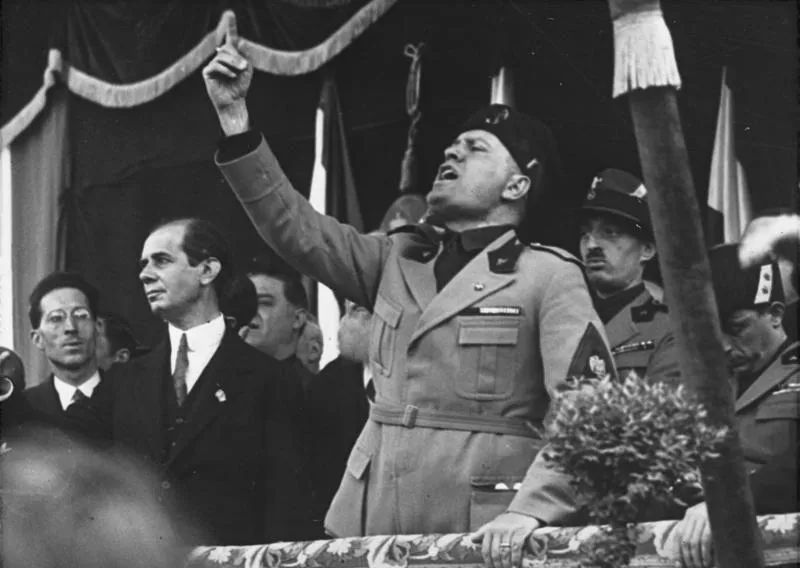
Why We Call the Axis Powers the Axis Powers
On this day in 1936, Italian dictator Benito Mussolini declared an axis between Berlin and Rome, coining a term that would be used by both sides in WWII
smithsonianmag.com →Link to a page describing this subject · 8,536 chars · not written by Vinony
Wikidata facts
- Instance of
- military alliance
- Has part
- Independent State of Croatia
- Participant in
- World War II
- Conflict
- World War II
- Image
- DOL 1938 03 16 1 Achse Rom Berlin.png
Show 8 more facts
- inception
- 1940-01-01
- dissolved, abolished or demolished date
- 1945-01-01
- topic's main category
- Category:Axis powers
- different from
- Central Powers
- on focus list of Wikimedia project
- Wikipedia:Vital articles/Level/4
- Commons category
- Axis powers
- native label
- 枢軸国
via Wikidata · CC0
Article · Italiano
L'espressione potenze dell'Asse, o semplicemente Asse, è usata per indicare l'insieme degli Stati che parteciparono alla seconda guerra mondiale in opposizione agli Alleati. A dare popolarità al termine fu Benito Mussolini che, durante un discorso tenuto a Milano il 1º novembre 1936, definì «asse» l'intesa stipulata il precedente 24 ottobre tra la Germania e il Regno d'Italia, chiamata per questo motivo «Asse Roma-Berlino». Il successivo Patto d'Acciaio, stipulato dalle due potenze il 22 maggio 1939, rappresentò il primo nucleo dell'alleanza militare, poi estesa anche al Giappone con il Patto tripartito del 27 settembre 1940 (detto anche «Asse Roma-Berlino-Tokyo»). Successivamente anche altri Stati entrarono a far parte della coalizione aderendo al Patto Tripartito. L'Asse, formato soprattutto dalle nazioni insoddisfatte dell'assetto geopolitico venutosi a creare in seguito alla prima guerra mondiale, era cementato dalle affinità ideologiche dei regimi autoritari che le governavano, e mirava a costituire un «Nuovo Ordine» che avrebbe visto la supremazia della Germania nell'Europa continentale, dell'Italia nel Mediterraneo, e del Giappone nell'Estremo Oriente. Sul piano politico mirava a contrastare il capitalismo delle democrazie occidentali (Regno Unito, Francia e Stati Uniti) e il bolscevismo dell'Unione Sovietica.
Abstract from DBpedia / Wikipedia · CC BY-SA
Gallery (12)
Available in 100 languages
- Español
- Français
- Deutsch
- 中文
- 日本語
- Русский
- Português
- Italiano
- العربية
- हिन्दी
- Afrikaans
- Albanian
- Armenian
- Asturian
- azb
- Azerbaijani
- Bahasa Indonesia
- Bangla
Show 81 more
- Basque
- be_x_old
- Belarusian
- Bosnian
- Breton
- Bulgarian
- Burmese
- Catalan
- Central Kurdish
- Chuvash
- Croatian
- Czech
- Danish
- Egyptian Arabic
- Esperanto
- Estonian
- Faroese
- Filipino
- Finnish
- Galician
- Georgian
- Greek
- Guarani
- Hebrew
- Hungarian
- Icelandic
- Ido
- Interlingua
- Javanese
- Kazakh
- Khmer
- Lao
- Latin
- Latvian
- Lithuanian
- lld
- Macedonian
- Malagasy
- Malay
- Malayalam
- Maltese
- Manx
- Marathi
- Mongolian
- Nederlands
- Norwegian
- Norwegian Nynorsk
- Occitan
- Ossetic
- Palatine German
- Pashto
- Polski
- Punjabi
- Romanian
- Rusyn
- Scots
- Serbian
- Serbian (Latin)
- Sicilian
- simple
- Slovak
- Slovenian
- Svenska
- Tamil
- Telugu
- Tiếng Việt
- Toki Pona
- Türkçe
- Ukrainian
- Urdu
- Uyghur
- Uzbek
- Waray
- Western Panjabi
- Wu Chinese
- zh_classical
- zh_min_nan
- zh_yue
- فارسی
- ไทย
- 한국어
via Wikidata sitelinks · CC0