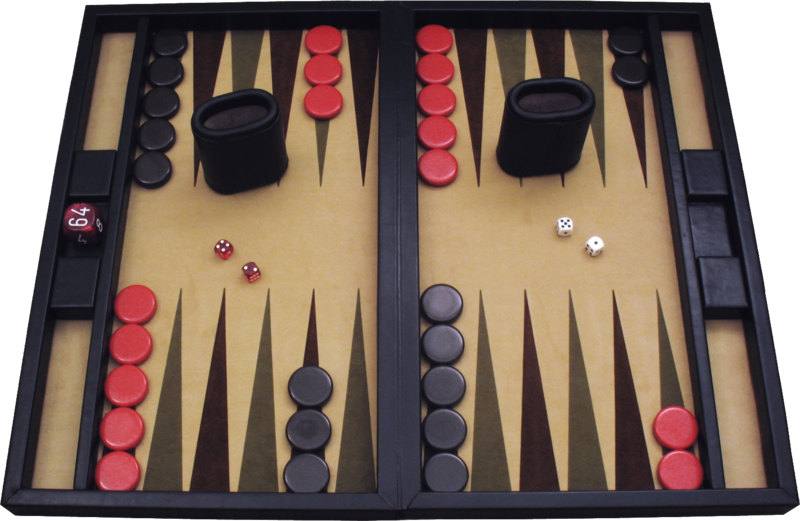
File:Backgammon_lg.png · Wikimedia Commons · See Wikimedia Commons
Backgammon is a two-player board game in which players move counters across a board according to dice rolls. It is the most popular Western version of an ancient family of games with roots stretching back at least 1,600 years, with backgammon itself first documented in 17th-century England.
AI-generated from the Wikipedia summary — may contain errors.
Key facts
- Game.italic title
- no
- Game.title
- Backgammon
- Game.image_link
- Backgammon lg.png
- Game.image_caption
- A backgammon set
- Game.years
- 1646 to present
- Game.players
- 2
- Game.setup_time
- 10–30 seconds
- Game.playing_time
- 5–60 minutes
- Game.movement
- Contrary
- Game.random_chance
- Medium (dice rolling)
- Game.ages
- 5+
- Game.related
- Irish, Nard
- Game.footnotes
- Origin: 17th-century EnglandDescended from: Irish
via Wikipedia infobox
Wikidata facts
- Instance of
- hobby
- Subclass of
- mind sport
- Image
- Backgammon lg.jpg
- Has use
- competition
Show 9 more facts
- on focus list of Wikimedia project
- Wikipedia:Vital articles/Level/4
- described by source
- Encyclopædia Britannica 11th edition
- Commons category
- Backgammon
- topic's main category
- Category:Backgammon
- minimum number of players
- 2
- maximum number of players
- 2
- minimum age
- 5
- partially coincident with
- Tric Trac
- maintained by WikiProject
- WikiProject Mathematics
via Wikidata · CC0
Article · Português
Gamão é um jogo de tabuleiro para dois jogadores, realizado num caminho unidimensional, no qual os adversários movem suas peças em sentidos contrários, à medida que jogam os dados e estes determinam quantas "casas" serão avançadas, sendo vitorioso aquele que conseguir retirar todas as peças primeiro (de onde pode ser tido como sendo também um "jogo de corrida" ou "de percurso"). Atividade lúdica de regras simples, o gamão desenvolve as relações lógico-matemáticas, com uso da estratégia: aprimora o senso matemático da subtração e adição não apenas pelas próprias jogadas, como ainda pela antecipação dos movimentos do adversário. É visto como um passatempo do qual se tira proveito prático, pois exercita a capacidade de elaborar pensamentos estratégicos, como o xadrez. Dele se diz que é "o rei dos jogos e o jogo dos reis".
Abstract from DBpedia / Wikipedia · CC BY-SA
Gallery (632)
Available in 98 languages
- Español
- Français
- Deutsch
- 中文
- 日本語
- Русский
- Português
- Italiano
- العربية
- हिन्दी
- Afrikaans
- Albanian
- Albanian
- Aragonese
- Armenian
- Assamese
- Asturian
- azb
Show 79 more
- Azerbaijani
- Bahasa Indonesia
- Bangla
- Bashkir
- Basque
- bat_smg
- be_x_old
- Belarusian
- Bosnian
- Breton
- Bulgarian
- Catalan
- Central Kurdish
- Chechen
- Cornish
- Croatian
- Czech
- Danish
- Egyptian Arabic
- Esperanto
- Estonian
- Fiji Hindi
- Filipino
- Finnish
- Galician
- Georgian
- Greek
- Hausa
- Hebrew
- Hungarian
- Icelandic
- Ido
- Interlingua
- Kazakh
- Kurdish
- Latin
- Latvian
- Limburgish
- Lingua Franca Nova
- Lithuanian
- Low German
- Macedonian
- Malay
- Malayalam
- Nederlands
- Norwegian
- Norwegian Nynorsk
- Occitan
- Piedmontese
- Polski
- Punjabi
- Romanian
- Serbian
- Serbian (Latin)
- Sicilian
- simple
- Sindhi
- Slovak
- Slovenian
- Svenska
- Swahili
- Tamil
- Tiếng Việt
- Türkçe
- Ukrainian
- Urdu
- Veps
- Waray
- Welsh
- West Flemish
- Western Frisian
- Western Panjabi
- Wu Chinese
- Yiddish
- zh_min_nan
- zh_yue
- فارسی
- ไทย
- 한국어
via Wikidata sitelinks · CC0