Encyclopedia of Life · EOL (see source)
Species
SPECIES
- KingdomPlantae
- PhylumTracheophyta
- ClassMagnoliopsida
- OrderMalpighiales
- FamilyMalpighiaceae
Chile Central
via GBIF · Kew POWO
Museum specimens
- Specimen records
- 616
- With media
- 394
- Family
- Malpighiaceae
- Collections
- MICH, IBUNAM
- Recorded in
- Costa Rica, Colombia, Peru, Bolivia, United States, Brazil, Argentina
Wikidata facts
- Instance of
- taxon
- Subclass of
- useful plant
- Parent taxon
- Banisteriopsis
- Image
- Ejemplar de Banisteriopsis caapi en el jardín botánico del Centro Takiwasi.jpg
- Has use
- entheogen
Show 7 more facts
Sources (1)
via Wikidata · CC0
~7 min read
Encyclopedic overview
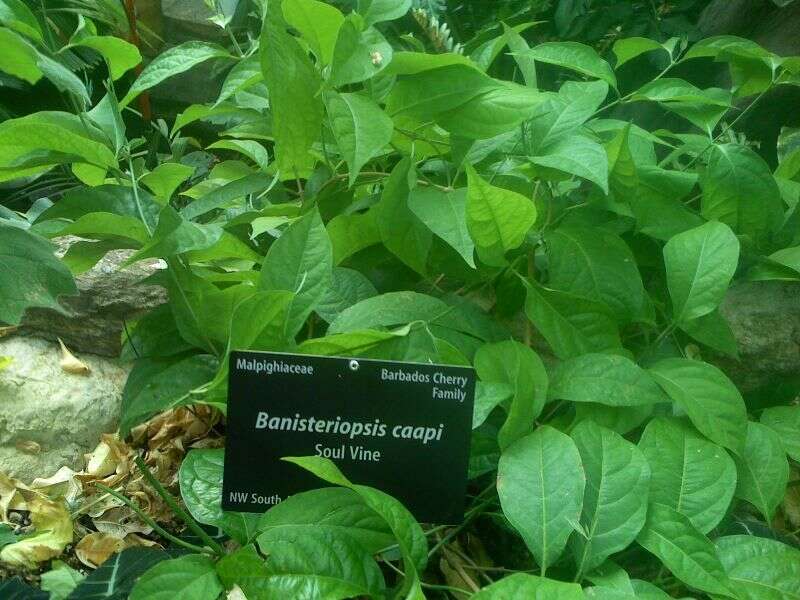
Banisteriopsis caapi, also known as, caapi, soul vine, yagé (yage), or ayahuasca (the latter of which also refers to the psychedelic decoction made with the vine and a plant source of dimethyltryptamine) is a South American liana of the family Malpighiaceae. It is commonly used as an ingredient of ayahuasca, a decoction with a long history of its entheogenic use and holds status as a "plant teacher" among the Indigenous peoples of the Amazon rainforest.
It was used by Indigenous peoples of South America for centuries, but it was first documented by Europeans in the 16th century and formally identified by botanist Richard Spruce in 1851. According to The CRC World Dictionary of Plant Names by Umberto Quattrocchi, the naming of the genus Banisteriopsis was dedicated to John Banister, a 17th-century English clergyman and naturalist. An earlier name for the genus was Banisteria and the plant is sometimes referred to as Banisteria caapi. Other names include Banisteria quitensis, Banisteriopsis inebrians, and Banisteriopsis quitensis.
Excerpted from Wikipedia’s “Banisteriopsis caapi” article, available under the CC BY-SA 4.0 licence.