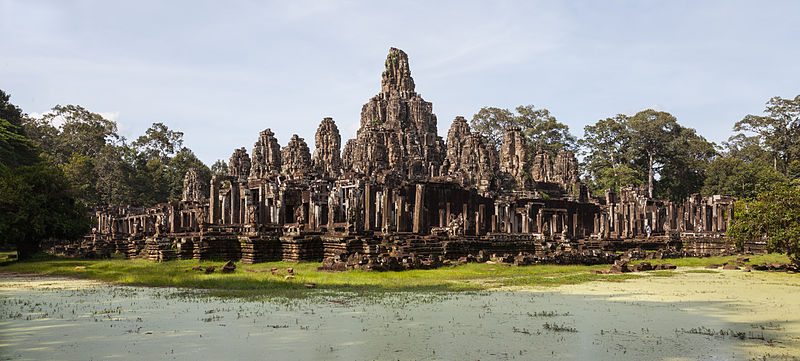
File:Bayon,_Angkor_Thom,_Camboya,_2013-08-17,_DD_37.JPG · Wikimedia Commons · See Wikimedia Commons
Bayon
Sign in to saveAlso known as Prasat Bayon, Madhyadri
The Bayon (, ; BAI-on) is a richly decorated Theravada Buddhist temple of the Khmer Empire located at Angkor in Cambodia. Built in the late 12th or early 13th century as the state temple of King Jayavarman VII (), it stands at the centre of Jayavarman’s capital city, Angkor Thom (). The Bayon reflects the strong Buddhist orientation of Jayavarman VII’s reign. Originally conceived as a Mahayana Buddhist monument centered on the cult of the Bodhisattva of compassion, the temple later adapted to the spread of Theravada Buddhism in Cambodia. Its iconography, spatial organization, and emphasis on c
Key facts
- Buddhist temple.name
- Bayon
- Buddhist temple.image
- Bayon, Angkor Thom, Camboya, 2013-08-17, DD 37.JPG
- Buddhist temple.map_type
- Cambodia
- Buddhist temple.map_caption
- Location in Cambodia
- Buddhist temple.native_name
- Jayagiri (Chey Kiri)
- Buddhist temple.country
- Cambodia
- Buddhist temple.locale
- Angkor Thom
- Buddhist temple.deity
- Avalokiteshvara, Hevajra (Jayagiri)
- Buddhist temple.sect
- Theravada
- Buddhist temple.architecture
- Bayon
- Buddhist temple.year_completed
- End of the 12th century CE
- Buddhist temple.creator
- Jayavarman VII
- Buddhist temple.religious_affiliation
- Buddhism
via Wikipedia infobox
Wikidata facts
- Instance of
- archaeological site
- Religion
- Buddhism
- Country
- Cambodia
- Located in
- Angkor Thom
- Founded by
- Jayavarman VII
- Image
- Trusty Tuk Tuk .jpg
Show 3 more facts
- Commons category
- Bayon
- culture
- Khmer Empire
- native label
- ប្រាសាទបាយ័ន
Sources (3)
via Wikidata · CC0
~17 min read
Encyclopedic overview
15 sectionsContents
- Etymology
- History
- Buddhist symbolism in the foundation of the temple by King Jayavarman VII
- Alterations following the death of Jayavarman VII
- Modern restoration
- The site
- The outer gallery: historical events and everyday life
- The inner gallery: depictions of mythological events
- {{anchor | Lokesvara }} The upper terrace: 200 faces of Lokesvara
- The central tower and sanctuary
- Gallery
- See also
- References
- Bibliography
- External links
The Bayon (, ; BAI-on) is a richly decorated Theravada Buddhist temple of the Khmer Empire located at Angkor in Cambodia. Built in the late 12th or early 13th century as the state temple of King Jayavarman VII (), it stands at the centre of Jayavarman’s capital city, Angkor Thom (). The Bayon reflects the strong Buddhist orientation of Jayavarman VII’s reign. Originally conceived as a Mahayana Buddhist monument centered on the cult of the Bodhisattva of compassion, the temple later adapted to the spread of Theravada Buddhism in Cambodia. Its iconography, spatial organization, and emphasis on compassion and kingship illustrate the close relationship between Buddhism and royal authority at Angkor, while its continued use as a Buddhist sanctuary demonstrates the enduring influence of Buddhism in the region.
The temple is best known for its many towers adorned with serene, smiling stone faces carved on all sides, which are commonly interpreted as representations of King Jayavarman VII and symbolize compassion and royal authority. The Bayon also features extensive bas-reliefs depicting historical events, religious themes, and scenes of everyday life in the Khmer Empire, making it one of the most important visual sources for the study of Angkorian society. The Japanese Government Team for the Safeguarding of Angkor (JSA) has described the Bayon as “the most striking expression of the baroque style” of Khmer architecture, in contrast to the classical style of Angkor Wat ().
Excerpted from Wikipedia’s “Bayon” article, available under the CC BY-SA 4.0 licence.
Gallery (30)
On the map
3 mapped locations