
Benin
Sign in to saveAlso known as Dahomey, BEN, Republic of Benin, BJ
Benin, officially the Republic of Benin, formerly known as Dahomey, is a country in West Africa. Benin is bordered by Togo to the west, Nigeria to the east, Burkina Faso to the northwest, and Niger to the northeast. The majority of its population lives on the southern coastline of the Bight of Benin, part of the Gulf of Guinea in the northernmost tropical portion of the Atlantic Ocean. The capital is Porto-Novo, and the seat of government is in Cotonou, the most populous city and economic capital. Benin covers an area of , and its population in was estimated to be approximately million. It is
OverviewAI-generated
Benin, officially the Republic of Benin, is a sovereign state in Western Africa. It is named after the Bight of Benin and shares borders with Burkina Faso, Niger, Nigeria, and Togo. The country’s capital is Porto-Novo, with Cotonou also serving as a capital. French is the official language, and the currency is the West African CFA franc. Its top-level Internet domain is .bj.
The nation has a population of 13,224,860 and covers an area of 112,622 square kilometers. It is a member of the United Nations, African Union, World Trade Organization, and Organisation of Islamic Cooperation. Benin’s highest point is Mont Sokbaro. The head of government includes Pascal Koupaki, Lionel Zinsou, and Patrice Talon. The country uses the telephone country code 229 and is located in the UTC+01:00 time zone.
Synthesized by Vinony from 72 facts across 10 sources: Wikidata, REST Countries, Openweathermap, Open Meteo, World Bank, OpenStreetMap, Firecrawl, PubMed, Vinony graph, Geo. Generated from structured data (not the Wikipedia text) and checked against those facts — may still contain errors.
Weather now
7-day forecast
via Open-Meteo
Country
- Capital
- Porto-Novo
- Population
- 13,224,860
- Region
- Africa · Western Africa
- Demonym
- Beninese
- Currencies
- XOF (Fr)
- Languages
- French
- Calling code
- +229
- Drives on
- Right
- Gini
- 47.8 (2015)
- FIFA code
- BEN
- TLD
- .bj
- Timezones
- UTC+01:00
- Borders
- BFA, NER, NGA, TGO
via REST Countries
Indicators · World Bank
- GDP
- $21.5B(2024)
- Population
- 14,462,724(2024)
- Life expectancy
- 61 yrs(2024)
- Unemployment
- 1.6 %(2025)
- Urban population
- 52.5 %(2024)
- Internet users
- 34 %(2024)
- Forest area
- 26.5 %(2023)
- Renewable energy
- 54.5 %(2021)
via World Bank Open Data · CC BY 4.0
Place details
- Locality
- Cotonou
- Region
- Littoral
- Country
- Bénin
- Population
- 11,485,048
- Timezone
- Africa/Porto-Novo
via OpenStreetMap · GeoNames
Wikipedia views (30d)
104,255 totalvia Wikimedia Pageviews API
Key facts
- Country.conventional_long_name
- Republic of Benin
- Country.common_name
- Benin
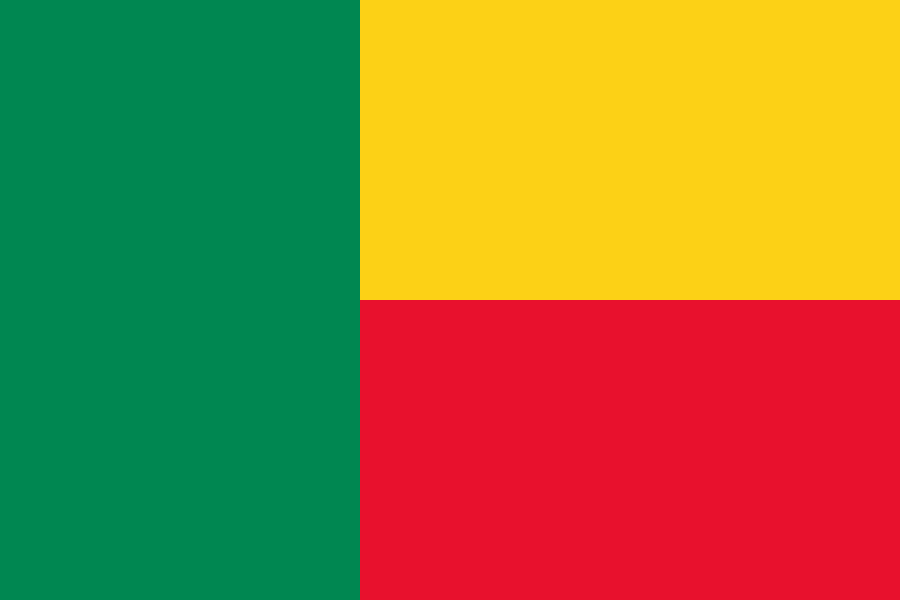
- Country.image_flag
- Flag of Benin.svg
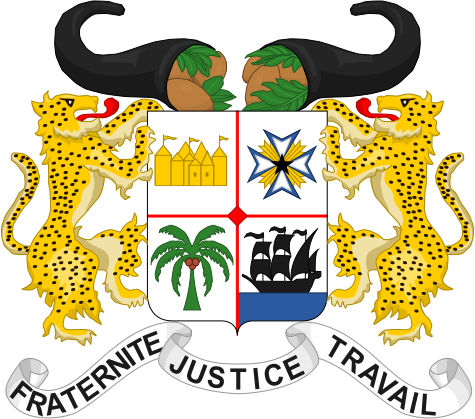
- Country.image_coat
- Coat of arms of Benin.svg
- Country.englishmotto
- Fraternity, Justice, Labour
- Country.national_anthem
- "The New Dawn"File:L'Aube Nouvelle.ogg
- Country.official_languages
- French
- Country.languages_type
- National languages
- Country.ethnic_groups_year
- 2013
- Country.religion_year
- 2020
- Country.capital
- Porto-Novo
- Country.largest_city
- Cotonou
- Country.government_type
- Unitary presidential republic
- Country.leader_title1
- President
- Country.leader_name1
- Patrice Talon
- Country.leader_title2
- Vice President
- Country.leader_name2
- Mariam Chabi Talata
- Country.legislature
- National Assembly
via Wikipedia infobox
Research
10,806 papers- Benin.Department of State publication. Background notes series · 1984United States. Department of State. Bureau of Public Affairs
- Benin.Department of State publication. Background notes series · 1989United States. Department of State. Bureau of Public Affairs
- Benin.Population today · 1989May JF
- [Benin].Jeune Afrique (Paris, France : 1980) · 1996
- Léiomyome volumineux bénin de la vulve : une localisation extra-utérine insolite.Journal of obstetrics and gynaecology Canada : JOGC = Journal d'obstetrique et gynecologie du Canada : JOGC · 2022Pokoradi A, Agrawal ADOI: 10.1016/j.jogc.2020.06.002
- Introduction of monkeypox virus in Benin, 2022.Military Medical Research · 2022Yadouleton A, Faye M, Tchibozo C et al.DOI: 10.1186/s40779-022-00424-w
- [Seroprevalence of Toxoplasmosis among Pregnant Women in Benin: Meta-Analysis and Meta-Regression].Bulletin de la Societe de pathologie exotique (1990) · 2019Tonouhewa ABN, Amagbégnon R, Atchadé SP et al.DOI: 10.3166/bspe-2019-0078
- Emergence of SARS-CoV-2 Delta Variant, Benin, May-July 2021.Emerging infectious diseases · 2022Yadouleton A, Sander AL, Adewumi P et al.DOI: 10.3201/eid2801.211909
via PubMed
Official website
Gouvernement de la République du Bénin
Toute l'actualité du Gouvernement de la République du Bénin : les actions du Gouvernement, le Président de la République, les ministères, les ministres, les événements, etc.
gouv.bj →Link to the official site · 13,939 chars · not written by Vinony
Wikidata facts
- Instance of
- country
- Named after
- Bight of Benin
- Official name
- République du Bénin
- Demonym
- Beinineach
- Contains
- Zou Department
- Continent
- Africa
- Capital
- Cotonou
- Official language
- French
- Currency
- West African CFA franc
- Population
- 14111034
- Area
- 114763
- Body of water
- Atlantic Ocean
- Head of government
- Patrice Talon
- Head of state
- Patrice Talon
- Form of government
- republic
- Legislature
- National Assembly
- Anthem
- L'Aube Nouvelle
- Shares border with
- Niger
- Highest point
- Mont Sokbaro
- Official website
- www.gouv.bj
- Life expectancy
- 60.907
- Nominal GDP
- 19676049075
- Unemployment rate
- 1
- Calling code
- +229
Show 61 more facts
- Licence plate code
- DY
- Mains voltage
- 220
- Motto
- Fraternity, Justice, Labour
- Flag
- flag of Benin
- Coat of arms
- coat of arms of Benin
- top-level Internet domain
- .bj
- Commons category
- Benin
- member of
- Multinational Joint Task Force
- topic's main category
- Category:Benin
- category for people who died here
- Category:Deaths in Benin
- category for people born here
- Category:Births in Benin
- category for films shot at this location
- Category:Films shot in Benin
- category of associated people
- Category:Beninese people
- diplomatic relation
- North Korea
- topic's main Wikimedia portal
- Portal:Benin
- inception
- 1960-08-01
- IPA transcription
- bɛˈnɪn
- Commons gallery
- Bénin
- mobile country code
- 616
- lowest point
- Bight of Benin
- driving side
- right
- geography of topic
- Geography of Benin
- described by source
- Pax Leksikon
- marriageable age
- 18
- office held by head of government
- President of the Republic of Benin
- office held by head of state
- President of the Republic of Benin
- number of out-of-school children
- 827619
- has characteristic
- free country
- located in/on physical feature
- West Africa
- total fertility rate
- 4.766
- maritime identification digits
- 610
- Unicode character
- 🇧🇯
- replaces
- French West Africa
- history of topic
- history of Benin
- language used
- Gun
- literacy rate
- 38.4
- suicide rate
- 9.5
- culture
- culture of Benin
- VAT rate
- 18
- different from
- Benin City
- BTI Status Index
- 6.08
- BTI Governance Index
- 5.85
- economy of topic
- economy of Benin
- demographics of topic
- demographics of Benin
- Democracy Index
- 4.58
- Gini coefficient
- 37.8
- Human Development Index
- 0.525
- P11012
- Eilbek
- central bank
- Central Bank of West African States
- hashtag
- Benin
- on focus list of Wikimedia project
- Wikipedia:Vital articles/Level/4
- Happy Planet Index score
- 41.4
- Inequality-adjusted Human Development Index
- 0.334
- P12749
- Johann Sebastian Bach
- birth rate
- 36.071
- male population
- 4887820
- death rate
- 9.323
- rural population
- 6738656
- female population
- 5120929
- urban population
- 6614208
- P8168
- Come Clean
Sources (15)
via Wikidata · CC0
Travel guide
Understand
Benin, known as Dahomey until 1960, was one of the few countries to transition from Marxist rule to a democratic system in the 1990s. The country enjoys an island of stability and provides a complex heritage, handful of spiritual traditions and endless tropical landscapes.
Get in
thumb|375px|A map showing the visa requirements of Benin, with countries in green having visa-free access, and in yellow are required to obtain electronic visa
Do
Whale watching Check out sea turtles Shop for artisanal goods and handicrafts Make your own pottery: While in Se (close to Gran Popo) visit for a refreshing drink at North Pole or Victoria Palace. US Peace Corps volunteers say Se is one of Benin's best kept travel secrets, where you can take a tour of the local pottery production and make your own pottery. Observe Christmas: Benin admires a joyful Christmas, celebrated by Christian denominations and adherent religious followers. Typical local festive observances includes outdoor performances and key mass ceremonies.
Buy
Prices for goods purchased in a store, restaurant, hotel, bus tickets, etc. are non-negotiable, but almost everything else is. Depending on the item, it's not uncommon for foreigners to be quoted a price that is double the final purchase price.
You can find any type of African commodity all over Benin.
Eat
thumb|Aloko (fried plantains) and fish in Cotonou In every city/village one will find street vendors selling anything from beans and rice to grilled chicken, goat and turkey. Prices are nominal. But one must be careful, always choose a vendor whose food is still hot, and they have taken care to keep the bowls covered with a lid or a cloth.
Signature dishes Kuli-Kuli Boulettes de Poulet avec Sauce Rouge (Chicken Meatballs with Red Sauce)
Drink
The beer is cheap and good. Local pubs (buvettes) are on every corner in every neighborhood. You can get a bottle of local beer "La Béninoise", Heineken, Guinness, Castel and others depending on the bar. They all cost about CFA 250 for a small bottle or CFA 500 for a large bottle. In nightclubs beer is excessively expensive, around CFA 30,000 a bottle. So stick to the local pubs, or avoid buying beer at the nightclub. There is also the local vin de palme (palm wine), an alcoholic beverage that is made from the sap of the palm tree. A fermented palm liquor (Sodabi) is also available, it costs about CFA 2000 for a litre and it is very strong.
Sleep
Benin's sleeping habit is a vast contrast compared to Westerners. While most rise before dawn, they all work until 12:30, when most take a 2½ hour siesta. Then it's back to work for 3 hours.
Depending on how far they've commuted to work, most are back home by 19:00. The next 3 hours are consumed by preparing dinner, TV, dancing or mingling with friends and neighbours. Then it's time for bed around 22:00.
Stay safe
The best way to stay safe in Benin is to always always always be in the presence of a local person whom you can trust, such as a friend or even a hired tourist guide. They know which areas are safe and which are not, they know the prices of things so you won't get ripped off, they speak the native languages, they know which venues sell good food that is safe for westerners to eat.
For women, avoid travelling alone, try to be in the company of other people as much as possible. Do not travel at night alone: attacks along the beaches are frequent, and of course near hotels, nightclubs and other venues. Ignore any person who whistles at you during the night if you are alone. Benin is a peaceful country and the people are very kind and generous, but muggings and robberies occur everywhere, no matter how peaceful the place seems, so be on guard. If you are a victim of a crime, contact the Gendarme (Police) immediately.
Stay healthy
Watch what you eat/drink and where you eat/drink it. If you are going to eat street food, make sure it is served very very hot, since bacteria will not live in hot food. The most common causes of sickness is E.coli bacteria found in undercooked meat.
Drinking water is readily available, if you want bottled water there is "Possatome"- a natural spring water bottled in the city with the same name. It is very good and about CFA 500 a bottle. In Cotonou, the tap water is safe to drink but is treated with chlorine which some people may be sensitive to.
Malaria is a reality in Benin. Mosquitoes appear from dusk to dawn, and they use standing water as a breeding ground. Medications are available by prescription only. The only compulsory vaccination needed to enter the country is against Yellow Fever. The customs agents at the airport generally do not check to see if you have it, but it is strongly advised to get it before entering for your own health. Along with vaccines against polio, hepatitis A and B, Measles, Mumps, Rubella, Tetanus, Rabies and all the other standard childhood vaccines.
AIDS is an issue in Benin as in all sub-Saharan African countries; use of a condom is highly recommended if entering into a sexual relationship with a Beninese partner. Other risks pertaining to unprotected sex are the same as in any other country whether developed or not: Syphilis, Chlamydia, HPV, etc.
If visiting Benin it is highly recommended that you speak to a doctor who specialises in t…
Travel guide from Wikivoyage (CC BY-SA 4.0)
~40 min read
Encyclopedic overview
33 sectionsContents
- Etymology
- History
- Pre-colonial
- Colonial
- Post-colonial
- 21st century
- Geography
- Wildlife
- Government and politics
- Administrative divisions
- Military
- Demographics
- Language
- Religion
- Education
- Health
- Economy
- Science and technology
- National policy framework
- Human and financial investment in research
- Research output
- Transportation
- Culture
- Arts
- Customary names
- Traditional authorities
- Cuisine
- Sports
- See also
- Notes
- References
- Further reading
- External links
Benin, officially the Republic of Benin, formerly known as Dahomey, is a country in West Africa. Benin is bordered by Togo to the west, Nigeria to the east, Burkina Faso to the northwest, and Niger to the northeast. The majority of its population lives on the southern coastline of the Bight of Benin, part of the Gulf of Guinea in the northernmost tropical portion of the Atlantic Ocean. The capital is Porto-Novo, and the seat of government is in Cotonou, the most populous city and economic capital. Benin covers an area of 112,622 km (43,484 sq mi), and its population in 2021 was estimated to be approximately 13 million. It is a tropical country with an economy heavily dependent on agriculture and the exports of palm oil and cotton.
From the 17th to the 19th centuries, political entities in the area included the Kingdom of Dahomey, the city-state of Porto Novo, and other states to the north. France took over the territory in 1894, incorporating it into French West Africa as French Dahomey. In 1960, Dahomey gained full independence from France. As a sovereign state, Benin has had democratic governments, military coups, and military governments. A self-described Marxist–Leninist state called the People's Republic of Benin existed between 1975 and 1990. In 1991, it was replaced by the multi-party Republic of Benin.
Excerpted from Wikipedia’s “Benin” article, available under the CC BY-SA 4.0 licence.
Gallery (578)
On the map
31 mapped locations
Available in 261 languages
- Español
- Français
- Deutsch
- 中文
- 日本語
- Русский
- Português
- Italiano
- العربية
- हिन्दी
- Abkhazian
- abstract
- Achinese
- Adyghe
- Afrikaans
- Akan
- Albanian
- Albanian
Show 242 more
- Amharic
- ami
- Angika
- Aragonese
- Armenian
- Arpitan
- Asturian
- Aymara
- azb
- Azerbaijani
- Bahasa Indonesia
- Balinese
- Bambara
- Bangla
- Banjar
- Bashkir
- Basque
- bat_smg
- Bavarian
- be_x_old
- Belarusian
- Betawi
- Bhojpuri
- Bikol
- Bishnupriya
- Bislama
- Bosnian
- Breton
- Bulgarian
- Buriat
- Burmese
- Catalan
- cbk_zam
- cdo
- Cebuano
- Central Kurdish
- Chechen
- Cherokee
- Chuvash
- Cornish
- Corsican
- Crimean Tatar
- Croatian
- Czech
- dag
- Danish
- dga
- Divehi
- dty
- Dzongkha
- Egyptian Arabic
- Esperanto
- Estonian
- Ewe
- Extremaduran
- Faroese
- Fiji Hindi
- Filipino
- Finnish
- fiu_vro
- Fon
- Frafra
- Fula
- Gagauz
- Galician
- Ganda
- gcr
- Georgian
- Gilaki
- gpe
- Greek
- Guarani
- Gujarati
- guw
- Haitian Creole
- Hakka Chinese
- Hausa
- Hebrew
- Hungarian
- hyw
- Icelandic
- Ido
- Igbo
- Iloko
- Inari Sami
- Interlingua
- Interlingue
- Irish
- Jamaican Creole English
- Javanese
- Kabyle
- kai
- Kannada
- Kanuri
- Kara-Kalpak
- Kazakh
- kbp
- kge
- Kikuyu
- Kinyarwanda
- Kongo
- Kotava
- Kurdish
- Kyrgyz
- Ladino
- Lao
- Latin
- Latvian
- Ligurian
- Limburgish
- Lingala
- Lingua Franca Nova
- Lithuanian
- lld
- Lojban
- Lombard
- Low German
- Lower Sorbian
- Luxembourgish
- Macedonian
- Maithili
- Malagasy
- Malay
- Malayalam
- Maltese
- Manx
- Māori
- Marathi
- Mazanderani
- Minangkabau
- Mingrelian
- Mirandese
- Moksha
- Mongolian
- Moroccan Arabic
- Mossi
- N’Ko
- nds_nl
- Nederlands
- Nepali
- Newari
- Nigerian Pidgin
- Northern Frisian
- Northern Sami
- Northern Sotho
- Norwegian
- Norwegian Nynorsk
- Novial
- nup
- Nyanja
- Obolo
- Occitan
- Old English
- olo
- Oromo
- Ossetic
- Pampanga
- Papiamento
- Pashto
- Pennsylvania German
- Piedmontese
- Polski
- Punjabi
- Quechua
- roa_rup
- Romanian
- Romansh
- Rusyn
- Samoan
- Sango
- Sanskrit
- Santali
- Sardinian
- Saterland Frisian
- Scots
- Scottish Gaelic
- Serbian
- Serbian (Latin)
- Shan
- Shona
- Sicilian
- Silesian
- simple
- Sindhi
- Sinhala
- Slovak
- Slovenian
- Somali
- South Ndebele
- Southern Sotho
- Standard Moroccan Tamazight
- Sundanese
- Svenska
- Swahili
- Swati
- szy
- Tachelhit
- Tajik
- Talysh
- Tamil
- Taroko
- Tatar
- tay
- Telugu
- Tibetan
- Tiếng Việt
- Tigrinya
- Toki Pona
- Tsonga
- Tumbuka
- Türkçe
- Turkmen
- Tyap
- Udmurt
- Ukrainian
- Upper Sorbian
- Urdu
- Uyghur
- Uzbek
- Venetian
- Veps
- Volapük
- Waray
- Welsh
- Western Frisian
- Western Mari
- Western Panjabi
- Wolof
- Wu Chinese
- Yakut
- Yiddish
- Yoruba
- Zaza
- Zeelandic
- zh_classical
- zh_min_nan
- zh_yue
- Zhuang
- Zulu
- فارسی
- ไทย
- 한국어
via Wikidata sitelinks · CC0