Bernard Blommers
Sign in to saveAlso known as Bernardus-Johannes Bloomers, Bernardus Johannes, Bart-John Bloomers, B. J. Blommers, us Blommers, Bernard Johannes Blommers, b.j. blommers, blommers j. b.
Dutch painter (1845-1914)
Described at
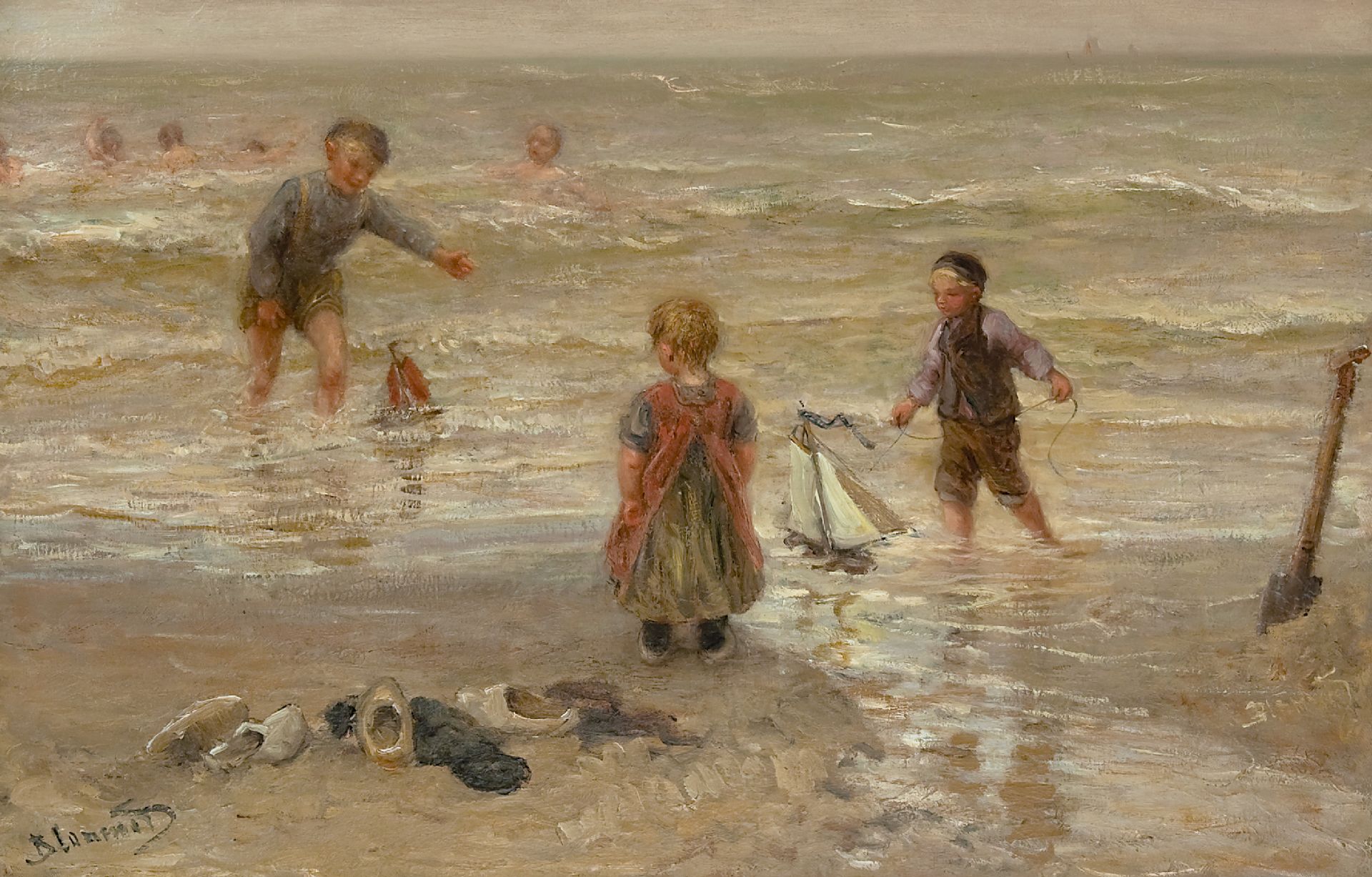
Bernard Blommers (1845-1914) Paintings for Sale
Paintings, watercolours and drawings for sale by painter Bernardus Johannes 'Bernard' Blommers. View all artworks with prices by the artist Blommers B.J.
simonis-buunk.com →Bernard Blommers, initially destined for a life as a lithographer in his father's printing company, decided at a young age to follow his heart and take evening classes at the Academi in The Hague. There he met Willem Maris. Together they regularly went outside to paint nature and in 1865 they made a trip along the Rhine. In the same year, Blommers made his debut at the Living Masters Exhibition in Amsterdam, where his entry was given a place of honor alongside a large beach view by Jozef Israëls. The twenty years older Israelis, who shortly afterwards became a friend for life, had a great influence on the work of Blommers. They both depicted the simple life of farmers and fishermen in Katwijk aan Zee and Scheveningen. But where Israelis usually portrayed the harsh living conditions of the fishing population, Blommers saw everything from the bright side and emphasized the cosiness of the dark fisherman's houses. As the father of a large and lively family, he painted the happy family life. His early works, mostly sunny beach scenes with bathing guests for which his children were modeled in Scheveningen costumes, have been worked out in detail, with a strong sense of color. Until around 1900 Blommers worked in Scheveningen and Zandvoort. But when Scheveningen developed more and more into a sophisticated seaside resort, he moved to Katwijk aan Zee. There he built the Villa Thérèse, named after his youngest daughter. Just like Israëls, Blommers had a 'Scheveningen corner' there. Blommers mainly spent summer and autumn in this fishing town; the rest of the year he was in The Hague and Scheveningen. Every year he also worked for a few weeks in Heeze in Brabant. The work of Blommers was very popular at home and abroad. Many of his paintings were traded via Goupil in Amsterdam to England, Scotland and the United States. At the height of his fame, around 1906, people had to pay around 8,000 guilders for a painting by him. Blommers enjoyed life and traveled to the United States several times, where he was even received by President Theodore Roosevelt. Later in his life, under the influence of Jacob Maris, Blommers develops a more impressionistic, loose touch, and then his light and muted colors determine the character of his paintings.
Excerpt from a page describing this subject · 40,000 chars · not written by Vinony
Wikidata facts
- Instance of
- human
- Gender
- male
- Citizenship
- Kingdom of the Netherlands
- Place of birth
- The Hague
- Place of death
- The Hague
- Movement
- Hague School
- Image
- Blommers-Haverman.jpg
Show 12 more facts
- Commons category
- Bernard Blommers
- date of birth
- 1845-01-31
- date of death
- 1914-12-15
- Commons Creator page
- Bernard Blommers
- member of
- Hague School
- birth name
- Bernardus Johannes Blommers
- name in native language
- Bernard Blommers
- has works in the collection
- Van Gogh Museum
- place of burial
- Oud Eik en Duinen
- start of work period
- 1868-01-01
- end of work period
- 1914-01-01
- described at URL
- www.vvnk.nl/monografieen/blommers-bernardus-johannes
Sources (4)
via Wikidata · CC0
Available in 12 languages
- Español
- Français
- Deutsch
- 日本語
- Português
- Bahasa Indonesia
- Basque
- Haitian Creole
- Nederlands
- Romanian
- Western Frisian
via Wikidata sitelinks · CC0