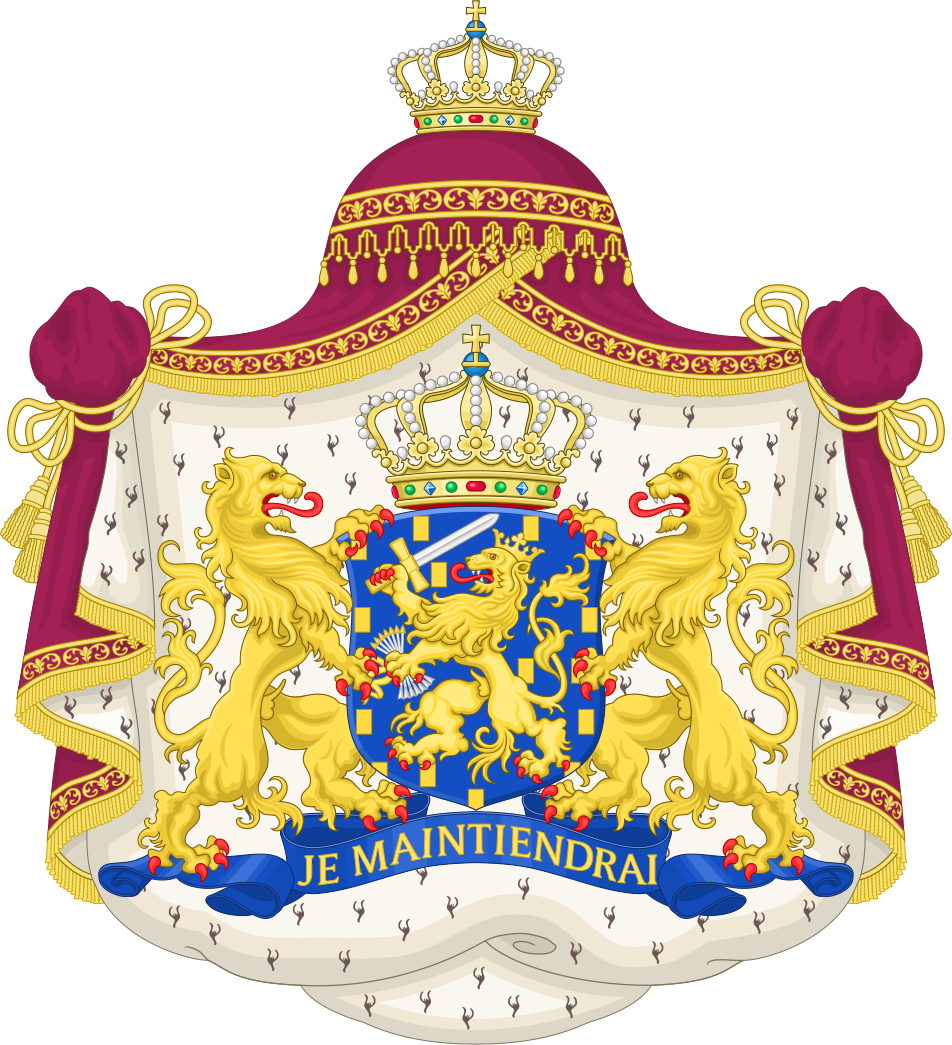
Also known as Netherlands, the Netherlands, Nederlanden
The Kingdom of the Netherlands, commonly known simply as the Netherlands, is a sovereign state consisting of a collection of constituent territories united under the monarch of the Netherlands, who functions as head of state. The realm is not a federation; it is a unitary monarchy with its largest subdivision, the eponymous Netherlands, predominantly located in Northwestern Europe and with three smaller island territories located in the Caribbean.
The Kingdom of the Netherlands is a sovereign country made up of several territories—including the Netherlands in Northwestern Europe and three Caribbean islands—all governed under a single monarch as head of state. It matters as a significant European and Caribbean power, operating as a unitary monarchy rather than a federation, which affects how its diverse territories are governed together.
AI-generated from the Wikipedia summary — may contain errors.
via Open-Meteo
All non-EEA/Swiss travellers must register their residence within 5 business days of entering the Netherlands with the Aliens' Police (Vreemdelingenpolitie) or the municipality responsible for your place of residence. Hotels normally will handle the registration formalities for their guests.
Applications for visas and long-term residence permits are handled by the IND. Travellers from Australia, Canada, Japan, Monaco, New Zealand, Vatican City, the UK, the US, South Korea, and Switzerland can enter the Netherlands without a provisional residence permit (MVV) to stay for more than 90 days for any purpose, but must complete registration formalities with the IND and obtain a residence within 90 days of entering, while all other foreign nationals will likely need a provisional residence permit visa to stay for longer than 90 days.
Dutch territories in the Caribbean are not part of the Schengen Area and have slightly different visa requirements from the European Netherlands, but in short, if you do not need a visa to visit the Netherlands, you can also visit these territories without a visa. You may visit the Dutch Caribbean with a valid Schengen visa, but Dutch Caribbean visas are not valid for visits to the European Netherlands.
The Netherlands is served by an extensive public transport network, making this a good way to get around and discover the main sights. Motorists can rely on an extensive system of (Auto)snelwegen (Highways/motorways) and Autowegen (semi-highways). Of course the Netherlands is known as one of the most bicycle-friendly countries in the world. A truly extensive bicycle infrastructure makes cycling an excellent way to get around.
One of the most popular local pastimes is cycling, which makes sense given how flat the country is. Nowadays, the Netherlands boasts 22,000 km of dedicated cycle paths, forming a dense web across the country. If you do decide to cycle, you'll notice just how easy it is: the numbered routes and multitude of signposts means it's almost impossible to get lost! There are also plenty of areas well-suited for scenic cycling, including the Green Heart, Hoge Veluwe National Park, South Limburg, and the Zaanstreek-Waterland. Winds can be strong (because of the flat lands), and winters can be cold and rainy.
There is no shortage of beaches along the 1,245 km of Dutch coastline. Popular activities include swimming and sunbathing, but these are mostly restricted to warm summer days. Expect Scheveningen to be extremely crowded when temperatures rise towards tropical levels. More mellow and family friendly beaches include Zandvoort, Bloemendaal, Bergen, Noordwijk, Katwijk and the West Frisian Islands. Texel also has some beautiful beaches, but be careful; some beaches are reserved for nature and it is strictly forbidden to enter those.
~37 min read
The Kingdom of the Netherlands, commonly known simply as the Netherlands, is a sovereign state consisting of a collection of constituent territories united under the monarch of the Netherlands, who functions as head of state. The realm is not a federation; it is a unitary monarchy with its largest subdivision, the eponymous Netherlands, predominantly located in Northwestern Europe and with three smaller island territories located in the Caribbean.
The four subdivisions of the Kingdom—Aruba, Curaçao, the Netherlands, and Sint Maarten—are constituent countries (landen in Dutch; sg. land) and participate on a basis of equality as partners in the Kingdom. All four are autonomous with their own parliaments, however, the Kingdom itself is administered in the constituent country of the Netherlands, which comprises roughly 98% of the Kingdom's land area and population, with matters like foreign policy and defence done on behalf of the entire Kingdom.
via REST Countries
via World Bank Open Data · CC BY 4.0
via Wikimedia Pageviews API
via Wikidata · CC0
Water sports is another activity mostly undertaken by the locals. Lakes can be found in every province, but the Frisian Lakes are outstanding, especially during the annual Sneekweek that starts the boating season. Boating can be done without licence as long as the boat is not longer than 15m and/or faster than 20 km/h. Other lake-rich areas …
A wide range of accommodation is available, concentrated in the major tourist destinations. They include regions popular for domestic tourism, such as the Veluwe and Zuid-Limburg.
The Netherlands has some of the best tap water in the world. It is even considered to be of similar or better quality than bottled natural mineral or spring water due to high standards that are strictly enforced and are even more strict than the already high food standards. Due to the high quality of both the water production and the distribution network, there is no need to add chlorine. At the majority of the train stations and even in some natural reserves, there is a water tap point, where the water is also of very good quality. Food (either bought in a supermarket or eaten at a restaurant) shouldn't pose any problems either.
The health care system of the Netherlands is up to par with the rest of Europe. Hospitals are mostly situated in larger cities, and all have English-speaking medical staff. General practitioners can be found in almost all towns, except for small villages, and they can typically speak English too. In case of a potential life-threatening emergency: call 112 and if necessary an ambulance will be sent and bring you to the most suitable emergency department (Dutch: Spoedeisende Hulp/SEH) of a hospital. In case of a non-life-threatening emergency call the local GP (Dutch: Huisarts) during office hours or the night GP (Dutch: Huisartsenpost) after office hours. If necessary the GP will send an ambulance or make a referal to the most suitable emergency department. If you have a non-life-threatening emergency do not go to the emergency department without ref…
The Dutch have a reputation of being among most informal and easy-going people in Europe, and there are few strict social taboos to speak of. It's unlikely that Dutch people will be offended simply by your behaviour or appearance. Similar to their German neighbours, Dutch people value honesty, being straightforward, and not beating around the bush. Visitors from the Anglosphere are often taken aback by the directness of Dutch people in conversations, but rarely do they intend to offend. Nevertheless, the standards for overt rudeness and hostility are similar to those in other western European countries.
The Dutch have a strong culture of egalitarianism, and it is considered vulgar to ask people about their personal wealth or reveal how rich you are. Service staff such as waiters, cleaners, hotel staff, shop workers and drivers expect that customers will treat them as equals.
It is not advisable to be forceful about your own religion or to assume a Dutch person you've met is a Catholic or a Calvinist, since in most of the country, religion only plays a modest role and many people are not religious. In urban areas it's not considered rude to ask somebody about this, but you'll generally be expected to be entirely tolerant of whatever the other person believes and not attempt to proselytise in any way. Openly religious behaviour is usually met with bewilderment and ridicule rather than hostility. An exception is the Dutch Bible Belt which runs from Zeeland into South Holland, …
The country code for the Netherlands is 31. The outbound international prefix is 00 (e.g. to call the US, substitute 00 1 for +1 and for the UK 00 44 for +44.)
The cellular phone networks in the Netherlands are operated by KPN, VodafoneZiggo and Odido; other operators use one of these 3 networks. All providers offer 4G coverage in almost every corner of the Netherlands, and 5G is at almost the same level. Note that 3G networks have been turned off, and 2G is only available at KPN and VodafoneZiggo, mainly for business purposes.
If you're bringing your own (GSM) cell phone to call (or receive calls) whilst in the Netherlands, make sure to check the relevant "roaming" charges for your provider, as they vary substantially. Receiving phone calls on a cell phone using a Dutch SIM card is free in most cases; charges may apply if you're using a foreign SIM card, as the call is theoretically routed through your country of origin. It may be cheaper to buy a pay-as-you-go SIM card to insert into your GSM phone, or even to buy a very cheap pay-as-you-go card+phone bundle. Providers that specialise in discount rates to foreign countries include Lyca and Lebara.
As of January 2023, there are no public phone booths left in the Netherlands.
0800 numbers are toll-free while 09xx numbers are charged at premium rates. Mobile phones have numbers in the 06 range, and calls to cell phones are also priced at higher rates. (National) Directory Inquiries can be reached via 1888, 1850 and various…
Travel guide from Wikivoyage (CC BY-SA 4.0)
via Wikidata sitelinks · CC0
Discovered by embedding cosine similarity (sentence-transformers MiniLM, 384-dim).