File:Alfa_beta_gamma_radiation.svg · Wikimedia Commons · See Wikimedia Commons
beta particle
Sign in to saveAlso known as β-particle, β particle, beta particles
high-energy, high-speed electron or positron emitted during beta decay
A beta particle is a high-speed electron or positron released when certain unstable atoms break down in a process called beta decay. Understanding beta particles matters because they help scientists study radioactive materials and are used in medical applications like PET scans for detecting diseases.
AI-generated from the Wikipedia summary — may contain errors.
Research
23,195 papers- Alpha and Beta Radiation for Theragnostics.ReviewPET clinics · 2024Song H, Sgouros GDOI: 10.1016/j.cpet.2024.03.006
- Radiation Imagers for Quantitative, Single-particle Digital Autoradiography of Alpha- and Beta-particle Emitters.ReviewSeminars in nuclear medicine · 2018Miller BWDOI: 10.1053/j.semnuclmed.2018.02.008
- Therapeutic Radiometals Beyond (177)Lu and (90)Y: Production and Application of Promising α-Particle, β(-)-Particle, and Auger Electron Emitters.ReviewJournal of nuclear medicine : official publication, Society of Nuclear Medicine · 2017Müller C, van der Meulen NP, Benešová M et al.DOI: 10.2967/jnumed.116.186825
- Radiation.ReviewIARC monographs on the evaluation of carcinogenic risks to humans · 2012IARC Working Group on the Evaluation of Carcinogenic Risks to Humans
- Heterogeneity of absorbed dose distribution in kidney tissues and dose-response modelling of nephrotoxicity in radiopharmaceutical therapy with beta-particle emitters: A review.ReviewZeitschrift fur medizinische Physik · 2024Saldarriaga Vargas C, Andersson M, Bouvier-Capely C et al.DOI: 10.1016/j.zemedi.2023.02.006
- Targeted β(-)-Particle Plus Conversion and Auger-Electron Therapy with (161)Tb-Labeled Somatostatin Receptor Antagonist DOTA-LM3: A Phase 0 Study.Journal of nuclear medicine : official publication, Society of Nuclear Medicine · 2026Fricke JG, Westerbergh F, McDougall L et al.DOI: 10.2967/jnumed.125.270654
- Monte Carlo simulation of beta particle-induced bremsstrahlung doses.Journal of radiological protection : official journal of the Society for Radiological Protection · 2018Mrdja D, Bikit K, Bikit I et al.DOI: 10.1088/1361-6498/aa928f
- Thermoluminescence analysis of beta particle irradiated Gd(1-x)Eu(x)AlO(3) phosphors.Applied radiation and isotopes : including data, instrumentation and methods for use in agriculture, industry and medicine · 2022Alonso Sotolongo A, Rivera Montalvo T, Nolasco Altamirano D et al.DOI: 10.1016/j.apradiso.2022.110471
via PubMed
Wikidata facts
- Subclass of
- ionizing radiation
- Part of
- beta radiation
- Named after
- beta
- Image
- Beta-plus Decay.svg
Show 2 more facts
- different from
- beta decay
- on focus list of Wikimedia project
- Wikipedia:Vital articles/Level/4
Sources (3)
via Wikidata · CC0
~11 min read
Encyclopedic overview
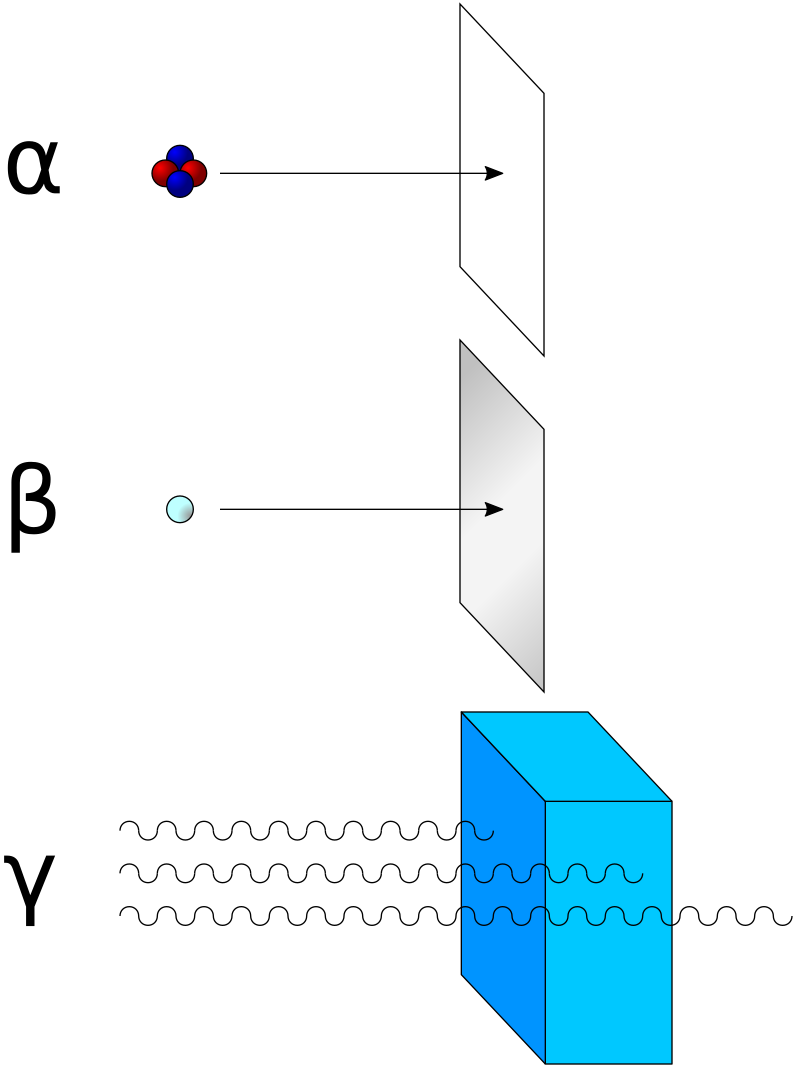
Alpha radiation consists of helium nuclei and is readily stopped by a sheet of paper. Beta radiation, consisting of electrons or positrons, is stopped by a thin aluminium plate, but gamma radiation requires shielding by dense material such as lead or concrete.
A beta particle, also called beta ray or beta radiation (symbol β), is a high-energy, high-speed electron or positron emitted by the radioactive decay of an atomic nucleus, known as beta decay. There are two forms of beta decay, β decay and β decay, which produce electrons and positrons, respectively.
Excerpted from Wikipedia’s “beta particle” article, available under the CC BY-SA 4.0 licence.
Gallery (5)
Available in 69 languages
- Español
- Français
- Deutsch
- 中文
- 日本語
- Русский
- Português
- Italiano
- العربية
- हिन्दी
- Afrikaans
- Aragonese
- Armenian
- Asturian
- Azerbaijani
- Bahasa Indonesia
- Bangla
- Basque
Show 50 more
- Belarusian
- Bosnian
- Bulgarian
- Burmese
- Catalan
- Central Kurdish
- Croatian
- Czech
- Estonian
- Galician
- Greek
- Haitian Creole
- Hebrew
- Hungarian
- Interlingua
- Irish
- Kannada
- Kazakh
- Kurdish
- Latvian
- Ligurian
- Lithuanian
- Macedonian
- Malay
- Malayalam
- Mongolian
- Nederlands
- Norwegian
- Norwegian Nynorsk
- Polski
- Punjabi
- Serbian
- Serbian (Latin)
- simple
- Sinhala
- Slovak
- Slovenian
- Tajik
- Tamil
- Tiếng Việt
- Türkçe
- Ukrainian
- Uzbek
- Waray
- Western Panjabi
- Wu Chinese
- zh_yue
- فارسی
- ไทย
- 한국어
via Wikidata sitelinks · CC0