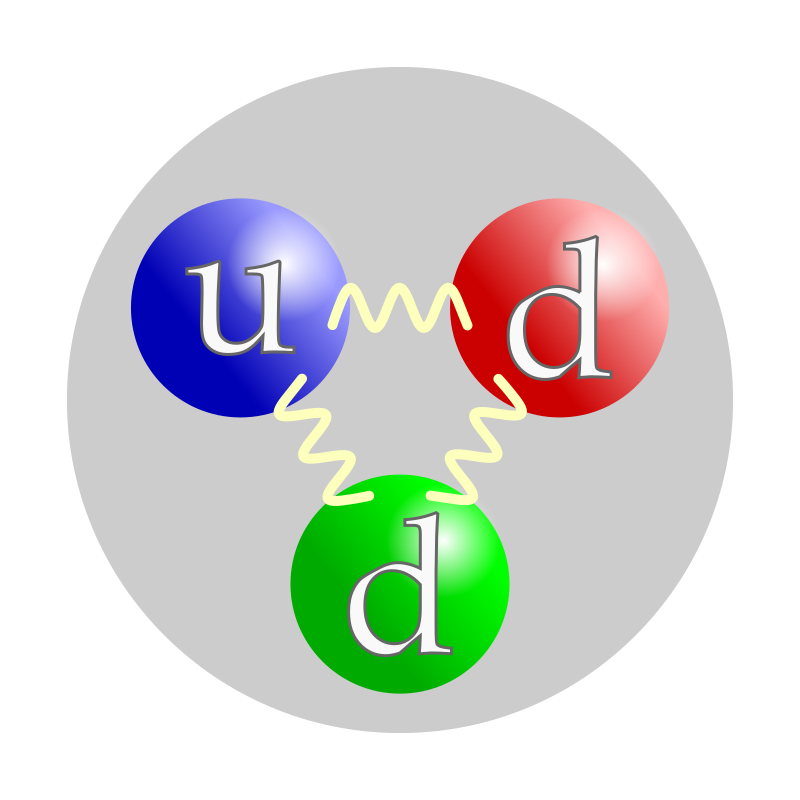
File:Quark_structure_neutron.svg · Wikimedia Commons · See Wikimedia Commons
neutron
Sign in to saveAlso known as N, n, neutrons
A neutron is a subatomic particle, symbol or , that has no electric charge, and a mass slightly greater than that of a proton. The neutron was discovered by James Chadwick in 1932, leading to the discovery of nuclear fission in 1938, the first self-sustaining nuclear reactor (Chicago Pile-1, 1942), and the first nuclear weapon (Trinity, 1945).
OverviewAI-generated
A neutron is a subatomic particle with an atomic number of 0 and a neutron number of 1. It possesses a spin quantum number of 0.5 and an isospin quantum number of 0.5. The particle has a parity quantum number of 1 and a binding energy of 0. Its electric charge is recorded as 0 and -0.0000000000000000000002.
The mass of a neutron is 939.565413, with a mass excess of 8071.31713. It has a mean lifetime of 1040 and a half-life of 10.183. The magnetic moment is -1.91304273 and -1.9130427. Its g-factor is -3.8260845 and its gyromagnetic ratio is 183247172. The electric dipole moment is 0.000000000000000000000000018.
Neutrons were discovered in 1932. The subject is categorized under "Neutrons" on Commons. It is referenced by 1,673 other encyclopedia articles. There are 44,330 PubMed entries related to the term.
Synthesized by Vinony from 22 facts across 3 sources: Wikidata, PubMed, Vinony graph. Generated from structured data (not the Wikipedia text) and checked against those facts — may still contain errors.
Key facts
- Particle.classification
- Baryon
- Particle.name
- Neutron
- Particle.image
- 250px
- Particle.caption
- The quark content of a neutron. The color assignment of individual quarks is arbitrary, but all three colors must be present. Forces between quarks are mediated by gluons.
- Particle.group
- Hadron
- Particle.composition
- 1 up quark, 2 down quarks
- Particle.statistics
- Fermionic
- Particle.interaction
- Gravity, weak, strong, electromagnetic
- Particle.antiparticle
- Antineutron
- Particle.theorized
- Ernest Rutherford (1920)
- Particle.discovered
- James Chadwick (1932)
- Particle.symbol
- , ,
- Particle.mean_lifetime
- (free)
- Particle.electric_charge
- (experimental limits)
- Particle.electric_dipole_moment
- < (experimental upper limit)
- Particle.magnetic_moment
- Neutron magnetic moment| J·T−1
- Particle.spin
- ħ
- Particle.isospin
- −
via Wikipedia infobox
Research
44,330 papers- Neutron brachytherapy in the modern era: Indications and evidence.Cancer radiotherapie : journal de la Societe francaise de radiotherapie oncologique · 2023Loap P, Barcellini A, de Marzi L et al.DOI: 10.1016/j.canrad.2022.08.010
- Neutron dose and its measurement in proton therapy-current State of Knowledge.ReviewThe British journal of radiology · 2020Hälg RA, Schneider UDOI: 10.1259/bjr.20190412
- An investigation into neutron-induced bystander effects: How low can you go?ReviewEnvironmental research · 2019Lad J, Rusin A, Seymour C et al.DOI: 10.1016/j.envres.2019.04.033
- Neutron radiotherapy for malignant gliomas.ReviewAmerican journal of clinical oncology · 1989Griffin BR, Berger MS, Laramore GE et al.DOI: 10.1097/00000421-198908000-00007
- Neutron dose from a 6-MV X-ray beam in radiotherapy.Radiological physics and technology · 2023Matsubara HDOI: 10.1007/s12194-023-00705-6
- Neutron relative biological effectiveness in Hiroshima and Nagasaki atomic bomb survivors: a critical review.ReviewJournal of radiation research · 2016Sasaki MS, Endo S, Hoshi M et al.DOI: 10.1093/jrr/rrw079
- Neutron microscopy. The low-damage imaging of specialized organic materials.ReviewCell biophysics · 1985Steinbach ADOI: 10.1007/BF02788636
- Neutron dosimetry in low-earth orbit using passive detectors.ReviewRadiation measurements · 2001Benton ER, Benton EV, Frank AL et al.DOI: 10.1016/s1350-4487(01)00047-6
via PubMed
Wikidata facts
- Subclass of
- fermion
- Part of
- neutronium
- Has part
- up quark
- Followed by
- dineutron
- Mass
- 1.008966491595
- Image
- Neutron quark structure.svg
Show 26 more facts
- Monte Carlo Particle Number
- 2112
- parity quantum number
- 1
- Commons category
- Neutrons
- interaction
- electromagnetic interaction
- decays to
- protium
- topic's main category
- Category:Neutron
- spin quantum number
- 0.5
- isospin quantum number
- 0.5
- g-factor
- -3.8260845
- antiparticle
- antineutron
- gyromagnetic ratio
- 183247172
- atomic number
- 0
- neutron number
- 1
- mean lifetime
- 878.4
- half-life
- 10.183
- magnetic moment
- -1.9130427
- electric charge
- -0.0000000000000000000002
- discoverer or inventor
- James Chadwick
- mass excess
- 8071.31713
- binding energy
- 0
- time of discovery or invention
- 1932-00-00
- different from
- neutronium
- electric dipole moment
- 0.000000000000000000000000018
- on focus list of Wikimedia project
- Wikipedia:Vital articles/Level/4
- studied by
- neutron transport
- Stack Exchange tag
- astronomy.stackexchange.com/tags/neutrons
Sources (7)
via Wikidata · CC0
~43 min read
Encyclopedic overview
31 sectionsContents
- Discovery
- Occurrence
- Atomic nucleus
- Free neutron
- Dineutrons and tetraneutrons
- Neutron stars and neutron matter
- Composition
- Beta decay
- Properties
- Mass
- Spin
- Magnetic moment
- Electric charge
- Electric dipole moment
- Antineutron
- Detection
- Neutron detection by neutron capture
- Neutron detection by elastic scattering
- Sources and production
- Neutron beams and modification of beams after production
- Applications
- Nuclear energy
- Other uses
- Medical therapies
- Health risks
- Neutron temperature
- See also
- Neutron sources
- Processes involving neutrons
- References
- Further reading
A neutron is a subatomic particle, symbol or , that has no electric charge, and a mass slightly greater than that of a proton. The neutron was discovered by James Chadwick in 1932, leading to the discovery of nuclear fission in 1938, the first self-sustaining nuclear reactor (Chicago Pile-1, 1942), and the first nuclear weapon (Trinity, 1945).
Neutrons are found, together with a similar number of protons in the nuclei of atoms. Atoms of a chemical element that differ only in neutron number are called isotopes. Free neutrons are produced copiously in nuclear fission and fusion. They are a primary contributor to the nucleosynthesis of chemical elements within stars through fission, fusion, and neutron capture processes. Neutron stars, formed from massive collapsing stars, consist of neutrons at the density of atomic nuclei but a total mass more than the Sun.
Excerpted from Wikipedia’s “neutron” article, available under the CC BY-SA 4.0 licence.
Gallery (22)
Available in 140 languages
- Español
- Français
- Deutsch
- 中文
- 日本語
- Русский
- Português
- Italiano
- العربية
- हिन्दी
- Afrikaans
- Albanian
- Albanian
- Angika
- Aragonese
- Armenian
- Assamese
- Asturian
Show 121 more
- azb
- Azerbaijani
- Bahasa Indonesia
- Bangla
- Basque
- bat_smg
- be_x_old
- Belarusian
- Bikol
- Bosnian
- Breton
- Buginese
- Bulgarian
- Burmese
- Catalan
- cdo
- Cebuano
- Central Kurdish
- Chuvash
- Colognian
- Croatian
- Czech
- Danish
- Esperanto
- Estonian
- Faroese
- Fiji Hindi
- Filipino
- Finnish
- fiu_vro
- Galician
- gcr
- Georgian
- Greek
- Haitian Creole
- Hebrew
- Hungarian
- Icelandic
- Ido
- Interlingua
- Interlingue
- Irish
- Jamaican Creole English
- Kabyle
- Kalmyk
- Kannada
- Karachay-Balkar
- Kashmiri
- Kazakh
- kbp
- Kurdish
- Kyrgyz
- Lao
- Latin
- Latvian
- Ligurian
- Limburgish
- Lingala
- Lingua Franca Nova
- Lithuanian
- Lombard
- Low German
- Luxembourgish
- Macedonian
- Malay
- Malayalam
- Marathi
- Mingrelian
- Mongolian
- Moroccan Arabic
- Nederlands
- Nepali
- Newari
- Northern Frisian
- Norwegian
- Norwegian Nynorsk
- Novial
- Occitan
- Pashto
- Piedmontese
- Polski
- Punjabi
- Quechua
- Romanian
- Saterland Frisian
- Serbian
- Serbian (Latin)
- Sicilian
- simple
- Sindhi
- Sinhala
- skr
- Slovak
- Slovenian
- Somali
- Sundanese
- Svenska
- Swahili
- Tamil
- Tatar
- Telugu
- Tiếng Việt
- Türkçe
- Ukrainian
- Urdu
- Uzbek
- Venetian
- Waray
- Welsh
- Western Frisian
- Western Panjabi
- Wolof
- Wu Chinese
- Yiddish
- zh_classical
- zh_min_nan
- zh_yue
- Zulu
- فارسی
- ไทย
- 한국어
via Wikidata sitelinks · CC0