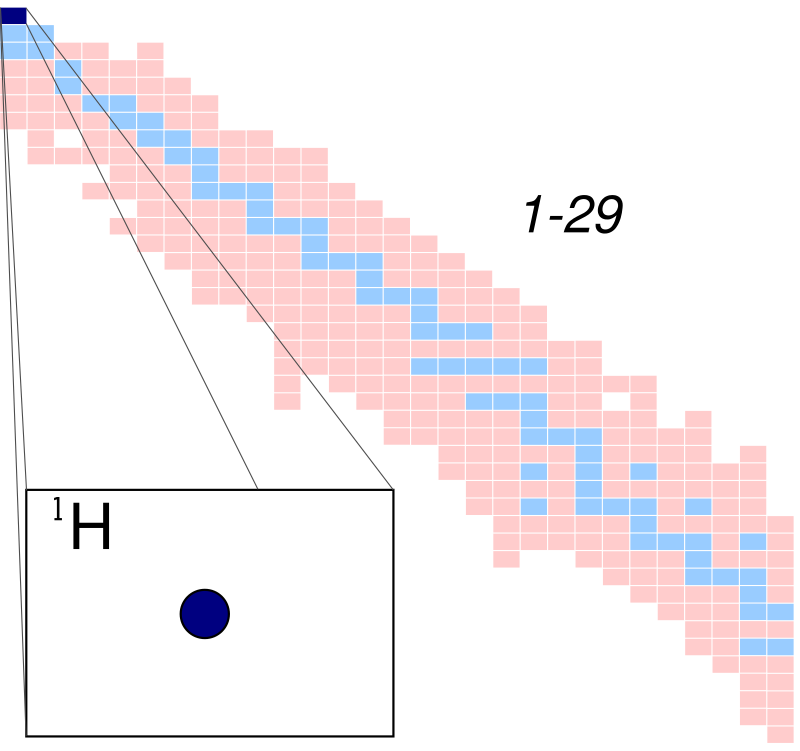
File:Hydrogen_1.svg · Wikimedia Commons · See Wikimedia Commons
hydrogen atom
Sign in to saveatom of element hydrogen
Key facts
- Symbol
- H
- Names
- hydrogen atom, protium
- Natural abundance
- 99.985%
- Half life t 1 2
- stable
- Isotope mass
- 1.007825 Da
- Spin
- 1 / 2 ħ
- Excess energy
- 7 288 .969 ± 0.001 keV
- Nuclear binding energy
- 0.000 ± 0.0000 keV
via Wikipedia infobox
Wikidata facts
- Subclass of
- atom
- Part of
- dihydrogen
- Has part
- electron
Show 4 more facts
Sources (2)
via Wikidata · CC0
~35 min read
Encyclopedic overview
Depiction of a hydrogen atom showing the diameter as about twice the Bohr model radius. (Image not to scale) A hydrogen atom is an atom of the chemical element hydrogen. The electrically neutral hydrogen atom contains a single positively charged proton in the nucleus, and a single negatively charged electron bound to the nucleus by the Coulomb force. Atomic hydrogen constitutes about 75% of the baryonic mass of the universe.
In everyday life on Earth, isolated hydrogen atoms (called "atomic hydrogen") are extremely rare. Instead, a hydrogen atom tends to combine with other atoms in compounds, or with another hydrogen atom to form ordinary (diatomic) hydrogen gas, H2. "Atomic hydrogen" and "hydrogen atom" in ordinary English use have overlapping, yet distinct, meanings. For example, a water molecule contains two hydrogen atoms, but does not contain atomic hydrogen (which would refer to isolated hydrogen atoms).
Excerpted from Wikipedia’s “hydrogen atom” article, available under the CC BY-SA 4.0 licence.