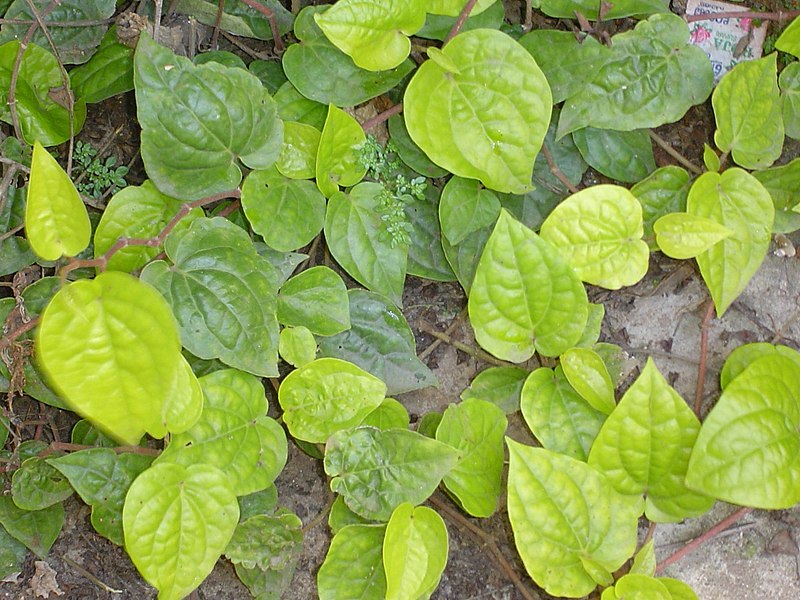
File:Piper_betle_plant.jpg · Wikimedia Commons · See Wikimedia Commons
betel
Sign in to saveAlso known as Piper betle
Betel (Piper betle) is a species of flowering plant in the pepper family Piperaceae, native to Southeast Asia. It is an evergreen, dioecious vine, with glossy heart-shaped leaves and white catkins. Betel plants are cultivated for their leaves, which are most commonly used as flavoring for chewing areca nut in so-called betel quid (often confusingly referred to as "betel nut"), which is toxic (as it is a psychostimulant drug) and is associated with a wide range of serious health conditions.
OverviewAI-generated
Piper betle, commonly known as betelpeper, is a species of plant within the genus Piper. It is classified as a useful plant and serves various purposes, including as a medicinal plant, food, flavor enhancer, and stimulant foodstuff. The species is distinct from the areca nut.
The taxonomic range for Piper betle includes Fujian, the Tibet Autonomous Region, Guangdong, and Myanmar. The plant is not extinct. While some sources list the common name "Areca Palm" and associate the name "betel" with Areca catechu in the family Arecaceae, the primary subject here is the Piper species.
Synthesized by Vinony from 28 facts across 5 sources: Wikidata, iNaturalist, PubMed, Plants of the World, Vinony graph. Generated from structured data (not the Wikipedia text) and checked against those facts — may still contain errors.
Species
Areca Palm
species
Climbers dioecious. Stems rooted at nodes, 2.5-5 mm thick, slightly woody. Petiole 2-5 cm, very finely powdery pubescent; prophylls ca. 1/3 as long as petioles; leaf blade ovate to ovate-oblong, those at apex of stem sometimes elliptic, 7-15 × 5-11 cm, papery to ± leathery, abaxially densely glandular with very finely powdery pubescent veins, adaxially glabrous, base cordate, sometimes rounded in leaf blades toward apex of stem, symmetric or nearly so, apex acuminate; veins 7, apical pair arising 0.7-2 cm above base, usually opposite, others basal; reticulate veins conspicuous. Spikes leaf-opposed. Male spikes nearly as long as leaf blades at anthesis; peduncle nearly as long as petioles; rachis pubescent; bracts orbicular or suborbicular, rarely obovate, 1-1.3 mm wide, peltate, ± sessile. Stamens 2; filaments thick, ca. as long as anthers or longer; anthers reniform. Female spikes 3-5 × ca. 1 cm, longer in fruit; rachis fleshy, densely pubescent. Ovary partly immersed in and connate to rachis, apex tomentose; stigmas usually 4 or 5, lanceolate, tomentose. Drupes fused to form terete, fleshy, reddish, compound fruit, apices tomentose, prominent. Fl. May-Jul.
via · Kew POWO
Research
3,081 papers- Betel cytotoxicity.ReviewJournal of ethnopharmacology · 1989Sen S, Talukder G, Sharma ADOI: 10.1016/0378-8741(89)90096-2
- Investigating Betel Nut Use, Antecedents and Consequences: A Review of Literature.ReviewSubstance use & misuse · 2020Joo YJ, Newcombe D, Nosa V et al.DOI: 10.1080/10826084.2019.1666144
- Betel: consumption and consequences.ReviewJournal of the American Academy of Dermatology · 1998Norton SADOI: 10.1016/s0190-9622(98)70543-2
- From betel nuts to Cobenfy: how an ancient recreational drug gave rise to a new class of schizophrenia medications.ReviewCNS spectrums · 2025Creeden JF, Machiraju SN, Amin JB et al.DOI: 10.1017/S1092852925100424
- Betel Quid Use and Tuberculosis Transmission: A Neglected Focus Area for Tuberculosis Control in Low- and Middle-Income Countries.ReviewOpen forum infectious diseases · 2024Manghani P, Prasad N, Khatri N et al.DOI: 10.1093/ofid/ofae577
- Betel chewer's mucosa--a review.ReviewJournal of oral pathology & medicine : official publication of the International Association of Oral Pathologists and the American Academy of Oral Pathology · 1998Reichart PA, Phillipsen HPDOI: 10.1111/j.1600-0714.1998.tb01949.x
- Betel Quid Health Risks of Insulin Resistance Diseases in Poor Young South Asian Native and Immigrant Populations.ReviewInternational journal of environmental research and public health · 2020de la Monte SM, Moriel N, Lin A et al.DOI: 10.3390/ijerph17186690
- Betel nut chewing and the risk of chronic kidney disease: evidence from a meta-analysis.ReviewInternational urology and nephrology · 2018Wang M, Yu SY, Lv ZT et al.DOI: 10.1007/s11255-018-1819-8
via PubMed
Wikidata facts
- Instance of
- taxon
- Subclass of
- useful plant
- Parent taxon
- Piper
- Image
- Betel leaves for selling in the market 01.jpg
- Has use
- psychoactive drug
Show 11 more facts
- taxon rank
- species
- taxon name
- Piper betle
- Commons category
- Piper betle
- Commons gallery
- Piper betle
- taxon common name
- 蒟酱
- different from
- areca nut
- short name
- P. betle
- taxon author citation
- L.
- taxon range
- Myanmar
- external data available at URL
- www.gbif.org/dataset/93725bf2-6ada-47f9-bd5e-0e679e3d245e
Sources (7)
via Wikidata · CC0
~12 min read
Encyclopedic overview
13 sectionsContents
- Etymology
- Distribution
- Cultivation
- Cultural significance
- Health effects
- Chemical composition
- Genome
- Economics
- Gallery
- See also
- References
- Further reading
- External links
Betel (Piper betle) is a species of flowering plant in the pepper family Piperaceae, native to Southeast Asia. It is an evergreen, dioecious vine, with glossy heart-shaped leaves and white catkins. Betel plants are cultivated for their leaves, which are most commonly used as flavoring for chewing areca nut in so-called betel quid (often confusingly referred to as "betel nut"), which is toxic (as it is a psychostimulant drug) and is associated with a wide range of serious health conditions.
==Etymology== The term betel was derived from the Malayalam/Tamil word vettila via Portuguese.
Excerpted from Wikipedia’s “betel” article, available under the CC BY-SA 4.0 licence.
Gallery (27)
Available in 76 languages
- Español
- Français
- Deutsch
- 中文
- 日本語
- Русский
- Português
- Italiano
- العربية
- हिन्दी
- Achinese
- Asturian
- Azerbaijani
- Bahasa Indonesia
- Balinese
- Bangla
- Batak Toba
- Bikol
Show 57 more
- Burmese
- Catalan
- Cebuano
- Central Dusun
- Croatian
- Czech
- Egyptian Arabic
- Esperanto
- Filipino
- Finnish
- Georgian
- Goan Konkani
- Gorontalo
- Greek
- Ido
- Irish
- Javanese
- Kannada
- kge
- Latin
- Latvian
- Lithuanian
- Madurese
- Maithili
- Malay
- Malayalam
- Marathi
- Minangkabau
- Nederlands
- Nepali
- Newari
- Nias
- Odia
- Polski
- Punjabi
- pwn
- Sanskrit
- Santali
- Scots
- Serbian
- Sinhala
- Sundanese
- Svenska
- Tamil
- Telugu
- Tiếng Việt
- Tok Pisin
- Tulu
- Türkçe
- Ukrainian
- Upper Sorbian
- Waray
- Wu Chinese
- zh_yue
- فارسی
- ไทย
- 한국어
via Wikidata sitelinks · CC0