File:Bigos_(1).jpg · Wikimedia Commons · See Wikimedia Commons
bigos
Sign in to saveAlso known as traditional Polish dish
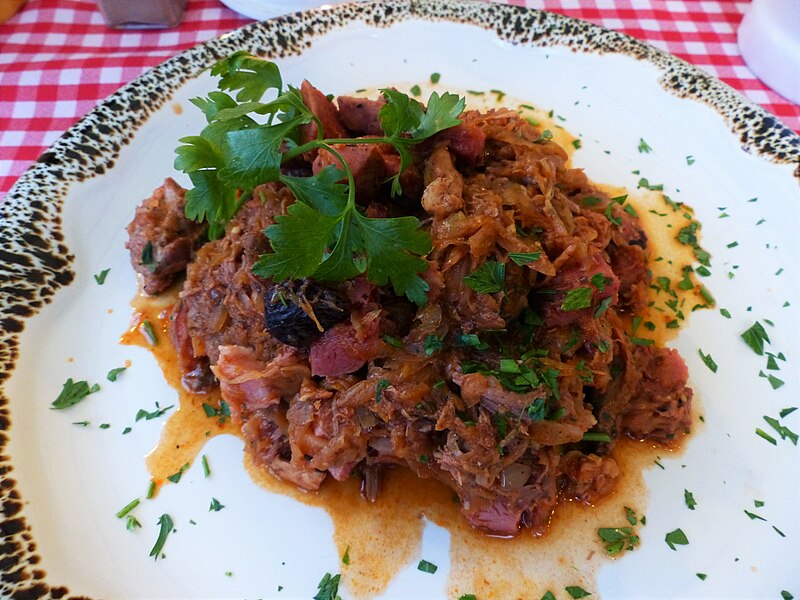
Bigos (), '''hunter's stew''', is a Polish dish of chopped meat of various kinds stewed with sauerkraut, shredded fresh cabbage and spices. It is served hot and can be enriched with additional vegetables and wine. Originally from Poland, the dish also became traditional in the areas of the vast Polish–Lithuanian Commonwealth.
Key facts
- Food.no_commons
- true
- Food.no_recipes
- true
- Food.name
- Bigos
- Food.image
- Bigos (1).jpg
- Food.caption
- A plate of bigos
- Food.alt
- A plate of bigos
- Food.place_of_origin
- Poland
- Food.associated_cuisine
- Polish
- Food.region
- Central Europe and Eastern Europe
- Food.type
- Stew
- Food.course
- Hot starter or main dish
- Food.served
- Hot
- Food.main_ingredient
- Various meats, sauerkraut, cabbage
via Wikipedia infobox
Wikidata facts
- Instance of
- dish
- Subclass of
- food
- Part of
- Polish cuisine
- Country of origin
- Poland
- Material used
- Brassica oleracea var. capitata
- Image
- Bigos in Kraków (Rynek Główny).jpg
Show 2 more facts
- Commons category
- Bigos
- native label
- bigos
Sources (3)
via Wikidata · CC0
~11 min read
Encyclopedic overview
11 sectionsContents
- Etymology
- Ingredients and preparation
- Varieties
- Serving
- History
- In culture
- See also
- Notes
- References
- Sources
- External links
Bigos (), '''hunter's stew, is a Polish dish of chopped meat of various kinds stewed with sauerkraut, shredded fresh cabbage and spices. It is served hot and can be enriched with additional vegetables and wine. Originally from Poland, the dish also became traditional in the areas of the vast Polish–Lithuanian Commonwealth.
== Etymology == The Polish word ' is probably of Italian or German origin, but its exact etymology is disputed. According to the Polish loanword dictionary edited by Elżbieta Sobol, it may derive from German ', meaning "doused" or "basted". Jerzy Bralczyk similarly derives the word from archaic German ', "sauce". Aleksander Brückner has proposed the German ', "piece of lead", as a possible source, referring to a tradition of divining from strangely shaped flakes of molten lead dropped into water. Maria Dembińska rejects this etymology as "doubtlessly erroneous", suggesting instead either archaic German ', "to chop", or old German ' (' in modern German), meaning "mugwort" (Artemisia vulgaris), a herb that was popular in medieval cuisine. Andrzej Bańkowski also points to the Italian ', or "pot for cooking soup", as a possible derivation via German.
Excerpted from Wikipedia’s “bigos” article, available under the CC BY-SA 4.0 licence.