(c) Kent Ross, some rights reserved (CC BY-NC), uploaded by Kent Ross · cc-by-nc
Black-capped Chickadee
Sign in to saveAlso known as Poecile atricapillus
species of small, non-migratory, North American songbird
Species
Least ConcernBlack-capped Chickadee
species
via IUCN
Wikidata facts
Show 8 more facts
- taxon rank
- species
- taxon name
- Poecile atricapillus
- Commons category
- Poecile atricapillus
- Commons gallery
- Poecile atricapillus
- habitat
- North America
- IUCN conservation status
- Least Concern
- taxon common name
- chapim-de-barrete-preto
- taxon author citation
- (Linnaeus, 1766)
via Wikidata · CC0
~27 min read
Encyclopedic overview
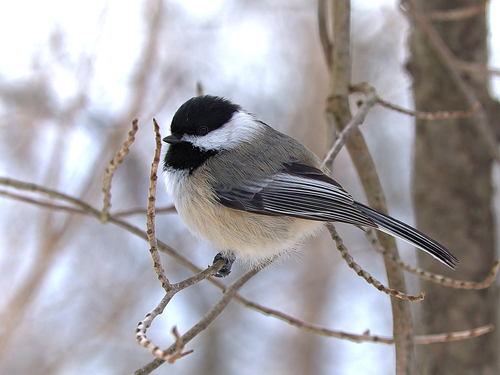
The black-capped chickadee (Poecile atricapillus) is a small, nonmigratory, North American passerine bird that lives in deciduous and mixed forests. It is a member of the Paridae family, also known as tits. It has a distinct black cap on its head, a black bib underneath, and white cheeks. It has a white belly, buff sides, and grey wings, back, and tail. The bird is well known for its vocalizations, including its fee-bee song and its chick-a-dee-dee-dee call, from which it derives its name.
The black-capped chickadee is widely distributed throughout North America, ranging from the northern United States to southern Canada and all the way up to Alaska and Yukon. It feeds primarily on insects and seeds, and is known for its ability to cache food for use during the winter. The hippocampus of the black-capped chickadee grows during the caching season, which is believed to help it better remember its cache locations. The black-capped chickadee is a social bird and forms strict dominance hierarchies within its flock. During the winter, these flocks include other bird species. It has the ability to lower its body temperature during cold winter nights, allowing it to conserve energy.
Excerpted from Wikipedia’s “Black-capped Chickadee” article, available under the CC BY-SA 4.0 licence.