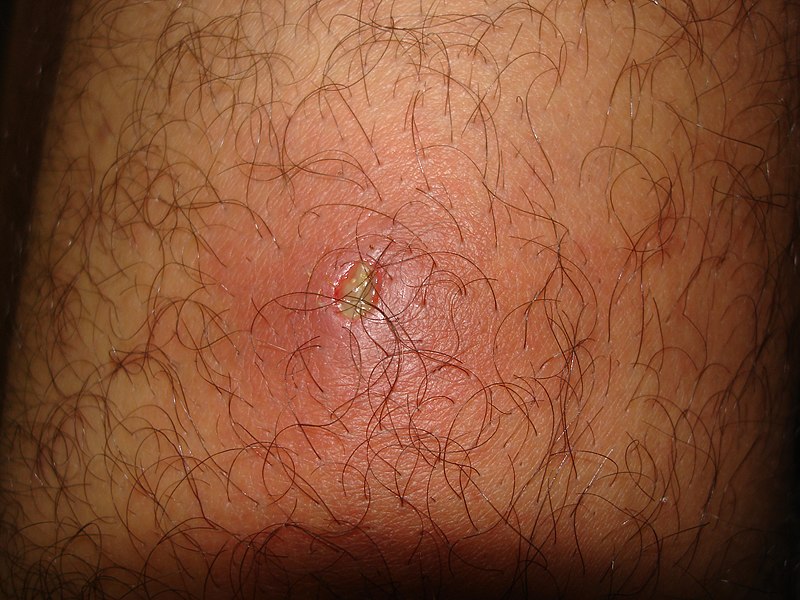
File:Furoncle.jpg · Wikimedia Commons · See Wikimedia Commons
boil
Sign in to saveAlso known as furuncle
A boil, also called a furuncle, is a deep folliculitis, which is an infection of the hair follicle. It is most commonly caused by infection by the bacterium Staphylococcus aureus, resulting in a painful swollen area on the skin caused by an accumulation of pus and dead tissue. Boils are therefore basically pus-filled nodules. Individual boils clustered together are called carbuncles. Most human infections are caused by coagulase-positive S. aureus strains, notable for the bacteria's ability to produce coagulase, an enzyme that can clot blood. Almost any organ system can be infected by S. aureu
A boil is a painful, pus-filled bump on the skin that forms when a hair follicle becomes infected, usually by a bacterium called Staphylococcus aureus. Boils matter because they're a common skin infection that can cause discomfort and, in some cases, spread to other parts of the body if left untreated.
AI-generated from the Wikipedia summary — may contain errors.
In the Vinony graph
Vinony's link graph records 415 inbound references to boil, and connects out to skin disease, bacteria and diabetes.
It is catalogued under the topic Bacterium-related cutaneous conditions.
Vinony links it to 60 Wikipedia language editions.
Key facts
- Medical condition.name
- Boils
- Medical condition.image
- Furoncle.jpg
- Medical condition.caption
- Furuncle
via Wikipedia infobox
Wikidata facts
- Subclass of
- skin disease
- Image
- Furuncle-DSC08137.jpg
Show 3 more facts
- health specialty
- dermatology
- ICPC 2 ID
- S10
- Commons category
- Furuncles
via Wikidata · CC0
~6 min read
Encyclopedic overview
11 sectionsContents
- Signs and symptoms
- Complications
- Causes
- Bacteria
- Family history
- Other
- Diagnosis
- Treatment
- See also
- References
- External links
A boil, also called a furuncle, is a deep folliculitis, which is an infection of the hair follicle. It is most commonly caused by infection by the bacterium Staphylococcus aureus, resulting in a painful swollen area on the skin caused by an accumulation of pus and dead tissue. Boils are therefore basically pus-filled nodules. Individual boils clustered together are called carbuncles. Most human infections are caused by coagulase-positive S. aureus strains, notable for the bacteria's ability to produce coagulase, an enzyme that can clot blood. Almost any organ system can be infected by S. aureus.
==Signs and symptoms== thumb|Close-up of boil showing sloughing and necrosis Boils are bumpy, red, pus-filled lumps around a hair follicle that are tender, warm, and painful. They range from pea-sized to golf ball-sized. A yellow or white point at the center of the lump can be seen when the boil is ready to drain or discharge pus. In a severe infection, an individual may experience fever, swollen lymph nodes, and fatigue. A recurring boil is called chronic furunculosis. Skin infections tend to be recurrent in many patients and often spread to other family members. Systemic factors that lower resistance commonly are detectable, including: diabetes, obesity, and hematologic disorders.
Excerpted from Wikipedia’s “boil” article, available under the CC BY-SA 4.0 licence.