
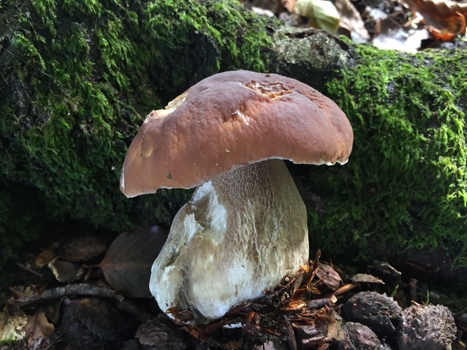
File:Boletus_edulis_IT.jpg · Wikimedia Commons · See Wikimedia Commons
Boletus edulis
Sign in to saveAlso known as porcino, bollo de centavo, boletus, champiñón, cep, penny bun, porcini, porcinis
species of fungus
OverviewAI-generated
Boletus edulis, commonly known as the cep or King Bolete, is a species of edible mushroom in the family Boletaceae. It belongs to the kingdom Fungi, phylum Basidiomycota, class Agaricomycetes, and order Boletales. The species is classified under the parent taxon Boletus sect. Boletus and was described by Bull. It forms mycorrhizal associations and produces a brown spore print. Synonyms for this taxon include Boletus persoonii and Boletus betulicola.
The IUCN Red List assessed the conservation status of Boletus edulis as Least Concern in 2019. Occurrence records are held by various institutions, including IBUNAM, ENCB-IPN, IB-CUCBA-UDG, INECOL, and CECOY-INIFAP, with records specifically noted from Mexico. The taxon range includes Hainan.
Synthesized by Vinony from 46 facts across 8 sources: Wikidata, GBIF, Firecrawl, iNaturalist, Gbif Occ, IUCN Red List, iDigBio, Vinony graph. Generated from structured data (not the Wikipedia text) and checked against those facts — may still contain errors.
Species
Least ConcernKing Bolete
Boletus edulis
SPECIES
- KingdomFungi
- PhylumBasidiomycota
- ClassAgaricomycetes
- OrderBoletales
- FamilyBoletaceae
B. edulis Boletus edulis Bull., 1782, volgarmente indicato come porcino, è un fungo edule della famiglia Boletaceae ed è la specie più conosciuta della sezione Edules. Inoltre è la specie tipo del genere Boletus.
via GBIF · IUCN
Museum specimens
- Specimen records
- 2,036
- With media
- 379
- Family
- Boletaceae
- Collections
- IBUNAM, ENCB-IPN, IB-CUCBA-UDG, INECOL, CECOY-INIFAP, ECOSUR
- Recorded in
- Mexico
Described at
Penny Bun - Wild Food UK
One of the stars of the mushroom world. Easily recognisable among the edible species. Generally seen eight days after rain around late summer to the start of…, One of the stars of the mushroom world. Easily recognisable among the edible species. Generally seen eight days after rain around late summer to the start of autumn.
wildfooduk.com →One of the stars of the mushroom world. Easily recognisable among the edible species. Generally seen eight days after rain around late summer to the start of autumn. Please note that each and every mushroom you come across may vary in appearance to these photos. 7-12 cm. White when very young, maturing to look like a crusty brown roll, hence the name penny bun. The edge of the cap is often white. Slug marks expose white flesh. Has very small white pores which turn yellow to green with age. 10-14 cm long, 2-4 cm diameter. Thick, bulbous and white ageing to slightly tan yellow. The stem has a fine net like covering just under the cap and sometimes extending all the way down the stem, solid when young, fresh or free from maggots. No poisonous mushrooms look similar, all the poisonous Boletus such as the Satans Boletus are either very red in the flesh or sponge, or stain blue immediately on cutting. You could potentially confuse this mushroom with the Bitter Bolete, Tylopilus felleus which although not poisonous will ruin any meal you are unfortunate enough to add this mushroom to. A little nibble of the mushroom when raw will soon identify it with the Penny Bun being delicious and the Bitter Bolete being as bitter as sin! A better way to distinguish the two is that the Penny Bun has a lighter net like mesh on a slightly darker stem, the Bitter Bolete has a darker mesh on a lighter stem, pictured. The Summer Bolete, Boletus reticulatus , looks very similar but the cap colour is paler, it has a slightly darker stem, not as solid flesh, lacks the white cap edge and usually grows in early Summer. Excellent raw or fried in butter when fresh. Very mushroomy, one of the best species to dry where the mushroom flavour is enhanced. Penny buns produce more glutamates when dried so enhancing the flavour. Tests on dried Penny Buns found that there were many different Boletes in a packet as they are hard to visually identify when dried. Please note that there are several closely related species in the US, including the White King Bolete ( Boletus barrowsii ), Spring King Bolete ( Boletus rex-veris ), and a local variety of our Boletus edulis in Western North America, called Boletus edulis var. grandedulis . In March 2025 the IUCN (International Union for Conservation of Nature) added 1000 fungal species to the IUCN Red List of Threatened Species. The IUCN (Global) Conservation Status of Penny Bun ( Boletus edulis ) is: LC – Least Concern, with stable population. For more information, see on the following link . I’d like to ask you about how the cep season works. Last weekend I found a large amount of ceps, and the one before I found a similar amount of summer ceps (boletus reticulatus). However, this weekend, although I have visited about 5 forests in SW England and Wales, I have only found old/rotting ones and the odd one or two young ones, in locations where I know that they appear. Is the season now over then? Can we expect more ceps following the next bout of rain? In the same areas? Thanks! We’ll hopefully see some more with rain but that might be the season over and done with. There is no rain forcast. I fear you are right, but for three weeks it was the best Penny Bun picking I’ve done. My son brought 2 carrier bags of ceps back from a forest in Northumberland yesterday. Some where huge. It’s very warm out – proper mushroom weather. Have found none in our local woodland in Kent this season after masses last year, even after the recent rain there are none to be seen I’m sure they came later last year .. Perhaps overly dry earlier on has stalled them ? Im in Surrey and Ceps are only just starting to poke their heads out, last year it was a few weeks before…fingers crossed! I’ve been looking for the last three weeks in Oxfordshire and found one single Cep! Hello, is there any other bolete that looks similar and grows to the same size? I found some huge boletes, stem thicker than my wrist and cap pretty much like a baseball c
Excerpt from a page describing this subject · 39,160 chars · not written by Vinony
Wikidata facts
- Instance of
- taxon
- Parent taxon
- Boletus
- Image
- Білий гриб у Гадяцькому сосновому бору. Полтавщина 2012 року 03.jpg
Show 15 more facts
- Commons category
- Boletus edulis
- taxon rank
- species
- taxon name
- Boletus edulis
- Commons gallery
- Boletus edulis
- mushroom ecological type
- mycorrhiza
- spore print color
- brown
- edibility
- edible mushroom
- taxon common name
- jesenski goban
- IUCN conservation status
- Least Concern
- taxon author citation
- Bull.
- on focus list of Wikimedia project
- Wikipedia:Vital articles/Level/4
- described at URL
- www.finefoodspecialist.co.uk/porcini-mushrooms-fresh
- color produced
- mustard
- short name
- B. edulis
- taxon range
- Hainan
Sources (9)
via Wikidata · CC0
~32 min read
Encyclopedic overview
Boletus edulis (English: cep, penny bun, porcino) is a basidiomycete fungus, and the type species of the genus Boletus. It is prized as an edible mushroom.
The fungus produces spore-bearing fruit bodies above ground in summer and autumn. The fruit body has a large brown cap which can reach 30 cm (12 in) in diameter and 3 kg (6 lb 10 oz) in weight. Like other boletes, it has tubes extending downward from the underside of the cap, rather than gills; spores escape at maturity through the tube openings (pores). The pore surface of the fruit body is whitish when young, aging to a greenish-yellow. The stout stipe (or stem) is white or yellowish, up to 25 cm (10 in) tall and 7 cm (3 in) thick, and partially covered with a raised network pattern (reticulations).
Excerpted from Wikipedia’s “Boletus edulis” article, available under the CC BY-SA 4.0 licence.
Gallery (17)
Available in 85 languages
- Español
- Français
- Deutsch
- 中文
- 日本語
- Русский
- Português
- Italiano
- العربية
- हिन्दी
- Armenian
- Asturian
- Bahasa Indonesia
- Balinese
- Bangla
- Bashkir
- Basque
- bat_smg
Show 66 more
- Bavarian
- be_x_old
- Belarusian
- Bosnian
- Bulgarian
- Catalan
- Cebuano
- Chuvash
- Croatian
- Czech
- Danish
- Egyptian Arabic
- Erzya
- Esperanto
- Estonian
- Finnish
- Galician
- Georgian
- Greek
- Hebrew
- Hungarian
- Icelandic
- Ido
- Irish
- Kashubian
- Kazakh
- Kurdish
- Latin
- Latvian
- Ligurian
- Lithuanian
- Macedonian
- Malay
- Nederlands
- Northern Frisian
- Norwegian
- Norwegian Nynorsk
- Occitan
- olo
- Ossetic
- Piedmontese
- Polski
- Romanian
- rsk
- Serbian
- Serbian (Latin)
- simple
- Slovak
- Slovenian
- Svenska
- Tamil
- Tatar
- Tiếng Việt
- Türkçe
- Ukrainian
- Venetian
- Walloon
- Waray
- Welsh
- Western Mari
- Wu Chinese
- Yakut
- zh_yue
- فارسی
- ไทย
- 한국어
via Wikidata sitelinks · CC0