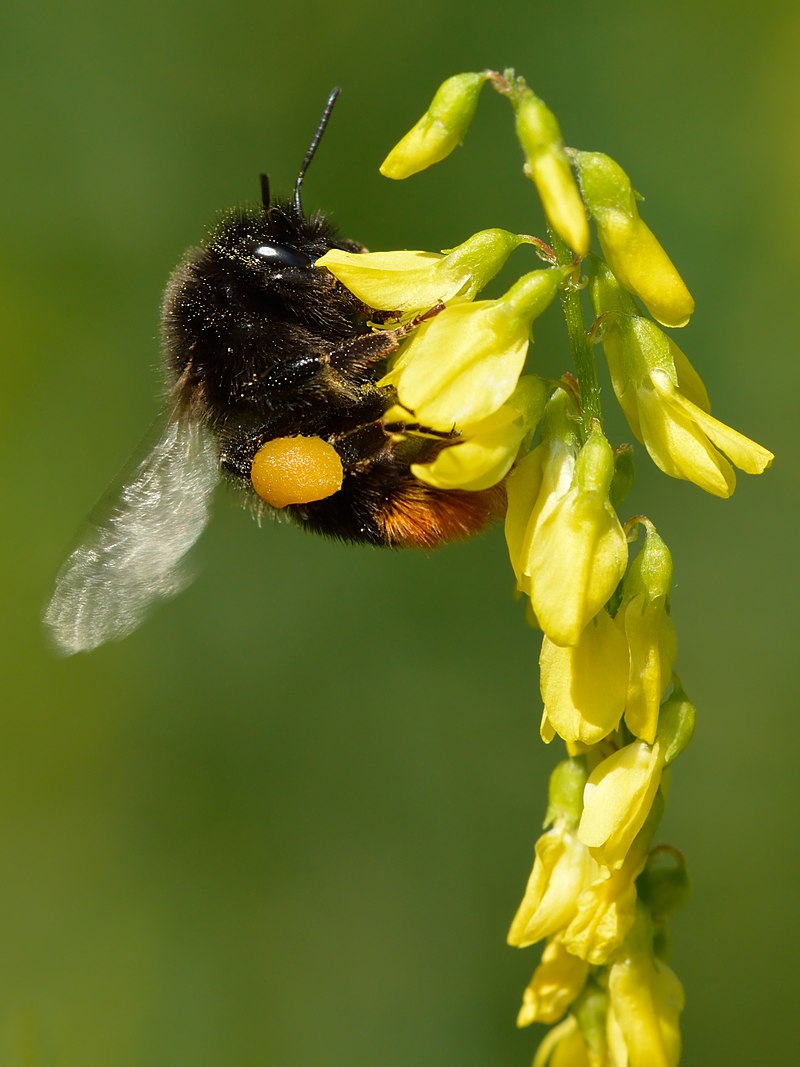
File:Bombus_lapidarius_-_Melilotus_officinalis_-_Tallinn.jpg · Wikimedia Commons · See Wikimedia Commons
Bombus
Sign in to saveAlso known as bumblebee, bumble bee, bumble-bee, humble-bee
A bumblebee (or bumble bee, bumble-bee, or humble-bee) is any of over 250 species in the genus Bombus, part of Apidae, one of the bee families. This genus is the only extant group in the tribe Bombini, though a few extinct related genera (e.g., Calyptapis) are known from fossils. They are found primarily in the Northern Hemisphere, although they are also found in South America, where a few lowland tropical species have been identified. European bumblebees have also been introduced to New Zealand and Tasmania. Female bumblebees can sting repeatedly, but generally ignore humans and other animals
OverviewAI-generated
Bombus is a genus of insects in the family Apidae, belonging to the order Hymenoptera. The taxon was established by Latreille in 1802 and is classified under the parent taxon Bombini. Common names for this group include bumble bees, bombo, humler, and črmlj. Members of this genus are recognized as pollinators and share characteristics such as aposematism and hibernation. Their primary food source is nectar.
The genus is distinct from Apis and is included in the topic’s main category of bumblebees. Records indicate a significant presence in Mexico, with institutions such as MHNCA holding media and specimen data. Observations from various sources document hundreds of thousands of occurrences, reflecting the widespread nature of these insects. The subject is referenced by numerous encyclopedia articles and is listed as a vital article.
Synthesized by Vinony from 44 facts across 7 sources: Wikidata, GBIF, iNaturalist, Gbif Occ, WoRMS, iDigBio, Vinony graph. Generated from structured data (not the Wikipedia text) and checked against those facts — may still contain errors.
Species
Common Eastern Bumble Bee
Bombus
GENUS
- KingdomAnimalia
- PhylumArthropoda
- ClassInsecta
- OrderHymenoptera
- FamilyApidae
熊蜂屬(Bombus),是蜜蜂科的一類。多築巢於枯木至建築物內。以花粉和花蜜為食。 熊蜂與蜜蜂有很多不同處,像後腳具有脛距,而蜜蜂則無;熊蜂和蜜蜂一樣是社會性昆蟲,但不如蜜蜂緊密;一到秋末或冬初,群中個體除了交尾的女王蜂能渡冬外,其餘皆死亡。 熊蜂體軀碩大,在所有蜂類中屬重量級。
via GBIF
Museum specimens
- Specimen records
- 39,000
- With media
- 11,480
- Family
- Apidae
- Collections
- MHNCA
- Recorded in
- Mexico
Wikidata facts
Show 12 more facts
- Commons category
- Bombus
- taxon rank
- genus
- taxon name
- Bombus
- Commons gallery
- Bombus
- taxon common name
- črmlj
- taxon author citation
- Latreille, 1802
- hashtag
- bumblebees
- main food source
- nectar
- has characteristic
- hibernation
- different from
- Apis
- on focus list of Wikimedia project
- Wikipedia:Vital articles/Level/4
- subject has role
- pollinator
Sources (8)
via Wikidata · CC0
~44 min read
Encyclopedic overview
33 sectionsContents
- Etymology
- Evolution
- Phylogeny
- Fossil record
- Taxonomy
- Description
- Distribution and habitat
- Abundance and diversity
- Physiological adaptations
- Biology
- Feeding
- Wax production
- Coloration
- Temperature control
- Chill-coma temperature
- Communication and social learning
- Reproduction and nesting
- Foraging behaviour
- Asynchronous flight muscles
- Cuckoo bumblebees
- Sting
- Predators, parasites, and pathogens
- Relationship to humans
- Agricultural use
- Population decline
- Conservation efforts
- Misconception about flight
- In music and literature
- See also
- Notes
- References
- Sources
- External links
A bumblebee (or bumble bee, bumble-bee, or humble-bee) is any of over 250 species in the genus Bombus, part of Apidae, one of the bee families. This genus is the only extant group in the tribe Bombini, though a few extinct related genera (e.g., Calyptapis) are known from fossils. They are found primarily in the Northern Hemisphere, although they are also found in South America, where a few lowland tropical species have been identified. European bumblebees have also been introduced to New Zealand and Tasmania. Female bumblebees can sting repeatedly, but generally ignore humans and other animals.
Most bumblebees are eusocial insects that form colonies with a single queen. The colonies are smaller than those of honey bees, growing to as few as 50 individuals in a nest. Cuckoo bumblebees are brood parasitic and do not make nests or form colonies; their queens aggressively invade the nests of other bumblebee species, kill the resident queens and then lay their own eggs, which are cared for by the resident workers. Cuckoo bumblebees were previously classified as a separate genus, but are now usually treated as members of Bombus.
Excerpted from Wikipedia’s “Bombus” article, available under the CC BY-SA 4.0 licence.
Gallery (55)
Available in 104 languages
- Español
- Français
- Deutsch
- 中文
- 日本語
- Русский
- Português
- Italiano
- العربية
- Afrikaans
- Albanian
- Aragonese
- Asturian
- Bahasa Indonesia
- Balinese
- Bashkir
- Basque
- bat_smg
Show 85 more
- Belarusian
- Bulgarian
- Burmese
- Catalan
- Cebuano
- Chechen
- Cheyenne
- Chuvash
- Corsican
- Crimean Tatar
- Croatian
- Czech
- Danish
- Egyptian Arabic
- Esperanto
- Estonian
- Faroese
- Filipino
- Finnish
- Galician
- Georgian
- Greek
- Guarani
- Hebrew
- Hungarian
- Icelandic
- Ido
- Ingush
- Interlingue
- Inupiaq
- Irish
- Kabyle
- Kashmiri
- Komi
- Kurdish
- Latin
- Latvian
- Lithuanian
- Lower Sorbian
- Malay
- Malayalam
- Mari
- Mongolian
- Navajo
- Nederlands
- Nepali
- Northern Frisian
- Norwegian
- Norwegian Nynorsk
- Occitan
- olo
- Ossetic
- Pennsylvania German
- Picard
- Polski
- roa_rup
- Romanian
- Scots
- Serbian
- Serbian (Latin)
- simple
- Slovak
- Slovenian
- Svenska
- Swahili
- Tajik
- Tamil
- Telugu
- Tiếng Việt
- Türkçe
- Udmurt
- Ukrainian
- Upper Sorbian
- Uzbek
- Veps
- Waray
- West Flemish
- Western Mari
- Wu Chinese
- Yakut
- zh_min_nan
- zh_yue
- فارسی
- ไทย
- 한국어
via Wikidata sitelinks · CC0