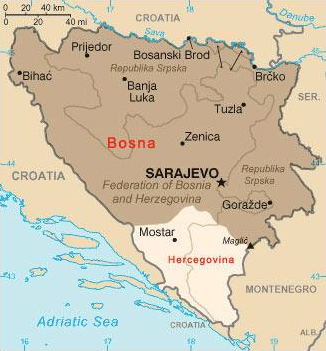
File:Bosna_regija_update.jpg · Wikimedia Commons · See Wikimedia Commons
Bosnia
Sign in to savehistorical country in central Europe
OverviewAI-generated
Bosnia is a historical country and region located at coordinates 44.16, 17.78. It is described in the Brockhaus and Efron Encyclopedic Dictionary and the Jewish Encyclopedia of Brockhaus and Efron. The demonym for people from this area includes Bosnian, Boisniach, בוסניאקי, and בוסניאקית.
The region has an elevation of 418 and operates in the Europe/Sarajevo timezone. Specific locations within the area, such as Vitez, are situated in the Federacija Bosne i Hercegovine state of Bosna i Hercegovina / Босна и Херцеговина.
Synthesized by Vinony from 29 facts across 6 sources: Wikidata, Open Meteo, Openweathermap, OpenStreetMap, Vinony graph, Geo. Generated from structured data (not the Wikipedia text) and checked against those facts — may still contain errors.
In the Vinony graph
Vinony catalogs Bosnia in its Countries collection (215 entries).
Vinony's link graph records 751 inbound references to Bosnia, and connects out to Lim, Ottoman conquest of Bosnia and Herzegovina and Srednja Bosna.
The entry is geolocated on the map.
Vinony files it under Bosnia (region), Metropolitan or continental parts of states and Regions of Bosnia and Herzegovina.
Weather now
cached 22h ago7-day forecast
via Open-Meteo
Place details
- Locality
- Vitez
- Region
- Federacija Bosne i Hercegovine
- Country
- Bosna i Hercegovina / Босна и Херцеговина
via OpenStreetMap · GeoNames
Air quality
- PM2.5
- 22.1 µg/m³
- PM10
- 23.9 µg/m³
Wikidata facts
- Instance of
- historical country
- Demonym
- בוסניאקי
Show 3 more facts
- topic's main category
- Category:Bosnia (region)
- Commons category
- Bosnia and Herzegovina
- described by source
- Jewish Encyclopedia of Brockhaus and Efron
via Wikidata · CC0
Travel guide
See
thumb|The famous Stari Most was beautifully restored. thumb|The waterfalls at Kravice
If Bosnia and Herzegovina makes you think of concrete Communist architecture or 1990s images of war-demolished town centres double-torn by ethno-religious strife, you're in for a pleasant surprise. Of course this country bears the marks of its tumultuous history, but visitors today find rebuilt and well restored historic cities, a warm and welcoming atmosphere, bustling city life and -overall- more medieval monuments than Socialist housing blocks. In fact, some of the remains of the Communist era, like the D-0 ARK bunker (otherwise known as Tito's Bunker) near Konjic, have become attractions of their own.
The country's main visitor draws however lie in its charming historic town centres, ancient heritage sites and splendid nature. Sarajevo has some of the most extensive Socialist housing projects, but is also a colourful historic mix of East and West, where religions and cultures coexisted for centuries. It's a vibrant town that resurrected into what it always was; the country's modern capital, proud of its heritage and a popular destination for travellers of all kinds. Top sights include the lively Baščaršija or Old Bazaar, the Sarajevo cathedral, the Gazi Husrev-beg's Mosque and of course the legacy sports facilities of the 1984 Olympics. Equally interesting is the Tunel spasa, or tunnel of hope, which brought supplies to the people of Sarajevo in the war and is now a museum. The beautif…
Do
thumb|Bobsleigh tracks from the Sarajevo 1984 Winter Olympics as of 2017 Rafting on the Neretva river, the Una river and the Tara with the Drina river, with some shorter courses on the Krivaja river, the Vrbas river and the Sana river. The 2009 World championship of rafting was held in Banja Luka on the Vrbas river and in Foča on the Drina, both in RS.
The Neretva river and its tributary the Trebižat, the Unac river, also the Krivaja river and its tributary Bioštica river are great kayaking destinations with a lot of whitewater on the Krivaja river. The Pliva river and its lakes Veliko and Malo are great canoeing destinations, also the middle and lower Una river, the Trebižat river.
The famous Rakitnica canyon of the Rakitnica river, tributary of the Neretva river, offer great canyoning adventure, but even extreme canyoning route can be found in the Bjela river another tributary of the Neretva river. The Unac river and its canyon offer great canyoning route. Also close to Banja Luka you can explore the canyons of the Svrakava and Cvrcka rivers.
Mountain biking is popular in the country, while mountainous terrain of the country getting increasingly popular destination for bikers from all over the world.
Bosnia and Herzegovina was the 1984 host for the Winter Olympics, and it still takes pride of its winter sports potential. Especially around Sarajevo there are challenging venues. During the war of the 1990s many Olympic venues were severely affected, but today's skier will…
Drink
thumb|204x204px|A beer in Mostar
The legal drinking age in Bosnia and Herzegovina is 18 years. Popular domestic beers are Nektar (from Banja Luka), Sarajevsko, Preminger (from Bihać, made according to a Czech recipe) and Tuzlansko, while the most common imports are Ozujsko and Karlovačko from Croatia, Jelen from Serbia, and Laško and Union from Slovenia. Like in almost every European country, beer is very common and popular. Even in more heavily Islamic areas alcohol is available in abundance to those who choose to drink and almost every bar is fully stocked.
Like most Slavs, Bosnians make 'Rakija' which comes in many a variety and is made both commercially and at home. Red wine is 'Crno vino' (Black wine) and white wine is 'bijelo vino'. Wines from Herzegovina are renowned for their quality. Alcohol is not taxed as heavily as in most Western nations and is often very affordable. Quality alcohol is sought after and valued.
Bosnians are among the biggest coffee drinkers in the world, particularly Turkish coffee, locally called Bosnian or domaca (homemade) coffee, which can be bought in every bar, restaurant or fast food place.
Sleep
In Bosnia and Herzegovina you can choose from the great number of hotels, hostels, motels and pensions. At the seaside town of Neum you can book hotels from 2–4 stars. In the other cities many hotels are 3 stars, 4 stars and some of them are 5 stars.
In Banja Luka the best hotels are: Cezar, Palas, Bosna, Atina, Cubic and Talija.
In Sarajevo the best hotels are: Hollywood, Holiday Inn, Bosnia, Saraj, Park, Grand and Astra. There are also cheap hostels available.
Campsites are not very common. An overview of campsites in Bosnia is available at the national tourism agency . Wild camping is often no problem, but be careful for mines.
Stay healthy
All Bosnian employees undergo regular health checks to ensure that they can physically do their jobs and that they will not transmit any disease or injure anyone. People in the food industry are particularly checked and random health and safety checks for the premises are held often. Food handlers and providers are held to the highest standards. Bosnian kitchens and food storehouses are expected to be sanitary and spotless and food safety is very important.
Tap water is drinkable in most parts of the country, there's even "hajrli česme" or "safe travel fountains" in some parts of the country which offers drinkable water from the source of a mountain.
Since the food is rich, some extra exercise may help.
And as above, never walk off dedicated paths in case of land mines.
Respect
It is of utmost importance to respect the religious differences of the people in the region, and their effort to move past the 1990s war, as it still affects those that survived those times to this day. Be careful in areas where there is still some form of ethnic tension, and ensure that you do not offend a particular group. Avoid talking about the war, or any other controversial topic in the Balkans, such as the legitimacy of Kosovo or Republika Srpska; it's very disrespectful and you won't get any good information from doing so, since everyone tends to be biased on what they perceive to be good or bad, like most parts of the world.
Muslims constitute 50–52% of the population, making Bosnia one of the few Muslim-majority countries in Europe. The form of Islam practised by the vast majority of Bosnians is liberal, and it is common for Bosnian Muslims to consume alcohol and somewhat common to eat pork.
Respect the environment. A lot of the country, as well as its neighbours, have been spared from pollution and it is very important to be careful of your influences.
The streams and rivers tend to be fierce, the mountains and valleys often unguarded and the footing unsure. Always have a tour guide with you or consult a local for advice on the natural dangers and land mines.
Connect
Each entity has its own postal service, so stamps bought in the Federation cannot be used in the RS and vice versa.
There are many mobile phone networks in Bosnia and Herzegovina, e.g.: HT ERONET (Mostar), GSMBiH (Sarajevo) and m:tel (Republika Srpska, Banja Luka) You can buy a prepaid SIM card from any network at any kiosk for 10 KM or less. Often operators offer special data only packages for tourists with a validity of 5-30 days (e.g. 30 days with 30GB for 40 KM).
The activation of any Bosnian SIM card takes less than 2 minutes, no proof of identity or any other bureaucratic steps are required.
Note that you can use Bosnian SIM cards in other West Balkan countries. Sometimes this requires a minimal "top up" of your call and SMS budget which you can also get at kiosks, if you know your phone number.
Go next
The land border can be crossed to Croatia, Montenegro and Serbia.
Travel guide from Wikivoyage (CC BY-SA 4.0)
~5 min read
Encyclopedic overview
Bosnia (Serbo-Croatian: Bosna / Босна, pronounced [bɔ̂sna]) is the northern region of Bosnia and Herzegovina, encompassing roughly 76% of the country; the other region, the southern part, is Herzegovina.
The two regions have formed a geopolitical entity since medieval times, and the name "Bosnia" commonly occurs in historical and geopolitical senses as generally referring to both regions (Bosnia and Herzegovina). The official use of the combined name started only in the late period of Ottoman rule.
Excerpted from Wikipedia’s “Bosnia” article, available under the CC BY-SA 4.0 licence.
Gallery (2)
On the map
Available in 61 languages
- Español
- Français
- Deutsch
- 中文
- 日本語
- Русский
- Português
- Italiano
- العربية
- Albanian
- Aragonese
- Armenian
- Azerbaijani
- Bahasa Indonesia
- Bashkir
- be_x_old
- Belarusian
- Bosnian
Show 42 more
- Breton
- Bulgarian
- Catalan
- Croatian
- Czech
- Danish
- Esperanto
- Estonian
- Extremaduran
- Finnish
- Galician
- Greek
- Hawaiian
- Hebrew
- Latin
- Latvian
- Lithuanian
- Macedonian
- Malagasy
- Malay
- Maltese
- Nederlands
- Norwegian Nynorsk
- Old English
- Polski
- Romanian
- Serbian
- Serbian (Latin)
- Slovak
- Slovenian
- Svenska
- Tajik
- Tamil
- Tiếng Việt
- Türkçe
- Ukrainian
- Urdu
- Uzbek
- Western Panjabi
- Wu Chinese
- فارسی
- 한국어
via Wikidata sitelinks · CC0