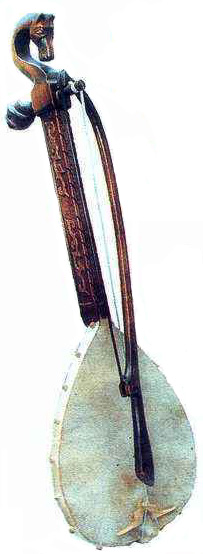
File:Serbian_Gusle.jpg · Wikimedia Commons · See Wikimedia Commons
lahuta
Sign in to saveThe () or lahuta (; related to English lute) is a bowed single-stringed musical instrument (and musical style) traditionally used in the Dinarides region of Southeastern Europe (in the Balkans). The instrument is always accompanied by singing; musical folklore, specifically epic poetry. The player (; ) holds the instrument vertically between the knees, with the left hand fingers on the string. The string is never pressed to the neck, giving a harmonic and unique sound.
Key facts
- Instrument.image
- Serbian Gusle.jpg
- Instrument.image_capt
- Typical Serbian
- Instrument.background
- string
- Instrument.classification
- Bowed string instrument
- Instrument.hornbostel_sachs_desc
- Bowl lyre sounded by a bow
- Instrument.hornbostel_sachs
- 321.321-71
- Instrument.related
- Byzantine lyra and its derivatives Masenqo (Horn of Africa) Other "fiddles"
- Intangible heritage.ICH
- Singing to the accompaniment of the
- Intangible heritage.State Party
- Serbia
- Intangible heritage.ID
- 02310
- Intangible heritage.Year
- 2025
- Intangible heritage.Region
- ENA
- Intangible heritage.Session
- 20th
- Intangible heritage.List
- Need of Urgent Safeguarding
- Intangible heritage.Name
- Art of playing, singing and making the lahuta
- Intangible heritage.Country
- Albania
via Wikipedia infobox
Wikidata facts
Show 4 more facts
- Commons category
- Gusle
- Hornbostel-Sachs classification
- 321.321-71
- described by source
- Encyclopædia Britannica 11th edition
- intangible cultural heritage status
- List of Intangible Cultural Heritage in Need of Urgent Safeguarding
via Wikidata · CC0
~14 min read
Encyclopedic overview
11 sectionsContents
- Etymology
- Origin
- Construction and use
- Serbs
- Bosniaks
- Albanians
- See also
- References
- Sources
- Further reading
- External links
The () or lahuta (; related to English lute) is a bowed single-stringed musical instrument (and musical style) traditionally used in the Dinarides region of Southeastern Europe (in the Balkans). The instrument is always accompanied by singing; musical folklore, specifically epic poetry. The player (; ) holds the instrument vertically between the knees, with the left hand fingers on the string. The string is never pressed to the neck, giving a harmonic and unique sound.
On November 29, 2018, the Serbian Gusle was inscribed as a part of Serbia's intangible cultural heritage on the UNESCO Intangible Cultural Heritage of Humanity.
Excerpted from Wikipedia’s “lahuta” article, available under the CC BY-SA 4.0 licence.