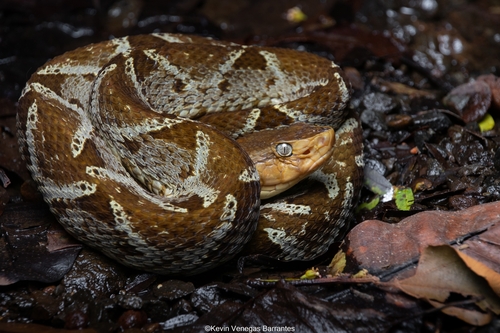
(c) Kevin Venegas Barrantes, all rights reserved, uploaded by Kevin Venegas Barrantes
Bothrops
Sign in to saveBothrops is a genus of highly venomous pit vipers endemic to the Neotropics. The generic name, Bothrops, is derived from the Greek words , , meaning , and , , meaning or , together an allusion to the heat-sensitive loreal pit organs. Members of this genus are responsible for more human deaths in the Americas than any other group of venomous snakes. Currently, 48 species are recognized.
OverviewAI-generated
Bothrops is a genus of reptiles within the family Viperidae. It belongs to the order Squamata, phylum Chordata, and kingdom Animalia. The taxon was described by Wagler in 1824 and holds an accepted status in the World Register of Marine Species. On iNaturalist, it is associated with the common name Terciopelo and is not considered extinct.
Records of this genus are documented across several countries, including Guatemala, Peru, Ecuador, Mexico, and Brazil. Institutional collections from UTA, USNM, ROM, MSUM, and OMNH hold related specimens. Various databases track numerous observations and occurrences, with iNaturalist listing 8139 observations and GBIF recording 38417 occurrences. PubMed indexes 2873 publications related to the genus.
Synthesized by Vinony from 30 facts across 8 sources: Wikidata, GBIF, PubMed, iNaturalist, Gbif Occ, WoRMS, iDigBio, Vinony graph. Generated from structured data (not the Wikipedia text) and checked against those facts — may still contain errors.
Species
Terciopelo
GENUS
- KingdomAnimalia
- PhylumChordata
- ClassSquamata
- OrderSquamata
- FamilyViperidae
矛頭蝮屬(學名:Bothrops),又稱槍蝰、矛頭蛇、黃腭蛇,是蛇亞目蝰蛇科蝮亞科下的一個有毒蛇屬,主要分布於中美洲及南美洲地區。[1]其學名「Bothrops」源自希臘語「Bothros」及「ops」,意指「洞」及「眼睛(或臉頰)」,象徵矛頭蝮鼻孔附近的的頰窩(熱能感測器官)。頭部狹小,呈三角形,因此俗稱「矛頭(Lancehead)」。矛頭蝮在美洲導致許多宗人類遭其咬傷致死的事件,其為禍情況比其它毒蛇更嚴重。[2]目前共有32個物種已被確認。[3] 目录 1 特徵 2 地理分布 3 行為 4 毒性 5 物種 6 分類 7 備註 8 外部連結 特徵 矛頭蝮屬下種類繁多,體型大小不一。小者不會超過50至70公分長,大者則可達200公分以上的長度。大部分矛頭蝮都有明顯的眼角窩,而且鼻端都向上翹起。[2]矛頭蝮的額冠鱗片排列形式十分多變,眶上鱗約有3至14片,上唇鱗約有7至9片,下唇鱗則有9至11片。身體上有21至29片背鱗,腹鱗約有139至240片,排列成對的尾下鱗則有30至86片。[2] 地理分布 矛頭蝮多分布於墨西哥東北部(塔毛利帕斯州),南至中美洲及南美洲阿根廷一帶,亦出沒於小安的列斯群島中的聖盧西亞及馬提尼克,與及巴西聖保羅州海岸對開的蛇島。[1] 行為 矛頭蝮多於夜間活動,不過也有一些分布於較高海拔的矛頭蝮會於日間活動,在陰天或雨天的時候也有機會在日間出沒。矛頭蝮是陸行性蛇類,然而牠們亦兼具攀爬能力,尤其是海島矛頭蝮(B. insularis)更屬於樹棲型的蛇類。[2] 毒性 相對其它各種毒蛇,矛頭蝮屬下的蛇是美洲地區大部分人類遭蛇咬傷導致死亡事件的元凶,當中最凶悍的是三色矛頭蝮(B. asper)、矛頭蝮(B. atrox)及巴西矛頭蝮(B. jararaca)。如果被矛頭蝮所咬而未能即時接受適當治療的話,其毒素的致命率高達7%;如果有接受治療的話,致命風險則可減低0.3至0.5%。[2] 矛頭蝮毒素有可能導致的徵狀包括:傷口即時劇痛、暈眩、噁心、嘔吐、冒汗、頭痛、傷口周邊廣泛範圍腫脹、嚴重出血、發皰、肌肉組織壞死、頭部孔竅滲血、出現瘀血、斑瘡、血壓急降、心跳加快、因血纖維蛋白原或血小板過低引致凝血異常、咯血、黑糞症、流鼻血、血尿、顱內出血、因低血壓引致的併發性腎衰竭,與及大腦皮質壞死等。另外,被咬傷口附近的皮膚會出現褪色現象,身體及手腳亦可能會出現各種紅疹。[2]普遍而言,中毒者多數因血壓急降引致血流量減少、腎功能衰竭及顱內出血等症狀導致死亡。[2] 物種 種名[3] 學名及命名者[3] 亞種數[3] 地理分布[1] 美麗矛頭蝮 Bothrops alternatus,(Duméril, Bibron and Duméril, 1854) 0 巴西東南部、巴拉圭、烏拉圭、阿根廷北部。 阿根廷矛頭蝮 Bothrops ammodytoides,(Le
via GBIF
Museum specimens
- Specimen records
- 603
- With media
- 8
- Family
- Viperidae
- Collections
- UTA, USNM, ROM, MSUM, OMNH
- Recorded in
- Guatemala, Peru, Ecuador, Mexico, Brazil
Research
2,873 papers- Bothrops envenomation and liver hematoma.European review for medical and pharmacological sciences · 2021
- Bothrops bilineatus: An Arboreal Pitviper in the Amazon and Atlantic Forest.Frontiers in immunology · 2021
- Bothrops (Fer-de-lance) snakebites in the French departments of the Americas (Martinique and Guyana): Clinical and experimental studies and treatment by immunotherapy.PLoS neglected tropical diseases · 2023
- Plants and Phytocompounds Active Against Bothrops Venoms.Current topics in medicinal chemistry · 2019
- Plant-derived secondary metabolites against Bothrops envenomation: A review.Toxicon : official journal of the International Society on Toxinology · 2025
via PubMed
Wikidata facts
Show 6 more facts
- taxon name
- Bothrops
- Commons category
- Bothrops
- taxon rank
- genus
- topic's main category
- Category:Bothrops
- Commons gallery
- Bothrops
- taxon common name
- 矛頭蝮屬
Sources (2)
via Wikidata · CC0
~12 min read
Encyclopedic overview
8 sectionsContents
- Description
- Common names
- Geographic range
- Behavior
- Venom
- Species
- References
- External links
Bothrops is a genus of highly venomous pit vipers endemic to the Neotropics. The generic name, Bothrops, is derived from the Greek words , , meaning , and , , meaning or , together an allusion to the heat-sensitive loreal pit organs. Members of this genus are responsible for more human deaths in the Americas than any other group of venomous snakes. Currently, 48 species are recognized.
==Description== Species in the genus Bothrops range in size from small, never growing to more than , to large at over in total length (tail included). Most are characterized by having a sharp canthus rostralis and an unelevated snout.
Excerpted from Wikipedia’s “Bothrops” article, available under the CC BY-SA 4.0 licence.